Interaction of impacts of doubling CO2 and changing regional land
... without and with natural and anthropogenic land-cover changes that are assumed in the inner core of four hydrothermally different, but similar-sized (≈3.27x10⁶ km2 ) regions (Yukon, Ob, St. Lawrence, Colorado, and lands adjacent to them). A further set of simulations assumes 710 ppm CO2 conditions w ...
... without and with natural and anthropogenic land-cover changes that are assumed in the inner core of four hydrothermally different, but similar-sized (≈3.27x10⁶ km2 ) regions (Yukon, Ob, St. Lawrence, Colorado, and lands adjacent to them). A further set of simulations assumes 710 ppm CO2 conditions w ...

[pdf]
... unchanged, concurrent with a likely increase in both global mean tropical cyclone maximum wind speed and precipitation rates. The future influence of climate change on tropical cyclones is likely to vary by region, but the specific characteristics of the changes are not yet well quantified and there ...
... unchanged, concurrent with a likely increase in both global mean tropical cyclone maximum wind speed and precipitation rates. The future influence of climate change on tropical cyclones is likely to vary by region, but the specific characteristics of the changes are not yet well quantified and there ...
14 Climate Phenomena and their Relevance for Future Regional Climate Change
... unchanged, concurrent with a likely increase in both global mean tropical cyclone maximum wind speed and precipitation rates. The future influence of climate change on tropical cyclones is likely to vary by region, but the specific characteristics of the changes are not yet well quantified and there ...
... unchanged, concurrent with a likely increase in both global mean tropical cyclone maximum wind speed and precipitation rates. The future influence of climate change on tropical cyclones is likely to vary by region, but the specific characteristics of the changes are not yet well quantified and there ...

Trends and variability in rain-on-snow events
... warm, and human activities are a primary driver [Solomon et al., 2007]. Nowhere on the globe has the impact of climate change been greater than in the higher latitudes of the Northern Hemisphere, including the rapidly declining sea ice, especially in late summer and early fall, and snow cover in the ...
... warm, and human activities are a primary driver [Solomon et al., 2007]. Nowhere on the globe has the impact of climate change been greater than in the higher latitudes of the Northern Hemisphere, including the rapidly declining sea ice, especially in late summer and early fall, and snow cover in the ...

A demographic approach to study effects of climate change in desert
... models applied to deserts have mostly used average temperature [13– 15] and—less commonly—average precipitation [16,17] to explore future distributions of species. This approach is problematic because the frequency of climatic extremes is also projected to change [4], and because deserts’ inherent v ...
... models applied to deserts have mostly used average temperature [13– 15] and—less commonly—average precipitation [16,17] to explore future distributions of species. This approach is problematic because the frequency of climatic extremes is also projected to change [4], and because deserts’ inherent v ...

Climate Change and the Outbreak Ranges of Two North American
... drought' and that a surfeit of water may also render pines more suitable for bark beetles. As a result of many of these direct and indirect factors, climate change may also simply allow bark beetles to move northward or higher in elevation into other ranges of their host species or the ranges of new ...
... drought' and that a surfeit of water may also render pines more suitable for bark beetles. As a result of many of these direct and indirect factors, climate change may also simply allow bark beetles to move northward or higher in elevation into other ranges of their host species or the ranges of new ...

Mammalian responses to climate change at the Paleocene
... and elevated atmospheric CO2 probably played an important role. ...
... and elevated atmospheric CO2 probably played an important role. ...

The Implications of Global Climate Change for Mountain Gorilla
... in the region, and modeled scenarios of potential climate change effects on mountain gorilla populations. The Albertine Rift of East Africa is known for its extremely high vertebrate biodiversity and endemism, the highest in continental Africa, and has been the focus of many biological and ecologic ...
... in the region, and modeled scenarios of potential climate change effects on mountain gorilla populations. The Albertine Rift of East Africa is known for its extremely high vertebrate biodiversity and endemism, the highest in continental Africa, and has been the focus of many biological and ecologic ...
Deforestation in Amazonia impacts riverine carbon dynamics
... al., 2008; Soares-Filho et al., 2006). Governmental and conservation efforts have helped to decrease recent deforestation Earth Syst. Dynam., 7, 953–968, 2016 ...
... al., 2008; Soares-Filho et al., 2006). Governmental and conservation efforts have helped to decrease recent deforestation Earth Syst. Dynam., 7, 953–968, 2016 ...

Vulnerability Does Not Fall From the Sky
... For too long, global warming has been viewed as tomorrow’s problem. The overwhelming evidence now suggests that climate change exacerbates existing development challenges, further exposing the vulnerability of the poor, and pushing those living on the margins closer to the edge. For those people mos ...
... For too long, global warming has been viewed as tomorrow’s problem. The overwhelming evidence now suggests that climate change exacerbates existing development challenges, further exposing the vulnerability of the poor, and pushing those living on the margins closer to the edge. For those people mos ...

what happens in the arctic doesn`t stay in the arctic
... declines, putting local ecosystems under acute threat. Increased temperatures will likely induce broad ecosystem shifts, changing many habitats for Arctic species, and allowing unwanted ‘alien’ species to move northwards. As well as these ‘local’ changes that will impact directly on Arctic biodivers ...
... declines, putting local ecosystems under acute threat. Increased temperatures will likely induce broad ecosystem shifts, changing many habitats for Arctic species, and allowing unwanted ‘alien’ species to move northwards. As well as these ‘local’ changes that will impact directly on Arctic biodivers ...

Keywords: climate change, land use, gravel-bed rivers
... effects of changing land use and climate on gravel riverbeds. The Managed Growth/No Climate Change (MGNCC) Scenario represents minimum effects of land use and climate change, while the Urban Sprawl/ Climate Change (USCC) Scenario represents more extensive effects. We apply our scenarios to a 30 m re ...
... effects of changing land use and climate on gravel riverbeds. The Managed Growth/No Climate Change (MGNCC) Scenario represents minimum effects of land use and climate change, while the Urban Sprawl/ Climate Change (USCC) Scenario represents more extensive effects. We apply our scenarios to a 30 m re ...

Climate change and habitat heterogeneity drive a population
... The effect of changing climatic conditions on wild populations has been the subject of much recent research. Most attention has been on the direct effects of climate changes on species of lower trophic levels and on the negative consequences of climate change. However, a deeper understanding of how ...
... The effect of changing climatic conditions on wild populations has been the subject of much recent research. Most attention has been on the direct effects of climate changes on species of lower trophic levels and on the negative consequences of climate change. However, a deeper understanding of how ...

Survival and population size of a resident bird species are declining
... Age models and potential causes of variation Some types of weather are more likely to directly impact annual survival through its effects on the availability of food resources. For example, rain followed by freezing temperatures may lead to cones becoming saturated and then freezing. Similarly, free ...
... Age models and potential causes of variation Some types of weather are more likely to directly impact annual survival through its effects on the availability of food resources. For example, rain followed by freezing temperatures may lead to cones becoming saturated and then freezing. Similarly, free ...

Cities and Climate Change: An Urgent Agenda
... change, along with their already full agenda of current disaster risk reduction efforts and improved provision of basic services, especially to the poor. Part 2 also explains why climate change is an urgent issue for cities. Given that the climate is a global good, it is difficult to put a price on ...
... change, along with their already full agenda of current disaster risk reduction efforts and improved provision of basic services, especially to the poor. Part 2 also explains why climate change is an urgent issue for cities. Given that the climate is a global good, it is difficult to put a price on ...

DICE 2013R - Yale Economics
... represents the outcome of market and policy factors as they currently exist. In other words, the baseline model is an attempt to project from a positive perspective the levels and growth of major economic and environmental variables as would occur with current climate-change policies. It does not ma ...
... represents the outcome of market and policy factors as they currently exist. In other words, the baseline model is an attempt to project from a positive perspective the levels and growth of major economic and environmental variables as would occur with current climate-change policies. It does not ma ...

Simulated interannual variation in summertime atmospheric
... results can be seen in the IPCC Data Distribution Centre website; http://www.ipcc-ddc.cru.uea.ac.uk). This means that summertime land–sea temperature contrast increases, and it is inferred that monsoonal circulation over East Asia is intensified (IPCC 2001). However, there is little agreement so far ...
... results can be seen in the IPCC Data Distribution Centre website; http://www.ipcc-ddc.cru.uea.ac.uk). This means that summertime land–sea temperature contrast increases, and it is inferred that monsoonal circulation over East Asia is intensified (IPCC 2001). However, there is little agreement so far ...
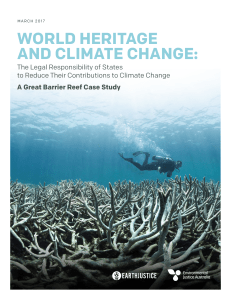
World Heritage and Climate Change
... Like all nations with World Heritage-listed coral reefs, Australia’s fair share to protect the Great Barrier Reef begins with action to increase the Reef’s resilience by minimizing non-climate stressors. For smallisland states and other states with minimal greenhouse gas emissions or fossil fuel dev ...
... Like all nations with World Heritage-listed coral reefs, Australia’s fair share to protect the Great Barrier Reef begins with action to increase the Reef’s resilience by minimizing non-climate stressors. For smallisland states and other states with minimal greenhouse gas emissions or fossil fuel dev ...

Understanding the implications of Climate Change for woodland
... half million hectares (an area slightly larger than Wales), which equates to 12% of our total land area. The tree species native to the UK have gradually spread in response to the local climate, atmosphere and soils since the last glaciers retreated over 10,000 years ago ...
... half million hectares (an area slightly larger than Wales), which equates to 12% of our total land area. The tree species native to the UK have gradually spread in response to the local climate, atmosphere and soils since the last glaciers retreated over 10,000 years ago ...
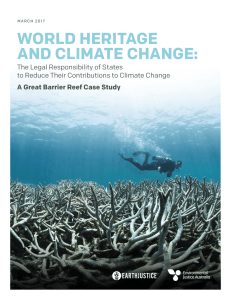
world heritage and climate change
... Like all nations with World Heritage-listed coral reefs, Australia’s fair share to protect the Great Barrier Reef begins with action to increase the Reef’s resilience by minimizing non-climate stressors. For smallisland states and other states with minimal greenhouse gas emissions or fossil fuel dev ...
... Like all nations with World Heritage-listed coral reefs, Australia’s fair share to protect the Great Barrier Reef begins with action to increase the Reef’s resilience by minimizing non-climate stressors. For smallisland states and other states with minimal greenhouse gas emissions or fossil fuel dev ...

Constraining temperature variations over the last
... Estimates of past temperature and climate variability are a prerequisite for a possible attribution of the twentieth century warming to anthropogenic greenhouse gas forcing. While proxy based climate reconstructions can inform our knowledge of large-scale temperature variations in past centuries, th ...
... Estimates of past temperature and climate variability are a prerequisite for a possible attribution of the twentieth century warming to anthropogenic greenhouse gas forcing. While proxy based climate reconstructions can inform our knowledge of large-scale temperature variations in past centuries, th ...

Funding proposal - Green Climate Fund
... Predictions foresee a stronger variability, but also an overall slight increase of the cumulative amount of rainfall in the Lake Victoria region. Temperature and extreme weather events such as droughts, heavy rains and flooding are predicted to increase further in both frequency and severity in the ...
... Predictions foresee a stronger variability, but also an overall slight increase of the cumulative amount of rainfall in the Lake Victoria region. Temperature and extreme weather events such as droughts, heavy rains and flooding are predicted to increase further in both frequency and severity in the ...

doc - Canadian Pugwash Group
... model from the Max-Planck Institute for Meteorology, as well as a dataset from the Arctic and Antarctic Research Institute in Russia, have enabled examination of warming cycles early in the 20th century as well as those late in the century. The late century global warming anomaly can only be simulat ...
... model from the Max-Planck Institute for Meteorology, as well as a dataset from the Arctic and Antarctic Research Institute in Russia, have enabled examination of warming cycles early in the 20th century as well as those late in the century. The late century global warming anomaly can only be simulat ...

What happens in the arctic doesn`t stay in the arctic
... declines, putting local ecosystems under acute threat. Increased temperatures will likely induce broad ecosystem shifts, changing many habitats for Arctic species, and allowing unwanted ‘alien’ species to move northwards. As well as these ‘local’ changes that will impact directly on Arctic biodivers ...
... declines, putting local ecosystems under acute threat. Increased temperatures will likely induce broad ecosystem shifts, changing many habitats for Arctic species, and allowing unwanted ‘alien’ species to move northwards. As well as these ‘local’ changes that will impact directly on Arctic biodivers ...
Recent observed climate change over the Arabian Peninsula
... [2] Many parts of the world and especially developed countries have benefited from assessments of observed climate changes, especially in relation to temperature and precipitation owing to the societal importance of these parameters [Goddard et al., 2001]. According to the IPCC fourth assessment rep ...
... [2] Many parts of the world and especially developed countries have benefited from assessments of observed climate changes, especially in relation to temperature and precipitation owing to the societal importance of these parameters [Goddard et al., 2001]. According to the IPCC fourth assessment rep ...
Effects of global warming on humans

Climate change has brought about possibly permanent alterations to our planet’s geological, biological and ecological systems. The Intergovernmental Panel on Climate Change (IPCC) contended in 2003 that “there is new and stronger evidence that most of the warming observed over the last 50 years is attributable to human activities”. These changes have led to the emergence of large-scale environmental hazards to human health, such as extreme weather, ozone depletion, increased danger of wildland fires, loss of biodiversity, stresses to food-producing systems and the global spread of infectious diseases. The World Health Organization (WHO) estimates that 160,000 deaths, since 1950, are directly attributable to climate change. Many believe this to be a conservative estimate.To date, a neglected aspect of the climate change debate, much less research has been conducted on the impacts of climate change on health, food supply, economic growth, migration, security, societal change, and public goods, such as drinking water, than on the geophysical changes related to global warming. Human impacts can be both negative and positive. Climatic changes in Siberia, for instance, are expected to improve food production and local economic activity, at least in the short to medium term. Numerous studies suggest, however, that the current and future impacts of climate change on human society are and will continue to be overwhelmingly negative.The majority of the adverse effects of climate change are experienced by poor and low-income communities around the world, who have much higher levels of vulnerability to environmental determinants of health, wealth and other factors, and much lower levels of capacity available for coping with environmental change. A report on the global human impact of climate change published by the Global Humanitarian Forum in 2009, estimated more than 300,000 deaths and about $125 billion in economic losses each year, and indicating that most climate change induced mortality is due to worsening floods and droughts in developing countries. This also raises questions of climate justice, since the 50 least developed countries of the world account for not more than 1% of worldwide emissions of greenhouse gases.