Teachers guide to geologic trails in Delaware Water Gap National
... gently inclined sandstone and shale of Middle and Late Devonian age. More complexly folded rocks form the Valley and Ridge Province. The rocks include a variety of shale, sandstone, limestone, and dolomite of Ordovician, Silurian, and Devonian age, aggregating ~9000 feet in thickness within the park ...
... gently inclined sandstone and shale of Middle and Late Devonian age. More complexly folded rocks form the Valley and Ridge Province. The rocks include a variety of shale, sandstone, limestone, and dolomite of Ordovician, Silurian, and Devonian age, aggregating ~9000 feet in thickness within the park ...

Geochemistry of an island-arc plutonic suite
... gabbros comprise olivine gabbro, norite, gabbro and anorthositic gabbro. They caused a thermal metamorphic effect up to hornblende hornfels-facies. In addition, the Wadi Dabr intrusive complex, young gabbros and ophiolitic melange are also invaded by late to post-orogenic granites. The contacts are ...
... gabbros comprise olivine gabbro, norite, gabbro and anorthositic gabbro. They caused a thermal metamorphic effect up to hornblende hornfels-facies. In addition, the Wadi Dabr intrusive complex, young gabbros and ophiolitic melange are also invaded by late to post-orogenic granites. The contacts are ...
Outline of Geology of Iceland Chapman Conference 2012
... The volcanic zones are 20-50 km-wide belts and their magma production does more than match the extension generated by the plate movements. Consequently, the magma that emerges at the surface through volcanic activity accumulates within the volcanic zones, more so towards the centre than to the margi ...
... The volcanic zones are 20-50 km-wide belts and their magma production does more than match the extension generated by the plate movements. Consequently, the magma that emerges at the surface through volcanic activity accumulates within the volcanic zones, more so towards the centre than to the margi ...
Crustal-Scale Cross-Section of the US Cordillera
... continental margin collisions, and subduction of a large oceanic plateau. Early Mesozoic subduction along the Pacific margin of North America was modified by a 165–176 Ma collision of a major intraoceanic arc/ophiolite complex. A complex SW Pacific-like set of small plates and their boundaries at va ...
... continental margin collisions, and subduction of a large oceanic plateau. Early Mesozoic subduction along the Pacific margin of North America was modified by a 165–176 Ma collision of a major intraoceanic arc/ophiolite complex. A complex SW Pacific-like set of small plates and their boundaries at va ...

IM_chapter7 Metamorphic Rocks
... useful for determining the metamorphic facies of a rock. Rocks that had basalt composition often contain eclogite garnet. Pyrope is formed at high pressures, so a pyrope-containing peridotite formed at great depth, possibly as deep as 100 km. Silica-rich garnets come from even deeper; if they are fo ...
... useful for determining the metamorphic facies of a rock. Rocks that had basalt composition often contain eclogite garnet. Pyrope is formed at high pressures, so a pyrope-containing peridotite formed at great depth, possibly as deep as 100 km. Silica-rich garnets come from even deeper; if they are fo ...
tectonic models for the geological evolution of crust, cratons and
... Abstract The earliest sialic crust was probably destroyed by meteorite impacts, leaving only detrital 4.2-3.9 Ga zircons in later sediments. The oldest rocks are 3.9-3.8 Ga high-grade gneisses commonly associated with lavas and sediments which were transported into the deep crust. They indicate that ...
... Abstract The earliest sialic crust was probably destroyed by meteorite impacts, leaving only detrital 4.2-3.9 Ga zircons in later sediments. The oldest rocks are 3.9-3.8 Ga high-grade gneisses commonly associated with lavas and sediments which were transported into the deep crust. They indicate that ...
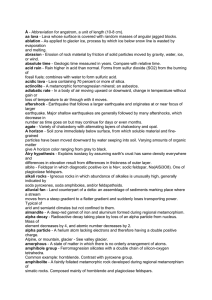
Å - Abbreviation for angstrom, a unit of length (10
... base flow - That portion of stream flow attributable to groundwater flow. base level - Level below which a stream cannot erode. There may be temporary base levels along a stream's course, such as those established by lakes or resistant layers of rock. Ultimate base level is sea level. basement compl ...
... base flow - That portion of stream flow attributable to groundwater flow. base level - Level below which a stream cannot erode. There may be temporary base levels along a stream's course, such as those established by lakes or resistant layers of rock. Ultimate base level is sea level. basement compl ...
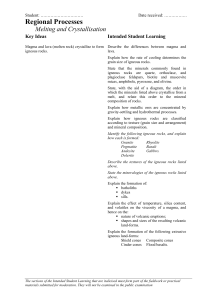
Regional Processes 1.3.1
... Magma and lava (molten rock) crystallise to form Describe the differences between magma and igneous rocks. lava. Explain how the rate of cooling determines the grain size of igneous rocks. State that the minerals commonly found in igneous rocks are quartz, orthoclase, and plagioclase feldspars, biot ...
... Magma and lava (molten rock) crystallise to form Describe the differences between magma and igneous rocks. lava. Explain how the rate of cooling determines the grain size of igneous rocks. State that the minerals commonly found in igneous rocks are quartz, orthoclase, and plagioclase feldspars, biot ...

article in press - Centro de Geociencias
... of the type Cosoltepec Formation (Fig. 2). The Salada, Cosoltepec (s.s.) and Cuatlaco units all contain mafic lenses of tholeiitic, within-plate affinity (Keppie et al., 2007; Grodzicki et al., in press). Compared with the Ordovician units, concordant detrital zircons in the Salada, Cosoltepec (s.s) ...
... of the type Cosoltepec Formation (Fig. 2). The Salada, Cosoltepec (s.s.) and Cuatlaco units all contain mafic lenses of tholeiitic, within-plate affinity (Keppie et al., 2007; Grodzicki et al., in press). Compared with the Ordovician units, concordant detrital zircons in the Salada, Cosoltepec (s.s) ...
GEOL 109 - Continuing Education
... b) Quartz sandstone is formed from mature sediment and greywacke is formed from immature sediment. Both kinds of rocks can form on the margins of continents. The difference between having an immature greywacke and a mature quartz sandstone is that the quartz sandstone is always much older than the g ...
... b) Quartz sandstone is formed from mature sediment and greywacke is formed from immature sediment. Both kinds of rocks can form on the margins of continents. The difference between having an immature greywacke and a mature quartz sandstone is that the quartz sandstone is always much older than the g ...

CRUSTAL GROWTH IN SOUTHERN ARIZONA: U
... Zone southwest of the Colorado Plateau, while the herein studied Pinal block is preserved as scattered outcrops over a much larger area in the Basin and Range province of Southern Arizona, extending into Sonora, Mexico (fig. 1). Karlstrom and Bowring (1988) have identified eight Proterozoic tectonic ...
... Zone southwest of the Colorado Plateau, while the herein studied Pinal block is preserved as scattered outcrops over a much larger area in the Basin and Range province of Southern Arizona, extending into Sonora, Mexico (fig. 1). Karlstrom and Bowring (1988) have identified eight Proterozoic tectonic ...
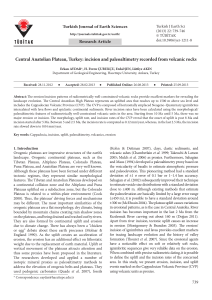
Central Anatolian Plateau, Turkey - Tubitak Journals
... Orogenic plateaus are impressive structures of the earth’s landscape. Orogenic continental plateaus, such as the Tibetan Plateau, Altiplano Plateau, Colorado Plateau, Puna Plateau, and Anatolian Plateau are very well known. Although these plateaus have been formed under different tectonic regimes, t ...
... Orogenic plateaus are impressive structures of the earth’s landscape. Orogenic continental plateaus, such as the Tibetan Plateau, Altiplano Plateau, Colorado Plateau, Puna Plateau, and Anatolian Plateau are very well known. Although these plateaus have been formed under different tectonic regimes, t ...

Caves - WLWV Staff Blogs
... • Typical primary caves are lava tubes, blister caves, tufa caves and reef caves • If the liquid lava inside the crust flows out, a hollow tube remains which is the lava tube • Lava tubes are formed by volcanic activity ( most common primary caves ) • Kazumura cave is the longest and deepest lava tu ...
... • Typical primary caves are lava tubes, blister caves, tufa caves and reef caves • If the liquid lava inside the crust flows out, a hollow tube remains which is the lava tube • Lava tubes are formed by volcanic activity ( most common primary caves ) • Kazumura cave is the longest and deepest lava tu ...

Petrogenetic Types, Tectonic Settings and Mineral Potential of
... Fig. 7 Geochemical discrimination diagrams for granitoids in north-central Manitoba: a) Log s versus Log t diagram used for the granitoids, where s = [Na2O + K2O]2/[SiO2 43] (the Rittmann Serial Index; Rittmann, 1962) and t = (Al2O3 - Na2O)/TiO2 (Gottini, 1968); Field A represents anorgenic, B oroge ...
... Fig. 7 Geochemical discrimination diagrams for granitoids in north-central Manitoba: a) Log s versus Log t diagram used for the granitoids, where s = [Na2O + K2O]2/[SiO2 43] (the Rittmann Serial Index; Rittmann, 1962) and t = (Al2O3 - Na2O)/TiO2 (Gottini, 1968); Field A represents anorgenic, B oroge ...

Igneous rocks
... • How are igneous rocks formed? • How does magma differ from lava? • What two criteria are used to classify igneous rocks? • How does the rate of cooling of magma influence the crystal size of minerals in igneous rocks? • How is the mineral makeup of an igneous rock related to Bowen’s reaction serie ...
... • How are igneous rocks formed? • How does magma differ from lava? • What two criteria are used to classify igneous rocks? • How does the rate of cooling of magma influence the crystal size of minerals in igneous rocks? • How is the mineral makeup of an igneous rock related to Bowen’s reaction serie ...
The dynamic Earth
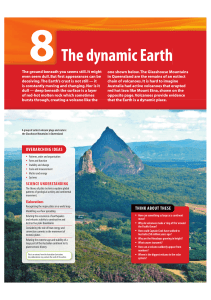
... Strong evidence for the theory of plate tectonics has been provided by the location of volcanoes and earthquakes, growing mountain ranges, spreading ocean ridges and the movement of the continents. However there is further evidence: • Two-hundred-million-year-old fossils of the same land animals hav ...
... Strong evidence for the theory of plate tectonics has been provided by the location of volcanoes and earthquakes, growing mountain ranges, spreading ocean ridges and the movement of the continents. However there is further evidence: • Two-hundred-million-year-old fossils of the same land animals hav ...
The Gold Belt of the Blue Mountains of Oregon
... were extended somewhat farther north it would be seen that the same lavas entirely surround the northern part of the Elkhorn Range as well as the Eagle Creek Mountains. These cores of ·older rocks form a salient from the great mass of mountains filling central Idaho. The vast granite area which occu ...
... were extended somewhat farther north it would be seen that the same lavas entirely surround the northern part of the Elkhorn Range as well as the Eagle Creek Mountains. These cores of ·older rocks form a salient from the great mass of mountains filling central Idaho. The vast granite area which occu ...

geology guidance for teaching
... of the four-fold classification and its delineation and be able to name at least one element from each group. lithophile: elements that combine well with oxygen and are concentrated in the crust; siderophile: ‘iron loving’ elements typical of the core; chalcophile: ‘ore loving’ elements which combin ...
... of the four-fold classification and its delineation and be able to name at least one element from each group. lithophile: elements that combine well with oxygen and are concentrated in the crust; siderophile: ‘iron loving’ elements typical of the core; chalcophile: ‘ore loving’ elements which combin ...
Why the Philippine Sea Plate Moves as It Does
... is a combination of erosion and the fact that thrusting has propagated to the foreland. The Ganges River currently occupies the modern foreland of the Himalayas, and its alluvial basin is the detritus of the Himalayas, the foreland basin. These sediments will eventually be incorporated into the next ...
... is a combination of erosion and the fact that thrusting has propagated to the foreland. The Ganges River currently occupies the modern foreland of the Himalayas, and its alluvial basin is the detritus of the Himalayas, the foreland basin. These sediments will eventually be incorporated into the next ...

Chapter 2: Non-tectonic Structures
... These rocks flow more readily than any other common rock type and can form folded structures under surface temperature and pressure These structures that move upward and gravitationally intrude overlying sediments are called diapirs. ...
... These rocks flow more readily than any other common rock type and can form folded structures under surface temperature and pressure These structures that move upward and gravitationally intrude overlying sediments are called diapirs. ...

3.2 Identifications of rocks and minerals in the field
... 2. Secondary Minerals – minerals formed by the alteration of primary minerals, or deposited after solidification of the igneous body. Common types of secondary processes: a. Kaolinization (高嶺石化) – alteration of alkali feldspars to clay minerals b. Saussuritization (鈉黝簾石化) – alteration of calcic pla ...
... 2. Secondary Minerals – minerals formed by the alteration of primary minerals, or deposited after solidification of the igneous body. Common types of secondary processes: a. Kaolinization (高嶺石化) – alteration of alkali feldspars to clay minerals b. Saussuritization (鈉黝簾石化) – alteration of calcic pla ...
Melting and Crystallisation
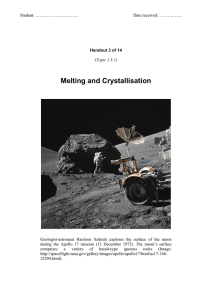
... Magma and lava (molten rock) crystallise to form Describe the differences between magma and igneous rocks. lava. Explain how the rate of cooling determines the grain size of igneous rocks. State that the minerals commonly found in igneous rocks are quartz, orthoclase, and plagioclase feldspars, biot ...
... Magma and lava (molten rock) crystallise to form Describe the differences between magma and igneous rocks. lava. Explain how the rate of cooling determines the grain size of igneous rocks. State that the minerals commonly found in igneous rocks are quartz, orthoclase, and plagioclase feldspars, biot ...
Alpine Granites
... Except for the Adamello batholith (42 Ma), the emplacement took place almost simultaneously over a short period of time (34-28 Ma) (Fig. 5). ...
... Except for the Adamello batholith (42 Ma), the emplacement took place almost simultaneously over a short period of time (34-28 Ma) (Fig. 5). ...

Chapter 3: Rocks - Hobbs Municipal Schools
... which originally was molten. Radioactive decay of elements contained in rocks balances some heat loss as Earth continues to cool. Because magma is less dense than surrounding solid rock, it is forced upward toward the surface, as shown in Figure 6. When magma reaches Earth’s surface and flows from v ...
... which originally was molten. Radioactive decay of elements contained in rocks balances some heat loss as Earth continues to cool. Because magma is less dense than surrounding solid rock, it is forced upward toward the surface, as shown in Figure 6. When magma reaches Earth’s surface and flows from v ...
Copy of A View of Earth`s Past Fill in Notes
... Identify two major geologic & biological developments during the Mesozoic Era. Identify two major geologic & biological developments during the Cenozoic Era. Academic Vocabulary—dominant (having the greatest effect; most numerous. I. ...
... Identify two major geologic & biological developments during the Mesozoic Era. Identify two major geologic & biological developments during the Cenozoic Era. Academic Vocabulary—dominant (having the greatest effect; most numerous. I. ...
Geology of Great Britain

The geology of Great Britain is renowned for its diversity. As a result of its eventful geological history, Great Britain shows a rich variety of landscapes across the constituent countries of England, Wales and Scotland. Rocks of almost all geological ages are represented at outcrop, from the Archaean onwards.