
Dr. G. Randy Keller - Amazon Web Services
... similarities between the two mountain ranges. Both are what geologists called fold-and-thrust belts–mountain ranges in which the formations are folded into anticlines (up-folds, like an “A”) and synclines (down-folds, like the letter “U”). These formations are highly faulted meaning huge blocks of r ...
... similarities between the two mountain ranges. Both are what geologists called fold-and-thrust belts–mountain ranges in which the formations are folded into anticlines (up-folds, like an “A”) and synclines (down-folds, like the letter “U”). These formations are highly faulted meaning huge blocks of r ...
Geology of the Seal Rock Area
... plastic layer beneath. The earth has seven major plates and many smaller ones on which the continents, oceans and islands are carried. Plates may move apart, as at spreading ocean ridges where new crust, underwater volcanoes and volcanic mountains form. Plates may also move past one another, as at C ...
... plastic layer beneath. The earth has seven major plates and many smaller ones on which the continents, oceans and islands are carried. Plates may move apart, as at spreading ocean ridges where new crust, underwater volcanoes and volcanic mountains form. Plates may also move past one another, as at C ...

The Rock Cycle
... cycle shows the three types of rock—igneous, metamorphic, and sedimentary—and the processes that form them. Look at the rock cycle and notice that rocks change by many processes. For example, a sedimentary rock can change by heat and pressure to form a metamorphic rock. The metamorphic rock then can ...
... cycle shows the three types of rock—igneous, metamorphic, and sedimentary—and the processes that form them. Look at the rock cycle and notice that rocks change by many processes. For example, a sedimentary rock can change by heat and pressure to form a metamorphic rock. The metamorphic rock then can ...

Igneous Rock Formation, Compositions, and Textures
... content in a magma __________ its melting temperature with ____________ pressure (water molecules will inhibit the silicate tetrahedra from forming bonds). Note that the melting temperature curve for a wet granitic melt increases with decreasing pressure (opposite of basaltic dry melt). Melting occu ...
... content in a magma __________ its melting temperature with ____________ pressure (water molecules will inhibit the silicate tetrahedra from forming bonds). Note that the melting temperature curve for a wet granitic melt increases with decreasing pressure (opposite of basaltic dry melt). Melting occu ...
Field Guide - Stanford Earth Sciences
... formed as early as Triassic (?) or Jurassic time and persisted until the early Tertiary. They are marked by a broad belt of plutonic rocks extending from Baja California in Mexico up the Sierra Nevada, into northern Nevada, Idaho, and Canada (Fig. 1-9 and 1-10). The forearc, trench, and subduction s ...
... formed as early as Triassic (?) or Jurassic time and persisted until the early Tertiary. They are marked by a broad belt of plutonic rocks extending from Baja California in Mexico up the Sierra Nevada, into northern Nevada, Idaho, and Canada (Fig. 1-9 and 1-10). The forearc, trench, and subduction s ...

Rock and Mineral 10-Specimen Kit Companion Book
... Figure 1. Location of coal mines (includes surface and underground mines). ...
... Figure 1. Location of coal mines (includes surface and underground mines). ...

PDF
... years. Deformation in the ANS ended by the beginning of Cambrian time, although it has locally continued into Cambrian and Ordovician time farther south in Africa. The most intense collision (i.e. greatest shortening, highest relief, and greatest erosion) occurred south of the ANS, in the Mozambique ...
... years. Deformation in the ANS ended by the beginning of Cambrian time, although it has locally continued into Cambrian and Ordovician time farther south in Africa. The most intense collision (i.e. greatest shortening, highest relief, and greatest erosion) occurred south of the ANS, in the Mozambique ...

INTERACTION BETWEEN LAVA LAKES AND PYROCLASTIC
... lapilli tuff. Regardless that Badacsony is volumetrically among the largest volcanic remnants of the BBHVF with a current elevation of 437 m absl and 1 km, slightly north-south aligned lava capped plateau, little has been published of its geological framework (Cserny et al. 1981) or reconstruction o ...
... lapilli tuff. Regardless that Badacsony is volumetrically among the largest volcanic remnants of the BBHVF with a current elevation of 437 m absl and 1 km, slightly north-south aligned lava capped plateau, little has been published of its geological framework (Cserny et al. 1981) or reconstruction o ...
Wadhwan Formation of Western India
... transportation of sediment by high gradient streams and rapid destruction offeldspars by abrasion. Since deposition of the Wadhwan sandstones took place in a tectonically active rift, presence of high gradient JuLy 1996 ...
... transportation of sediment by high gradient streams and rapid destruction offeldspars by abrasion. Since deposition of the Wadhwan sandstones took place in a tectonically active rift, presence of high gradient JuLy 1996 ...
http://ict.aiias.edu/vol_26B/26Bcc_179-199.pdf
... stored as coal and oil and dispersed carbon. There are additional trillions of tons of debris from inorganic constituents of fossils, such as shells, bones and other forms. There is a strong probability that at least a significant part of this material was produced in connection with Creation Week. ...
... stored as coal and oil and dispersed carbon. There are additional trillions of tons of debris from inorganic constituents of fossils, such as shells, bones and other forms. There is a strong probability that at least a significant part of this material was produced in connection with Creation Week. ...

Model Answers - Step Up IAS Coaching
... boundaries. They have been formed and eroded back since the time earths crust was formed. In the present time these fold mountain ranges are present in almost all the continents and mainly 7 major plates are there presentlynorth American, south American, Eurasian, Antarctic, Pacific, indo austral an ...
... boundaries. They have been formed and eroded back since the time earths crust was formed. In the present time these fold mountain ranges are present in almost all the continents and mainly 7 major plates are there presentlynorth American, south American, Eurasian, Antarctic, Pacific, indo austral an ...
The Bible and Paleontology - The Institute for Christian Teaching
... stored as coal and oil and dispersed carbon. There are additional trillions of tons of debris from inorganic constituents of fossils, such as shells, bones and other forms. There is a strong probability that at least a significant part of this material was produced in connection with Creation Week. ...
... stored as coal and oil and dispersed carbon. There are additional trillions of tons of debris from inorganic constituents of fossils, such as shells, bones and other forms. There is a strong probability that at least a significant part of this material was produced in connection with Creation Week. ...

ppt - nsf margins
... The accretion of island arc crust is believed to be a major contributor to the growth of continents. A particularly important question in arc evolution is the origin of felsic plutonic rocks in island arcs. Felsic rocks represent the nucleus of continents, yet there is no clear consensus on how thes ...
... The accretion of island arc crust is believed to be a major contributor to the growth of continents. A particularly important question in arc evolution is the origin of felsic plutonic rocks in island arcs. Felsic rocks represent the nucleus of continents, yet there is no clear consensus on how thes ...

Alteration zone Mapping in the Meiduk and Sar Cheshmeh Porphyry
... mining districts in southeastern segment of the UrumiehDokhtar Volcanic Belt, SE Iran, namely the Meiduk and Sar Cheshmeh have been selected as case studies. FPCS and band ratio methods have yielded spectral information for identifying iron oxide/hydroxide, clay minerals and lithological units using ...
... mining districts in southeastern segment of the UrumiehDokhtar Volcanic Belt, SE Iran, namely the Meiduk and Sar Cheshmeh have been selected as case studies. FPCS and band ratio methods have yielded spectral information for identifying iron oxide/hydroxide, clay minerals and lithological units using ...

MGS_ES_2_revised2
... lowland routes. Later, ice advanced along the Red River of the North and the Minnesota River lowlands into Iowa with sublobes advancing into the Minneapolis-St. Paul and Mesabi Range areas. For about 4,000 years, from 13,000 to 8,000 years ago, the waters of the famous Lake Agassiz covered large par ...
... lowland routes. Later, ice advanced along the Red River of the North and the Minnesota River lowlands into Iowa with sublobes advancing into the Minneapolis-St. Paul and Mesabi Range areas. For about 4,000 years, from 13,000 to 8,000 years ago, the waters of the famous Lake Agassiz covered large par ...

Climax Quadrangle Geologic Map, Lake and Park Counties, Colorado
... Surficial (Quaternary) deposits are shown on the map if they form a continuous cover over bedrock and are more than 5 ft thick. Quaternary deposits that vary in thickness from zero (exposed bedrock) to >5 ft as a discontinuous cover, are mapped as a “fractional” map unit, shown by a map unit abbr ...
... Surficial (Quaternary) deposits are shown on the map if they form a continuous cover over bedrock and are more than 5 ft thick. Quaternary deposits that vary in thickness from zero (exposed bedrock) to >5 ft as a discontinuous cover, are mapped as a “fractional” map unit, shown by a map unit abbr ...

The Rock Cycle - Henry County Schools
... cycle shows the three types of rock—igneous, metamorphic, and sedimentary—and the processes that form them. Look at the rock cycle and notice that rocks change by many processes. For example, a sedimentary rock can change by heat and pressure to form a metamorphic rock. The metamorphic rock then can ...
... cycle shows the three types of rock—igneous, metamorphic, and sedimentary—and the processes that form them. Look at the rock cycle and notice that rocks change by many processes. For example, a sedimentary rock can change by heat and pressure to form a metamorphic rock. The metamorphic rock then can ...
geological solutions concluded by petroleum geochemical data in
... The Triassic breccias of the Ionian zone correspond to typical evaporite dissolution collapse breccias (Karakitsios & Pomoni-Papaioannou, 1998). It is suggested that, the shale fragments, with significant content in organic matter, incorporated into the Triassic breccias were initially deposited as ...
... The Triassic breccias of the Ionian zone correspond to typical evaporite dissolution collapse breccias (Karakitsios & Pomoni-Papaioannou, 1998). It is suggested that, the shale fragments, with significant content in organic matter, incorporated into the Triassic breccias were initially deposited as ...
the structure of the sierra maestra near santiago de cuba
... STEPHEN TABER University of South Carolina ...
... STEPHEN TABER University of South Carolina ...
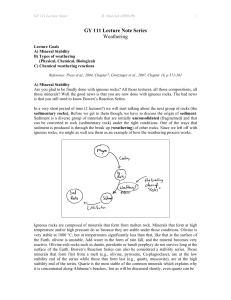
GY 111 Lecture Note Series Weathering
... There are three major types of weathering, although most textbooks only distinguish two. The first type is physical weathering and is defined as the mechanical breakup of rock. The second type of weathering is called chemical weathering. This is the most important process in soil formation (see the ...
... There are three major types of weathering, although most textbooks only distinguish two. The first type is physical weathering and is defined as the mechanical breakup of rock. The second type of weathering is called chemical weathering. This is the most important process in soil formation (see the ...
Cink, kadmium, ólom, gallium, indium, tallium
... Zinc in weathering and sedimentary processes The concentration of zinc in weathering solutions is controlled rather by adsorption (on clay minerals, Fe, Mn, AI hydroxides and organic matter) than by solubility of zinc carbonates, hydroxides and phosphates. The Zn content in soils depends on the nat ...
... Zinc in weathering and sedimentary processes The concentration of zinc in weathering solutions is controlled rather by adsorption (on clay minerals, Fe, Mn, AI hydroxides and organic matter) than by solubility of zinc carbonates, hydroxides and phosphates. The Zn content in soils depends on the nat ...

Metamorphic Rock
... quartz sand that have been cemented together. The quartz crystals in these grains can grow larger during metamorphism. The quartz crystals in quartzite can be much larger than those in quartz sandstone. Type of Metamorphic Rock ...
... quartz sand that have been cemented together. The quartz crystals in these grains can grow larger during metamorphism. The quartz crystals in quartzite can be much larger than those in quartz sandstone. Type of Metamorphic Rock ...
Ba – Barium 71
... top of Carboniferous limestone covered by Permo-Triassic sediments); medium to high values in the Miocene basins of Old Castilla and Ebro can be associated to evaporitic processes in lacustrine environment. High Ba also in central Europe, including most areas of Germany, western Poland, Slovakia, so ...
... top of Carboniferous limestone covered by Permo-Triassic sediments); medium to high values in the Miocene basins of Old Castilla and Ebro can be associated to evaporitic processes in lacustrine environment. High Ba also in central Europe, including most areas of Germany, western Poland, Slovakia, so ...

chapter4 - Geological Sciences
... Scientific attempts to estimate Earth's age were first made by naturalists during the 18th and 19th centuries. They formulated some of the basic principles used for deciphering the age of the earth. James Hutton, the father of modern geology, first suggested that present day processes operatin ...
... Scientific attempts to estimate Earth's age were first made by naturalists during the 18th and 19th centuries. They formulated some of the basic principles used for deciphering the age of the earth. James Hutton, the father of modern geology, first suggested that present day processes operatin ...
Geology of Great Britain

The geology of Great Britain is renowned for its diversity. As a result of its eventful geological history, Great Britain shows a rich variety of landscapes across the constituent countries of England, Wales and Scotland. Rocks of almost all geological ages are represented at outcrop, from the Archaean onwards.