Upgrade Your Physics 1
... The first says F d (mu ) dt mu m u ma m u , whereas the second simply states F=ma. Clearly they can’t both be correct, since they are different. Which is right? The first: which was actually the way Newton stated it in the first place! The good old F=ma will still work – but you have to ...
... The first says F d (mu ) dt mu m u ma m u , whereas the second simply states F=ma. Clearly they can’t both be correct, since they are different. Which is right? The first: which was actually the way Newton stated it in the first place! The good old F=ma will still work – but you have to ...

Document
... M&R Figure 2.4. A possible trajectory (dashed) that might be followed by an updraft parcel on a skew T-log p diagram as a result of the entrainment of environmental air. ...
... M&R Figure 2.4. A possible trajectory (dashed) that might be followed by an updraft parcel on a skew T-log p diagram as a result of the entrainment of environmental air. ...
On the Lamb Vector and the Hydrodynamic Charge
... can find also the expression “vortex force” in the literature to denote this vector) represents the Coriolis acceleration of a velocity field under the effect of its own rotation (usually for solid body rotation, the Coriolis force is built with a rotation vector which is independent of the veloc ...
... can find also the expression “vortex force” in the literature to denote this vector) represents the Coriolis acceleration of a velocity field under the effect of its own rotation (usually for solid body rotation, the Coriolis force is built with a rotation vector which is independent of the veloc ...
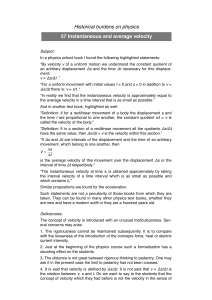
Historical burdens on physics 57 Instantaneous and average velocity
... Such statements are not a peculiarity of those books from which they are taken. They can be found in many other physics text books, whether they are new and have a modern outfit or they are a hundred years old. Deficiencies: The concept of velocity is introduced with an unusual meticulousness. Sever ...
... Such statements are not a peculiarity of those books from which they are taken. They can be found in many other physics text books, whether they are new and have a modern outfit or they are a hundred years old. Deficiencies: The concept of velocity is introduced with an unusual meticulousness. Sever ...

Introduction to mechanical engineering lecture notes
... The instantaneous velocity of a particle in linear motion may be found by differentiating the position x with respect to the time variable t: v = dx/dt. The acceleration may be found by differentiating the velocity: a = dv/dt. By the fundamental theorem of calculus the converse is also true: to find ...
... The instantaneous velocity of a particle in linear motion may be found by differentiating the position x with respect to the time variable t: v = dx/dt. The acceleration may be found by differentiating the velocity: a = dv/dt. By the fundamental theorem of calculus the converse is also true: to find ...



ME33: Fluid Flow Lecture 1: Information and Introduction
... Fluids in rigid – body motion In this section we obtain relations for the variation of pressure in fluids moving like a solid body with or without acceleration in the absence of any shear stresses (i.e., no motion between fluid layers relative to each other). ...
... Fluids in rigid – body motion In this section we obtain relations for the variation of pressure in fluids moving like a solid body with or without acceleration in the absence of any shear stresses (i.e., no motion between fluid layers relative to each other). ...
Fluids and Electrolytes
... Serum potassium level below 3.5 mEq/L Causes Loss of GI secretions (diarrhea) Excessive renal excretion of K Movement of K into the cells with insulin (Rx DKA) Prolonged g fluid administration without K supplementation Diuretics (some) and beta agonist (albuterol) Alkalosis ...
... Serum potassium level below 3.5 mEq/L Causes Loss of GI secretions (diarrhea) Excessive renal excretion of K Movement of K into the cells with insulin (Rx DKA) Prolonged g fluid administration without K supplementation Diuretics (some) and beta agonist (albuterol) Alkalosis ...

pressure perturbations
... M&R Figure 3.2. A possible trajectory (dashed) that might be followed by an updraft parcel on a skew T-log p diagram as a result of the entrainment of environmental air. ...
... M&R Figure 3.2. A possible trajectory (dashed) that might be followed by an updraft parcel on a skew T-log p diagram as a result of the entrainment of environmental air. ...


H2-rich fluids from serpentinization: Geochemical and biotic
... brucite. Note the differences of aqueous hydrogen concentrations required by the mineral buffers QFM and SBM and the sensitivity of H2(aq) concentrations of SBM equilibria to Fe(II) substitution. The curve labeled H2 Saturation in Fig. 1 denotes saturation of the fluid with H2(gas) at 500 bars total ...
... brucite. Note the differences of aqueous hydrogen concentrations required by the mineral buffers QFM and SBM and the sensitivity of H2(aq) concentrations of SBM equilibria to Fe(II) substitution. The curve labeled H2 Saturation in Fig. 1 denotes saturation of the fluid with H2(gas) at 500 bars total ...

Evolution of a vortex in a magnetic field
... Abstract – The evolution of a single vortex in an electrically-conducting liquid, subject to a uniform magnetic field acting parallel to the axis of the vortex, is investigated by an order-of-magnitude analysis and a numerical model. The non-linear phase of decay, wherein the Lorentz and the inertia ...
... Abstract – The evolution of a single vortex in an electrically-conducting liquid, subject to a uniform magnetic field acting parallel to the axis of the vortex, is investigated by an order-of-magnitude analysis and a numerical model. The non-linear phase of decay, wherein the Lorentz and the inertia ...
The Theory of Lorentz and The Principle of Reaction
... introduced by that scholar in his well known theory. In the same way, the term (X'4 - Y) represents the effect of the electrostatic pressure of Maxwell. Without the presence of the first term: ...
... introduced by that scholar in his well known theory. In the same way, the term (X'4 - Y) represents the effect of the electrostatic pressure of Maxwell. Without the presence of the first term: ...

Name
... 7. Explain why a dam is thicker at the bottom then at the top? (3pts) There is a much greater pressure at the bottom of the dam than at the top, due to the weight of the water at bottom compared to the top. 8. If an object is floating what can you say about the buoyancy force? (3pts) That the buoyan ...
... 7. Explain why a dam is thicker at the bottom then at the top? (3pts) There is a much greater pressure at the bottom of the dam than at the top, due to the weight of the water at bottom compared to the top. 8. If an object is floating what can you say about the buoyancy force? (3pts) That the buoyan ...

(1c): Pair production is the process, whereby a g ray disappears
... radiated energy incident on a unit area on earth’s surface per unit time is P. The calcium line in this radiation differs from its normal wavelength 0 by an amount , due only to the gravitational field of the ordinary star. (For this calculation the photon can be considered to have an effective m ...
... radiated energy incident on a unit area on earth’s surface per unit time is P. The calcium line in this radiation differs from its normal wavelength 0 by an amount , due only to the gravitational field of the ordinary star. (For this calculation the photon can be considered to have an effective m ...


Prezentacja programu PowerPoint
... geometry is given by: where the term 3/(+2) arises from the local field factor. Accordingly, dielectric analysis can be made in terms of the polarizability instead of the experimentally accessible permittivity if we assume the material to be a spherical specimen of radius large enough to contain al ...
... geometry is given by: where the term 3/(+2) arises from the local field factor. Accordingly, dielectric analysis can be made in terms of the polarizability instead of the experimentally accessible permittivity if we assume the material to be a spherical specimen of radius large enough to contain al ...


Evidence of Coherent Dynamics in Water Droplets of Waterfalls
... article focuses only on the data-set collected at the Krimml Falls. This selection is based on several reasons: Krimml provides easier access, has a higher water load and in terms of results, reveal similar properties in charge and size distribution as found with the falls in Gartl and Möll. In addi ...
... article focuses only on the data-set collected at the Krimml Falls. This selection is based on several reasons: Krimml provides easier access, has a higher water load and in terms of results, reveal similar properties in charge and size distribution as found with the falls in Gartl and Möll. In addi ...