evolutionary theory and biodiversity
... • James Hutton (1726–1797) and charles lyell (1797–1875) studied the forces of wind, water, earthquakes, and volcanoes. They concluded that the Earth is very old and has changed slowly over time due to natural processes. • erasmus Darwin (1731–1802) suggested that competition between individuals cou ...
... • James Hutton (1726–1797) and charles lyell (1797–1875) studied the forces of wind, water, earthquakes, and volcanoes. They concluded that the Earth is very old and has changed slowly over time due to natural processes. • erasmus Darwin (1731–1802) suggested that competition between individuals cou ...
NATURAL SELECTION
... Charles Darwin introduced the term "natural selection" in chapter book On the Origi,n of Species 1L859] ...
... Charles Darwin introduced the term "natural selection" in chapter book On the Origi,n of Species 1L859] ...
Molecular evolution and the latitudinal
... and Kerr, 2008). In recent work, temperature has become a focal putative driver replacing an earlier emphasis on habitat area. Palaeontological studies find evidence that environmental temperature is correlated with biodiversity through time in marine molluscs and protists (Crame, 2002; Mayhew et al ...
... and Kerr, 2008). In recent work, temperature has become a focal putative driver replacing an earlier emphasis on habitat area. Palaeontological studies find evidence that environmental temperature is correlated with biodiversity through time in marine molluscs and protists (Crame, 2002; Mayhew et al ...
Genetic Constraints and the Evolution of Display Trait Sexual
... a substantial portion of the species range. Quantitative genetic analyses showed that intersexual genetic correlations were high because of autosomal genetic variance but that the inclusion of X-linked effects reduced genetic correlations substantially, indicating that sex linkage may be an importan ...
... a substantial portion of the species range. Quantitative genetic analyses showed that intersexual genetic correlations were high because of autosomal genetic variance but that the inclusion of X-linked effects reduced genetic correlations substantially, indicating that sex linkage may be an importan ...
Thamnophis ordinoides
... basis, and produces immediate phenotypic effects within a generation that can be measured without recourse to principles of heredity or evolution. In contrast, evolutionary response to selection, the genetic change that occurs from one generation to the next, does depend on genetic variation. ... Up ...
... basis, and produces immediate phenotypic effects within a generation that can be measured without recourse to principles of heredity or evolution. In contrast, evolutionary response to selection, the genetic change that occurs from one generation to the next, does depend on genetic variation. ... Up ...

evolutio - The Skeptic Tank
... overwhelming. However, biologists readily admit that they are less certain of the exact MECHANISM of evolution; there are several THEORIES of the mechanism of evolution. Stephan J. Gould has put this as well as anyone else, "In the American vernacular, "theory" often means "imperfect fact" - part of ...
... overwhelming. However, biologists readily admit that they are less certain of the exact MECHANISM of evolution; there are several THEORIES of the mechanism of evolution. Stephan J. Gould has put this as well as anyone else, "In the American vernacular, "theory" often means "imperfect fact" - part of ...

What makes populations evolve?
... Robin Seeley hypothesized that the flat periwinkles of Appledore Island evolved by Darwin’s mechanism. When the green crabs arrived, they started eating the thin-shelled snails. This left only the thick shelled ones to reproduce. And when the thick-shelled survivors reproduced, they had thick-shelle ...
... Robin Seeley hypothesized that the flat periwinkles of Appledore Island evolved by Darwin’s mechanism. When the green crabs arrived, they started eating the thin-shelled snails. This left only the thick shelled ones to reproduce. And when the thick-shelled survivors reproduced, they had thick-shelle ...
The Genetic Architecture of Ecological Specialization: Correlated
... argued that genetic trade-offs are a likely cause of specialized resource use (e.g., Futuyma and Moreno 1988; Via 1991a). A genetic trade-off can be measured experimentally as a negative genetic correlation between fitness traits in different environments by considering a trait expressed in two envi ...
... argued that genetic trade-offs are a likely cause of specialized resource use (e.g., Futuyma and Moreno 1988; Via 1991a). A genetic trade-off can be measured experimentally as a negative genetic correlation between fitness traits in different environments by considering a trait expressed in two envi ...

Presentazione di PowerPoint
... resulted in the species seen today. Georges Cuvier (paleontologist) Catastrophes caused evolution to occur. ...
... resulted in the species seen today. Georges Cuvier (paleontologist) Catastrophes caused evolution to occur. ...

Presentazione di PowerPoint
... resulted in the species seen today. Georges Cuvier (paleontologist) Catastrophes caused evolution to occur. ...
... resulted in the species seen today. Georges Cuvier (paleontologist) Catastrophes caused evolution to occur. ...
Unit 2 - AGNR Groups
... Now that we have a few terms under our belts, let’s take a look back at classification systems past and present. The classification used today got its formal start with Linnaeus back in the early 1700’s. Like others before him, he grouped organisms based on similarities that they shared- these could ...
... Now that we have a few terms under our belts, let’s take a look back at classification systems past and present. The classification used today got its formal start with Linnaeus back in the early 1700’s. Like others before him, he grouped organisms based on similarities that they shared- these could ...
biology i - Center for Technology Outreach
... d. Discuss the characteristics and implications of both chromosomal and gene mutations. (DOK 2) • Significance of nondisjunction, deletion, substitutions, translocation, frame shift mutation in animals • Occurrence and significance of genetic disorders such as sickle cell anemia, Tay-Sachs disorder, ...
... d. Discuss the characteristics and implications of both chromosomal and gene mutations. (DOK 2) • Significance of nondisjunction, deletion, substitutions, translocation, frame shift mutation in animals • Occurrence and significance of genetic disorders such as sickle cell anemia, Tay-Sachs disorder, ...
The actuality of Lamarck: towards the
... behavioral traits and inheritance of learned abilities in higher vertebrates and social insects, and finally by the symbolic language inheritance systems of humans. According to Jablonka et al. (1999), “natural selection leads...to the evolution of new evolutionary rules” and to “new levels of indiv ...
... behavioral traits and inheritance of learned abilities in higher vertebrates and social insects, and finally by the symbolic language inheritance systems of humans. According to Jablonka et al. (1999), “natural selection leads...to the evolution of new evolutionary rules” and to “new levels of indiv ...

Artificial ecosystem selection
... two orders of magnitude in the number of organisms initiating each ecosystem. The substantial phenotypic variation observed in our experiments (and also in artificial selection experiments at the group and two-species community levels) reveals that something is wrong with theoretical reasoning based ...
... two orders of magnitude in the number of organisms initiating each ecosystem. The substantial phenotypic variation observed in our experiments (and also in artificial selection experiments at the group and two-species community levels) reveals that something is wrong with theoretical reasoning based ...

Chapter 7
... • What Is a Species? A species is a group of organisms that can mate with one another to produce fertile offspring. A characteristic that helps an organism survive and reproduce in its environment is called an adaptation. ...
... • What Is a Species? A species is a group of organisms that can mate with one another to produce fertile offspring. A characteristic that helps an organism survive and reproduce in its environment is called an adaptation. ...

SBL100 for 2nd Semester 2014-1515 Slot C -
... Darwin’s theory rests on three observations and one conclusion he drew from them. Observations: The reproductive rates of all organisms, even slowly reproducing ones, are sufficiently high that populations would quickly become enormous if death rates were not equally high. Within each type of or ...
... Darwin’s theory rests on three observations and one conclusion he drew from them. Observations: The reproductive rates of all organisms, even slowly reproducing ones, are sufficiently high that populations would quickly become enormous if death rates were not equally high. Within each type of or ...
【金屬鍵】
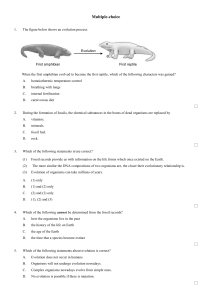
... Directions: Questions 22 and 23 refer to the following passage. Peppered moths exist in two colour forms: light and dark. In the past, those moths were mostly in the light form in Britain, as the tree trunks, which were covered with light-coloured lichens, offered them protection against birds whic ...
... Directions: Questions 22 and 23 refer to the following passage. Peppered moths exist in two colour forms: light and dark. In the past, those moths were mostly in the light form in Britain, as the tree trunks, which were covered with light-coloured lichens, offered them protection against birds whic ...
Natural Selection in Relation to Complexity
... level of selective percolation as the background to occasional episodes of secular evolutionary change. And here we also see selection entangled in a mesh of extensional complexity that it cannot be held responsible for having produced as a result of promoting the currently best organismic traits wi ...
... level of selective percolation as the background to occasional episodes of secular evolutionary change. And here we also see selection entangled in a mesh of extensional complexity that it cannot be held responsible for having produced as a result of promoting the currently best organismic traits wi ...

Campbell Biology: Concepts and Connections, 8e (Reece et al
... D) Organisms compete for limited resources. Answer: A Topic: 13.6 Skill: Knowledge/Comprehension Learning Outcome: 13.2 12) Which of the following thinkers argued that much of human suffering was the result of human populations increasing faster than food supply, an argument that later influenced Ch ...
... D) Organisms compete for limited resources. Answer: A Topic: 13.6 Skill: Knowledge/Comprehension Learning Outcome: 13.2 12) Which of the following thinkers argued that much of human suffering was the result of human populations increasing faster than food supply, an argument that later influenced Ch ...

Beaks of Finches
... 6. Did those who were successful in Round One survive equally well when other were competing for food at the same dish during Round Two? No. Fewer species survived when many species competed for food at the same dish. 7. Why were there fewer survivors at the end of Round Three There were fewer survi ...
... 6. Did those who were successful in Round One survive equally well when other were competing for food at the same dish during Round Two? No. Fewer species survived when many species competed for food at the same dish. 7. Why were there fewer survivors at the end of Round Three There were fewer survi ...

Natural Selection: Descent with Modification
... selection as a family of related modes of explanation, which have changed gradually over the years as the theories in which they are embedded have been reformulated in order to address different problems. In other words, our understanding of natural selection itself has been subject to a process of ...
... selection as a family of related modes of explanation, which have changed gradually over the years as the theories in which they are embedded have been reformulated in order to address different problems. In other words, our understanding of natural selection itself has been subject to a process of ...

Genetic variation at MHC, mitochondrial and microsatellite loci in
... different locations were sampled in this stream (VC1-VC4), two of which are connected (VC3 and VC4) and two (VC1 and VC2) are partially isolated from each other but completely isolated from VC3 and VC4. The number of individuals living in VC1 or VC2 could be less than 30, while in VC3 and VC4 there m ...
... different locations were sampled in this stream (VC1-VC4), two of which are connected (VC3 and VC4) and two (VC1 and VC2) are partially isolated from each other but completely isolated from VC3 and VC4. The number of individuals living in VC1 or VC2 could be less than 30, while in VC3 and VC4 there m ...
modelling the ecological context of evolutionary change
... these processes. Individuals within a given species (or sometimes within an age, condition, or size class of that species) are treated as being effectively identical. No allowance is made for genetic variation among individuals in traits that affect these ecological interactions, thereby precluding ...
... these processes. Individuals within a given species (or sometimes within an age, condition, or size class of that species) are treated as being effectively identical. No allowance is made for genetic variation among individuals in traits that affect these ecological interactions, thereby precluding ...

CHAPTER 10 Changes in biodiversity over time
... On his return to England, Darwin continued to struggle with the question of whether species could evolve. If species could change, then what was a possible mechanism by which evolution occurred? By 1838, in his notebooks, Darwin began to outline his view that species were not fixed and unchanging an ...
... On his return to England, Darwin continued to struggle with the question of whether species could evolve. If species could change, then what was a possible mechanism by which evolution occurred? By 1838, in his notebooks, Darwin began to outline his view that species were not fixed and unchanging an ...

Manuscript - Weizmann Institute of Science
... given species often fall on the same line as variations between species - a phenomenon called ‘evolution along genetic lines of least resistance’ ...
... given species often fall on the same line as variations between species - a phenomenon called ‘evolution along genetic lines of least resistance’ ...