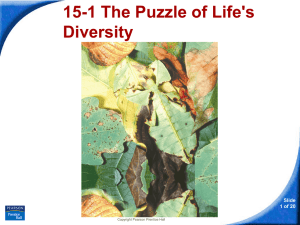
15-1 The Puzzle of Life`s Diversity Evolution
... Because more organisms are produced than can survive, they compete for limited resources. Slide 49 of 41 Copyright Pearson Prentice Hall ...
... Because more organisms are produced than can survive, they compete for limited resources. Slide 49 of 41 Copyright Pearson Prentice Hall ...
Evolution-Fitness and Rocks
... from ancestors, with modification, over time? Or that the modifications came by chance, not by design? Or, in addition, that all living things ultimately had the same ancestor? Or, still further, that the ‘first living thing’ had as its ancestor a nonliving thing? Context indicates that when evoluti ...
... from ancestors, with modification, over time? Or that the modifications came by chance, not by design? Or, in addition, that all living things ultimately had the same ancestor? Or, still further, that the ‘first living thing’ had as its ancestor a nonliving thing? Context indicates that when evoluti ...
Decent With Modification Darwin`s Theory
... from ancestors, with modification, over time? Or that the modifications came by chance, not by design? Or, in addition, that all living things ultimately had the same ancestor? Or, still further, that the ‘first living thing’ had as its ancestor a nonliving thing? Context indicates that when evoluti ...
... from ancestors, with modification, over time? Or that the modifications came by chance, not by design? Or, in addition, that all living things ultimately had the same ancestor? Or, still further, that the ‘first living thing’ had as its ancestor a nonliving thing? Context indicates that when evoluti ...

How is Biological Explanation Possible?
... manifest the same relationship. Since the importance of frequency-dependent selection became apparent, it has been recognized that an interbreeding population can be an environmental force in¯uencing its own evolutionary course. At least since the work of Waters,3 philosophers have recognized that a ...
... manifest the same relationship. Since the importance of frequency-dependent selection became apparent, it has been recognized that an interbreeding population can be an environmental force in¯uencing its own evolutionary course. At least since the work of Waters,3 philosophers have recognized that a ...

Darwinians at war Bateson`s place in histories of Darwinism
... In a train on his way to a meeting of the Royal Horticultural Society, William Bateson for the first time read Mendel's paper on peas and thus discovered Mendelian genetics for British biology, immediately incorporating the fruits of his reading into his lecture of 8 May 1900 (B. Bateson, 1928, pp. ...
... In a train on his way to a meeting of the Royal Horticultural Society, William Bateson for the first time read Mendel's paper on peas and thus discovered Mendelian genetics for British biology, immediately incorporating the fruits of his reading into his lecture of 8 May 1900 (B. Bateson, 1928, pp. ...

processes shaping diversity
... We can test the observed genotype frequency for an allele at a single nucleotide polymorphism (SNP, Section 3.2) against that expected from HWE given the allele frequencies deduced from the data. If the observed data do not fit the model well, one of the assumptions (for example, no selection) of the ...
... We can test the observed genotype frequency for an allele at a single nucleotide polymorphism (SNP, Section 3.2) against that expected from HWE given the allele frequencies deduced from the data. If the observed data do not fit the model well, one of the assumptions (for example, no selection) of the ...

Power Point Presentation
... the origin of new species as closely related processes • From studies made years after Darwin’s voyage, biologists have concluded that this is indeed what happened to the Galápagos finches ...
... the origin of new species as closely related processes • From studies made years after Darwin’s voyage, biologists have concluded that this is indeed what happened to the Galápagos finches ...

X Jornadas sobre Filosofía y Metodología actual de la Ciencia
... debate on the possible transformation of species was already in the air, and this, in the opinion of many naturalists of the day, threatened the scientificalness of biology, the possibility of establishing laws and explaining deviations as perturbations (as physics has done since Galileo).18 Now we ...
... debate on the possible transformation of species was already in the air, and this, in the opinion of many naturalists of the day, threatened the scientificalness of biology, the possibility of establishing laws and explaining deviations as perturbations (as physics has done since Galileo).18 Now we ...
Fodor `s Bubbe Meise Against Darwinism 1
... though the two traits are coextensive in the batch of marbles. I think the same is true of natural selection. The fact that ‘selection for T ’ is opaque doesn’t mean that selection-for floats free from the facts; the facts, after all, include causal facts. Fodor thinks there are no laws about the sel ...
... though the two traits are coextensive in the batch of marbles. I think the same is true of natural selection. The fact that ‘selection for T ’ is opaque doesn’t mean that selection-for floats free from the facts; the facts, after all, include causal facts. Fodor thinks there are no laws about the sel ...
MCAS Release of February 2012 Biology Test Items
... The Massachusetts Department of Elementary and Secondary Education is committed to working in partnership with policymakers, communities, parents, school districts, and students to build a system that will prepare all students to succeed as productive and contributing members of our democratic socie ...
... The Massachusetts Department of Elementary and Secondary Education is committed to working in partnership with policymakers, communities, parents, school districts, and students to build a system that will prepare all students to succeed as productive and contributing members of our democratic socie ...
Genome size and intron size in Drosophila
... insertions. Natural selection may also operate at the level of the individual DNA sequences themselves, provided that a small deletion produces a large enough selection coefficient to overcome the effects of random genetic drift. While selection at some level is undoubtedly an important factor in th ...
... insertions. Natural selection may also operate at the level of the individual DNA sequences themselves, provided that a small deletion produces a large enough selection coefficient to overcome the effects of random genetic drift. While selection at some level is undoubtedly an important factor in th ...
Disruptive Selection and then What?
... and Doebeli (2004). The x-axis corresponds to a quantitative property (e.g. size) of a resource, which has a continuous and unimodal distribution in the absence of predation. Consumers are characterized by the mean of their utilization curve, giving the capture rate per unit time for each resource t ...
... and Doebeli (2004). The x-axis corresponds to a quantitative property (e.g. size) of a resource, which has a continuous and unimodal distribution in the absence of predation. Consumers are characterized by the mean of their utilization curve, giving the capture rate per unit time for each resource t ...
Rajon, E. and Masel, J. (2013)
... Here we explore an abstract model of cryptic sequences, their attenuation, accumulation and eventual potential co-option. Our model is inspired by the concrete example of cryptic DNA sequences that are only rarely translated into proteins. These underexpressed sequences can be whole genes or parts ...
... Here we explore an abstract model of cryptic sequences, their attenuation, accumulation and eventual potential co-option. Our model is inspired by the concrete example of cryptic DNA sequences that are only rarely translated into proteins. These underexpressed sequences can be whole genes or parts ...
What-if history of science - Create and Use Your home.uchicago.edu
... Wallace did not exist might expand our historical imagination or help us contemplate what Darwin had to think through in the mid-1850s, but it might be more natural to say that we do not know what could have happened because there are too many unknown variables. Shifting the reception of Wallace’s l ...
... Wallace did not exist might expand our historical imagination or help us contemplate what Darwin had to think through in the mid-1850s, but it might be more natural to say that we do not know what could have happened because there are too many unknown variables. Shifting the reception of Wallace’s l ...
Artificial Selection and Domestication: Modern Lessons from
... chapter on natural selection (p. 102–103), we have seen how similar variations, occurring in cultivated plants and domestic animals, are capable of being perpetuated and accumulated by artificial selection, till they have resulted in all the wonderful varieties of our fruits, flowers, and vegetables ...
... chapter on natural selection (p. 102–103), we have seen how similar variations, occurring in cultivated plants and domestic animals, are capable of being perpetuated and accumulated by artificial selection, till they have resulted in all the wonderful varieties of our fruits, flowers, and vegetables ...
Population Variation in Continuously Varying Traits as an Ecological
... physiological or behavioral traits. It has received only partial support from empirical tests and has been criticized on theoretical grounds. Recent quantitative genetic models have made an advance by exploring the effects of mutation, migration, mating pattern and selection on phenotypic variance. ...
... physiological or behavioral traits. It has received only partial support from empirical tests and has been criticized on theoretical grounds. Recent quantitative genetic models have made an advance by exploring the effects of mutation, migration, mating pattern and selection on phenotypic variance. ...

ADAPTIVE RADIATION
... For radiations to be extensive, then, it appears that not only must empty niches be available, but extensive sets of adaptive zones must be free for colonization. ...
... For radiations to be extensive, then, it appears that not only must empty niches be available, but extensive sets of adaptive zones must be free for colonization. ...
CHAPTER 3 ORGANIC CHEMISTRY
... Darwin and Wallace suggested the theory of natural selection as a mechanism for evolution. Darwin wrote Origin of Species by Means of Natural Selection. The idea that some individuals have genetic combinations that allow them to survive, reproduce and pass their genes on to the next generation Copyr ...
... Darwin and Wallace suggested the theory of natural selection as a mechanism for evolution. Darwin wrote Origin of Species by Means of Natural Selection. The idea that some individuals have genetic combinations that allow them to survive, reproduce and pass their genes on to the next generation Copyr ...

Natural Selection
... adaptation to the environment and the origin of new species as closely related processes From studies made years after Darwin’s voyage, biologists have concluded that this is what happened to the Galápagos finches ...
... adaptation to the environment and the origin of new species as closely related processes From studies made years after Darwin’s voyage, biologists have concluded that this is what happened to the Galápagos finches ...
evolution
... Mutation occurs too rarely to be the direct cause of allele frequency change. Mutations occur at rates of 10–4 to 10–6 new mutations per gene per generation. In each generation, one mutation would occur in every 10,000 to 1,000,000 copies of a gene. At these rates, in one generation, mutation c ...
... Mutation occurs too rarely to be the direct cause of allele frequency change. Mutations occur at rates of 10–4 to 10–6 new mutations per gene per generation. In each generation, one mutation would occur in every 10,000 to 1,000,000 copies of a gene. At these rates, in one generation, mutation c ...
Evolution - Lemon Bay High School
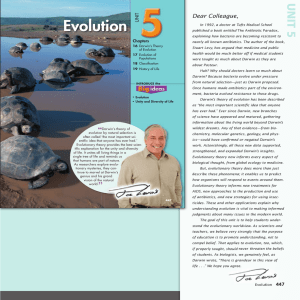
... were suggesting that life on Earth had also changed. The process Darwin developed a of change over time is called evolution. scientific theory of biological evolution that explains how modern organisms evolved over long periods of time through descent from common ancestors. Darwin’s journey began in ...
... were suggesting that life on Earth had also changed. The process Darwin developed a of change over time is called evolution. scientific theory of biological evolution that explains how modern organisms evolved over long periods of time through descent from common ancestors. Darwin’s journey began in ...
ageing Powerpoint
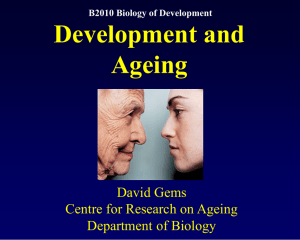
... • 1941 Haldane: why has natural selection not acted to remove the Huntington's mutation from populations? • Average age of onset of Huntington's 35.5 years. • For much of the evolutionary history of mankind, most people did not live to be that old. • The selective pressure to remove the Huntington's ...
... • 1941 Haldane: why has natural selection not acted to remove the Huntington's mutation from populations? • Average age of onset of Huntington's 35.5 years. • For much of the evolutionary history of mankind, most people did not live to be that old. • The selective pressure to remove the Huntington's ...
Neutral Biogeography and the Evolution of Climatic Niches
... in longitude. Each pixel in the lattice had a finite carrying capacity set to 20 individuals, leading to competition for space and hence ecological drift. Simulations were initiated with an empty lattice except for the central pixel, which was at carrying capacity with individuals of the ancestral s ...
... in longitude. Each pixel in the lattice had a finite carrying capacity set to 20 individuals, leading to competition for space and hence ecological drift. Simulations were initiated with an empty lattice except for the central pixel, which was at carrying capacity with individuals of the ancestral s ...
Theory Evolution Study Guide Answers Key
... answer key weebly our biology class - holt mcdougal biology principles of evolution study guide b answer key study guide b section 10 3 theory of natural principles of evolution study guide b, chapter 15 and 16 study guide answers - modern biology study guide answer key 3 population genetics is the ...
... answer key weebly our biology class - holt mcdougal biology principles of evolution study guide b answer key study guide b section 10 3 theory of natural principles of evolution study guide b, chapter 15 and 16 study guide answers - modern biology study guide answer key 3 population genetics is the ...