
Polisdigitocracy
... job growth and inward investment. The tech industry is one of the fastest growing sectors globally and appeared resilient to the most recent recession across western economies. City governments have a role to play. They can be the key catalyst in complex digital ecosystems, help to unleash the poten ...
... job growth and inward investment. The tech industry is one of the fastest growing sectors globally and appeared resilient to the most recent recession across western economies. City governments have a role to play. They can be the key catalyst in complex digital ecosystems, help to unleash the poten ...

Ethics and Geoengineering: Reviewing the Moral Issues Raised by
... required behavioral changes.35 Technological solutions can often be simpler, quicker, and demand less from people than the large social transformations that might otherwise be required. Without the assistance of technology, combating climate change would demand massive social and behavioral change. ...
... required behavioral changes.35 Technological solutions can often be simpler, quicker, and demand less from people than the large social transformations that might otherwise be required. Without the assistance of technology, combating climate change would demand massive social and behavioral change. ...

- ACE CRC
... transporting vast amounts of heat and carbon. The Southern Ocean (south of 30°S) absorbs about 40% of the total global ocean uptake of anthropogenic CO2 (Gruber et al., 2009). The widespread inluence of the Southern Ocean is the result of the unique ocean currents in the region. The Antarctic Circum ...
... transporting vast amounts of heat and carbon. The Southern Ocean (south of 30°S) absorbs about 40% of the total global ocean uptake of anthropogenic CO2 (Gruber et al., 2009). The widespread inluence of the Southern Ocean is the result of the unique ocean currents in the region. The Antarctic Circum ...

PDF
... unfolding climate change is not clear (CSIRO 2007). With some regional and seasonal variations, the annual average temperature across Australia has increased and average rainfall has decreased. There are however different opinions over whether these changes are weather variability rather than climat ...
... unfolding climate change is not clear (CSIRO 2007). With some regional and seasonal variations, the annual average temperature across Australia has increased and average rainfall has decreased. There are however different opinions over whether these changes are weather variability rather than climat ...
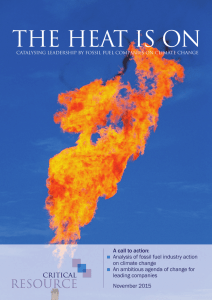
the heat is on
... ‘The Heat is On’ initiative What is the initiative about? Limiting the rise in global mean temperature to 2 °C above pre-industrial levels will imply significant changes both for fossil fuel industries and for economies that consume and produce fossil fuels. Meeting this target will result inevitab ...
... ‘The Heat is On’ initiative What is the initiative about? Limiting the rise in global mean temperature to 2 °C above pre-industrial levels will imply significant changes both for fossil fuel industries and for economies that consume and produce fossil fuels. Meeting this target will result inevitab ...


Crime, Weather, and Climate Change
... emissions scenarios such as A1FI and low emissions scenarios such as B1. This scenario represents a future world with high rates of economic growth and substantial convergence between developing and developed economies, where rapid technological change is based on a balance of fossil-fuel intensive ...
... emissions scenarios such as A1FI and low emissions scenarios such as B1. This scenario represents a future world with high rates of economic growth and substantial convergence between developing and developed economies, where rapid technological change is based on a balance of fossil-fuel intensive ...

Arctic Feedback Loops and Sea Ice Extent
... returns heat to space by thermal radiation. Most of the heat gain occurs in low latitudes, and this gain is balanced (on average) by heat loss that takes place at latitudes north and south of about 40 degrees. Therefore the Arctic is said to act as a "heat sink" for energy that is transported from l ...
... returns heat to space by thermal radiation. Most of the heat gain occurs in low latitudes, and this gain is balanced (on average) by heat loss that takes place at latitudes north and south of about 40 degrees. Therefore the Arctic is said to act as a "heat sink" for energy that is transported from l ...

Climate change and animal genetic resources for food and agriculture - State of knowledge, risks and opportunities
... on the genetic resources of domesticated avian and mammalian species that contribute to food production and agriculture. Climate change comes as an additional factor affecting a livestock sector that is already highly dynamic and facing many challenges. Important objectives of AnGR management includ ...
... on the genetic resources of domesticated avian and mammalian species that contribute to food production and agriculture. Climate change comes as an additional factor affecting a livestock sector that is already highly dynamic and facing many challenges. Important objectives of AnGR management includ ...

ARM_EU_clima_East_ProDoc
... Armenia is a small mountainous, landlocked country in the South Caucasus. Around 76.5% of Armenia’s territory is 1000-2500m above sea level. Armenia is a country of climate contradictions: even in small distances almost six climate patterns – from sub-tropical to frosty highlands - may be observed d ...
... Armenia is a small mountainous, landlocked country in the South Caucasus. Around 76.5% of Armenia’s territory is 1000-2500m above sea level. Armenia is a country of climate contradictions: even in small distances almost six climate patterns – from sub-tropical to frosty highlands - may be observed d ...
The Science of Geoengineering - Carnegie Department of Global
... Approaches that produce patchy influences on the climate system are deemed riskier than approaches capable of more uniformly distributed influences. ...
... Approaches that produce patchy influences on the climate system are deemed riskier than approaches capable of more uniformly distributed influences. ...

Gordon, et al (2005)
... Much interest has focused on the Amazon Basin. Currently, about 15% of the Brazilian Amazon has been deforested and converted to agricultural uses, with concomitant decreases in vapor f lows (Fig. 2). Model projections suggest that there is a critical threshold beyond which the reduction in rainfall ...
... Much interest has focused on the Amazon Basin. Currently, about 15% of the Brazilian Amazon has been deforested and converted to agricultural uses, with concomitant decreases in vapor f lows (Fig. 2). Model projections suggest that there is a critical threshold beyond which the reduction in rainfall ...

Ice Age DA - GDI - 2011
... doubt that the next little ice age would be much worse than the previous one and much more harmful than anything warming may do. There are many more people now and we have become dependent on a few temperate agricultural areas, especially in the US and Canada. Global warming would increase agricultu ...
... doubt that the next little ice age would be much worse than the previous one and much more harmful than anything warming may do. There are many more people now and we have become dependent on a few temperate agricultural areas, especially in the US and Canada. Global warming would increase agricultu ...

climate change in the african drylands
... continent we tend to be struck by one significant characteristic: much of it is dry. The wettest areas are located around the forest belts of West and Central Africa and a few highland areas. Outside those parts, Africa is largely covered by barren deserts, savannah, grassland, scrubland, woodlands ...
... continent we tend to be struck by one significant characteristic: much of it is dry. The wettest areas are located around the forest belts of West and Central Africa and a few highland areas. Outside those parts, Africa is largely covered by barren deserts, savannah, grassland, scrubland, woodlands ...
Recent pause in the growth rate of atmospheric CO2 associated with
... doubled1,5–8. The enhanced carbon sink has been attributed to increased ocean9 and terrestrial uptake1,6–8,10, and has occurred despite an increase in the severity and intensity of regional disruptions to ecosystems in recent years, such as extensive droughts, wildfires and insect damage11–14. On lan ...
... doubled1,5–8. The enhanced carbon sink has been attributed to increased ocean9 and terrestrial uptake1,6–8,10, and has occurred despite an increase in the severity and intensity of regional disruptions to ecosystems in recent years, such as extensive droughts, wildfires and insect damage11–14. On lan ...
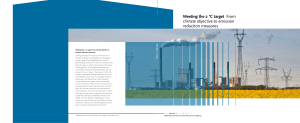
PBL rapport 500114012 Meeting the 2 degrees Celsius target
... less, are needed to keep a reasonable chance of staying below the 2 °C target. A 450 ppm CO2 eq level corresponds to about 20 to 70% probability of staying below this target, a 400 ppm CO2 eq level corresponds to a probability of between 40 and 90%. These concentration levels are consistent with CO2 ...
... less, are needed to keep a reasonable chance of staying below the 2 °C target. A 450 ppm CO2 eq level corresponds to about 20 to 70% probability of staying below this target, a 400 ppm CO2 eq level corresponds to a probability of between 40 and 90%. These concentration levels are consistent with CO2 ...

Brody Sandel - WordPress.com
... Sandel, B., Dalsgaard, B., Arge, L., Svenning, J.-C. 2011. Late Quaternary climatechange velocity: Implications for modern distributions and communities. Ecological Society of America, Annual Meeting, Austin, Texas. Sandel, B., Arge, L., Svenning, J.-C. 2011. Climate change velocity since the Last G ...
... Sandel, B., Dalsgaard, B., Arge, L., Svenning, J.-C. 2011. Late Quaternary climatechange velocity: Implications for modern distributions and communities. Ecological Society of America, Annual Meeting, Austin, Texas. Sandel, B., Arge, L., Svenning, J.-C. 2011. Climate change velocity since the Last G ...

Anthropogenic modification of the oceans
... While these correlations with regional climate indices are fully consistent with climate forcing phytoplankton through stratification, it is also the case that satellite datasets are probably not yet of sufficient duration to allow definitive separation of a global warming-associated trend from natural ...
... While these correlations with regional climate indices are fully consistent with climate forcing phytoplankton through stratification, it is also the case that satellite datasets are probably not yet of sufficient duration to allow definitive separation of a global warming-associated trend from natural ...

SNFI 2011 1 MHLM Solar Storms Neg Solar Storms Negative – 4
... Research Council” http://www.nap.edu/catalog/12507.html, 2008, accessed 7-21-11, ASR) La Porte acknowledged that the first response to the prospect of such technical and organizational disruptions is to try to learn to predict anomalies and extreme events, in short, to study space weather. But he ar ...
... Research Council” http://www.nap.edu/catalog/12507.html, 2008, accessed 7-21-11, ASR) La Porte acknowledged that the first response to the prospect of such technical and organizational disruptions is to try to learn to predict anomalies and extreme events, in short, to study space weather. But he ar ...

On Welfare Frameworks and Catastrophic Climate Risks
... that in some cases social evaluation of catastrophic risks is highly sensitive to the preferences of the most risk-averse members of society, even if they make up a vanishingly small fraction of the population. Thus, it is not a simple matter to reason from willingness to pay to avoid catastrophes a ...
... that in some cases social evaluation of catastrophic risks is highly sensitive to the preferences of the most risk-averse members of society, even if they make up a vanishingly small fraction of the population. Thus, it is not a simple matter to reason from willingness to pay to avoid catastrophes a ...

In the hot seat: Insolation, ENSO, and vegetation in the African tropics
... area index), NDVI saturates. In order to account for this, values above 0.7 or below 0.1 are not considered. Following the methods of Russell and Wallace [2004], 3 month mean values of NDVI fields were used to represent the seasonal mean vegetation and were regressed on time series of climatic variab ...
... area index), NDVI saturates. In order to account for this, values above 0.7 or below 0.1 are not considered. Following the methods of Russell and Wallace [2004], 3 month mean values of NDVI fields were used to represent the seasonal mean vegetation and were regressed on time series of climatic variab ...

ESPON Climate: Climate Change and Territorial Effects on Regions
... this area for domestic and international tourists. Therefore, climate change must necessarily be an issue of concern for the tourist sector and, more generally, for the well-being of the population. One of the most important challenges faced by Mediterranean societies during the last millennia is ho ...
... this area for domestic and international tourists. Therefore, climate change must necessarily be an issue of concern for the tourist sector and, more generally, for the well-being of the population. One of the most important challenges faced by Mediterranean societies during the last millennia is ho ...

Class 4 Autumn Spring Summer Term 1 Term 2 Term 3 Term 4 Term
... Understand the concept of change over time, representing this, along with evidence, on a time line. Use dates and terms to describe events. ...
... Understand the concept of change over time, representing this, along with evidence, on a time line. Use dates and terms to describe events. ...
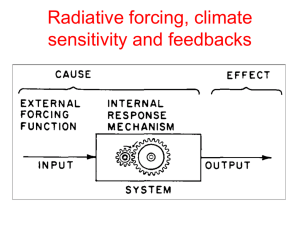
Radiative Forcing and Climate Feedbacks
... Radiative Forcing, Climate Sensitivity and Feedbacks Radiative forcing (RF) measures how strong a forcing perturbs the radiative energy balance of our climate system. A number of anthropogenic forcing have been identified and quantified. Their combined RF is a positive value and CO2 is the large ...
... Radiative Forcing, Climate Sensitivity and Feedbacks Radiative forcing (RF) measures how strong a forcing perturbs the radiative energy balance of our climate system. A number of anthropogenic forcing have been identified and quantified. Their combined RF is a positive value and CO2 is the large ...

NOTES AND CORRESPONDENCE Increasing Great Lake–Effect
... significant increases in lake-effect snow between 1951 and 1980. This finding confirmed the earlier work of Eichenlaub (1970) and Braham and Dungey (1984) who also noted increases in lake-effect snowfall. Norton and Bolsenga (1993) suggested that colder air masses flowing across the lakes were respo ...
... significant increases in lake-effect snow between 1951 and 1980. This finding confirmed the earlier work of Eichenlaub (1970) and Braham and Dungey (1984) who also noted increases in lake-effect snowfall. Norton and Bolsenga (1993) suggested that colder air masses flowing across the lakes were respo ...
Effects of global warming on Australia

Predictions measuring the effects of global warming on Australia assert that global warming will negatively impact the continent's environment, economy, and communities. Australia has been designated as one of the countries most vulnerable to climate change, according to the Stern report and others, due partially to the importance of its agricultural sector and the prominence of its coast.Australia is vulnerable to the effects of global warming projected for the next 50 to 100 years because of its extensive arid and semi-arid areas, high annual rainfall variability, and existing pressures on water supply. The continent's high fire risk increases this susceptibility to change in temperature and climate. Additionally, Australia's population is highly concentrated in coastal areas, and its important tourism industry depends on the health of the Great Barrier Reef and other fragile ecosystems. Impacts of climate change will be complex and to some degree uncertain, but increased foresight may enable the country to safeguard its future through planned mitigation and adaptation. Mitigation may reduce the ultimate extent of climate change and its impacts, but requires global solutions and cooperation, while adaptation can be performed at national and local levels.