
Dear Gary Johnson
... 1. The IPCC was established in 1988 by the World Meteorological Organization and the United Nations Environment Programme. 2. The IPCC provides policy makers with assessment of the current state of climate change. a. There are more than 150 participating countries. 3. The IPCC evaluates current rese ...
... 1. The IPCC was established in 1988 by the World Meteorological Organization and the United Nations Environment Programme. 2. The IPCC provides policy makers with assessment of the current state of climate change. a. There are more than 150 participating countries. 3. The IPCC evaluates current rese ...

Objectives and structure of the workshop
... Implications for economic development, food security and livelihoods Adaptations and policies to reduce threats and capitalise on opportunities ...
... Implications for economic development, food security and livelihoods Adaptations and policies to reduce threats and capitalise on opportunities ...

Modelling the interactions between climate change and rice
... Short periods of drought can cause large yield losses: Sorghum in Rajasthan ...
... Short periods of drought can cause large yield losses: Sorghum in Rajasthan ...

Global Warming is Unequivocal IPCC
... Declining Snow Pack in many mountain and continental areas contributes to drought • more precipitation falls as rain rather than snow, especially in the fall and spring. • snow melt occurs faster and sooner in the spring • snow pack is therefore less • soil moisture is less as summer arrives • the ...
... Declining Snow Pack in many mountain and continental areas contributes to drought • more precipitation falls as rain rather than snow, especially in the fall and spring. • snow melt occurs faster and sooner in the spring • snow pack is therefore less • soil moisture is less as summer arrives • the ...

End-of-Program Review 2011-12
... articles document disproportionate vulnerability and suffering of low-resource populations to climate change... ...
... articles document disproportionate vulnerability and suffering of low-resource populations to climate change... ...

Germany
... supported by the federal Ministry of Education and Research (BMBF) and operated by the GKSS Research Center in Geesthacht (Helmholtz ...
... supported by the federal Ministry of Education and Research (BMBF) and operated by the GKSS Research Center in Geesthacht (Helmholtz ...

Environmental Issues - Ana Lilia Acosta Patoni
... 2008. Destructive sudden heavy rains, intense tropical storms, repeated flooding and droughts are likely to increase, as will the vulnerability of local communities in the absence of strong concerted action." (OCHA) "Climate change is not just a distant future threat. It is the main driver behind ri ...
... 2008. Destructive sudden heavy rains, intense tropical storms, repeated flooding and droughts are likely to increase, as will the vulnerability of local communities in the absence of strong concerted action." (OCHA) "Climate change is not just a distant future threat. It is the main driver behind ri ...

2009-08-05-presentation
... changes in the Sun's output cannot be causing modern-day climate change. It shows that for the last 20 years, the Sun's output has declined, yet temperatures on Earth have risen.” Writing in the Royal Society's journal Proceedings A, the researchers say cosmic rays may have affected climate in the p ...
... changes in the Sun's output cannot be causing modern-day climate change. It shows that for the last 20 years, the Sun's output has declined, yet temperatures on Earth have risen.” Writing in the Royal Society's journal Proceedings A, the researchers say cosmic rays may have affected climate in the p ...

Environment and Security Initiative
... Vulnerability of mountain ecosystems to climate change Concrete adaptation experiences (sub-national/local level) Experiences from other regions (e.g. Alps, Carpathians, Central Asia) Climate change adaptation policies and strategies; Policy gap analysis; Priority areas for future action (government ...
... Vulnerability of mountain ecosystems to climate change Concrete adaptation experiences (sub-national/local level) Experiences from other regions (e.g. Alps, Carpathians, Central Asia) Climate change adaptation policies and strategies; Policy gap analysis; Priority areas for future action (government ...


Project Overview
... probabilities of both heavy rainfall and drought have increased. Rising sea levels in all of North America. Global sea levels continue to rise, causing flooding and coastal erosion (IPCC 2007). ...
... probabilities of both heavy rainfall and drought have increased. Rising sea levels in all of North America. Global sea levels continue to rise, causing flooding and coastal erosion (IPCC 2007). ...

Impact of Climate Change on Alaska Native Communities
... noticed that in the last 10 years that it doesn’t freeze across like it used to. The temperatures are warmer. The lakes are drying up. Over the last 2 years, the water has been low in June affecting the fish run. Sockeyes are much smaller and so are hatchery fish. ...
... noticed that in the last 10 years that it doesn’t freeze across like it used to. The temperatures are warmer. The lakes are drying up. Over the last 2 years, the water has been low in June affecting the fish run. Sockeyes are much smaller and so are hatchery fish. ...

Climate Change and Security Threats, Opportunities and
... Security Implications Plausible – But certain? Security consequences from climate change are plausible, but questions remaining are: When, where and what to expect and hopefully predict? ...
... Security Implications Plausible – But certain? Security consequences from climate change are plausible, but questions remaining are: When, where and what to expect and hopefully predict? ...

Regionalkonferenz der Metropolregion Hamburg
... • One construction is scientific, i.e. the analysis of an „objective“ analysis of observations and interpretation by theories. • The other construction is cultural, in particular maintained and transformed by the public media. • Climate science is in a post-normal phase (where interest-led utility i ...
... • One construction is scientific, i.e. the analysis of an „objective“ analysis of observations and interpretation by theories. • The other construction is cultural, in particular maintained and transformed by the public media. • Climate science is in a post-normal phase (where interest-led utility i ...
Climate Change Impacts - Pacific Islands
... - Pacific Islands The IPCC 4th assessment report identifies small island states as being the most vulnerable countries of the world to the adverse impacts of climate change. The Pacific is in fact without a doubt one of the world’s most vulnerable regions when it comes to risk of disaster due to cli ...
... - Pacific Islands The IPCC 4th assessment report identifies small island states as being the most vulnerable countries of the world to the adverse impacts of climate change. The Pacific is in fact without a doubt one of the world’s most vulnerable regions when it comes to risk of disaster due to cli ...
DavidWarrilow_UKApproach_AAAS_021304
... • Direct effects on human society (e.g. water resources, food security, health, land degradation and loss, economic activity) ...
... • Direct effects on human society (e.g. water resources, food security, health, land degradation and loss, economic activity) ...
DavidWarrilow_UKApproach_AAAS_021304
... • Direct effects on human society (e.g. water resources, food security, health, land degradation and loss, economic activity) ...
... • Direct effects on human society (e.g. water resources, food security, health, land degradation and loss, economic activity) ...
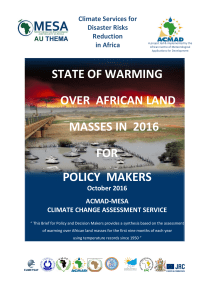
STATE OF WARMING OVER AFRICAN LAND MASSES IN 2016
... Africa. With the pre-industrial era as reference period, the warming level during the last 9 months of 2016 over African land masses reached +2 degrees Celsius. The global average warming for 2016 is less than +1 degree Celsius. Therefore, Africa is warming faster with levels close to twice the glob ...
... Africa. With the pre-industrial era as reference period, the warming level during the last 9 months of 2016 over African land masses reached +2 degrees Celsius. The global average warming for 2016 is less than +1 degree Celsius. Therefore, Africa is warming faster with levels close to twice the glob ...
Climate Change – Can science teachers play a part
... • Never before has the actual science been so important in the debate… • …because people need good reasons to change their behaviour – not just scientific ‘say-so’. ...
... • Never before has the actual science been so important in the debate… • …because people need good reasons to change their behaviour – not just scientific ‘say-so’. ...
Proxy Climate Data
... Last Glacial Maximum = 21,000 ybp (maximum North American continental glaciers, lower sea level exposed Bering land bridge allowing human migration from Asia to North America) ...
... Last Glacial Maximum = 21,000 ybp (maximum North American continental glaciers, lower sea level exposed Bering land bridge allowing human migration from Asia to North America) ...

New Scientist Sept 13, 2003
... some worry that it could detract from protecting the environment. But Mike Hulme, director of the Tyndall Centre for Climate Change Research in Norwich, UK, is one of those who argue that decisions made now will affect us for decades to come as temperatures rise. Changes to the climate affect all ar ...
... some worry that it could detract from protecting the environment. But Mike Hulme, director of the Tyndall Centre for Climate Change Research in Norwich, UK, is one of those who argue that decisions made now will affect us for decades to come as temperatures rise. Changes to the climate affect all ar ...

presentation
... Dan Cayan Scripps Institution of Oceanography, Climate Research Division, UCSD and ...
... Dan Cayan Scripps Institution of Oceanography, Climate Research Division, UCSD and ...
Climate Change
... different surfaces have different level of reflectivity Ice reflects more light than other substances Snow reflects 95% of radiation The water under the ice can absorb large amounts of heat energy, which could increase temp of water and cause more melting ...
... different surfaces have different level of reflectivity Ice reflects more light than other substances Snow reflects 95% of radiation The water under the ice can absorb large amounts of heat energy, which could increase temp of water and cause more melting ...
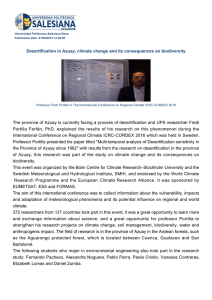
Desertification in Azuay, climate change and its consequences on
... The aim of this international conference was to collect information about the vulnerability, impacts and adaptation of meteorological phenomena and its potential influence on regional and world climate. 372 researchers from 127 countries took part in this event; it was a great opportunity to learn m ...
... The aim of this international conference was to collect information about the vulnerability, impacts and adaptation of meteorological phenomena and its potential influence on regional and world climate. 372 researchers from 127 countries took part in this event; it was a great opportunity to learn m ...
Effects of global warming on humans

Climate change has brought about possibly permanent alterations to our planet’s geological, biological and ecological systems. The Intergovernmental Panel on Climate Change (IPCC) contended in 2003 that “there is new and stronger evidence that most of the warming observed over the last 50 years is attributable to human activities”. These changes have led to the emergence of large-scale environmental hazards to human health, such as extreme weather, ozone depletion, increased danger of wildland fires, loss of biodiversity, stresses to food-producing systems and the global spread of infectious diseases. The World Health Organization (WHO) estimates that 160,000 deaths, since 1950, are directly attributable to climate change. Many believe this to be a conservative estimate.To date, a neglected aspect of the climate change debate, much less research has been conducted on the impacts of climate change on health, food supply, economic growth, migration, security, societal change, and public goods, such as drinking water, than on the geophysical changes related to global warming. Human impacts can be both negative and positive. Climatic changes in Siberia, for instance, are expected to improve food production and local economic activity, at least in the short to medium term. Numerous studies suggest, however, that the current and future impacts of climate change on human society are and will continue to be overwhelmingly negative.The majority of the adverse effects of climate change are experienced by poor and low-income communities around the world, who have much higher levels of vulnerability to environmental determinants of health, wealth and other factors, and much lower levels of capacity available for coping with environmental change. A report on the global human impact of climate change published by the Global Humanitarian Forum in 2009, estimated more than 300,000 deaths and about $125 billion in economic losses each year, and indicating that most climate change induced mortality is due to worsening floods and droughts in developing countries. This also raises questions of climate justice, since the 50 least developed countries of the world account for not more than 1% of worldwide emissions of greenhouse gases.