
Forcing of anthropogenic aerosols on temperature trends of the sub
... the pre-1990s IO sub-thermocline cooling is most likely due to climate change and not natural variability; ii. the models show a slowdown in the cooling trend during the 1990s; and iii. simulate a rapid warming after 2020, that lags observational estimates by approximately 30 years. The role of exte ...
... the pre-1990s IO sub-thermocline cooling is most likely due to climate change and not natural variability; ii. the models show a slowdown in the cooling trend during the 1990s; and iii. simulate a rapid warming after 2020, that lags observational estimates by approximately 30 years. The role of exte ...

Jul 16, 2016 - Science and Environmental Policy Project
... possible greenhouse warming, evaluation of computer models of climate change, and for understanding important factors in the climate system.” For their achievement, the Spencer-Christy team was awarded NASA's Medal for Exceptional Scientific Achievement in 1991 and a Special Award by the American Me ...
... possible greenhouse warming, evaluation of computer models of climate change, and for understanding important factors in the climate system.” For their achievement, the Spencer-Christy team was awarded NASA's Medal for Exceptional Scientific Achievement in 1991 and a Special Award by the American Me ...

Uncertainties in CMIP5 Climate Projections due to Carbon Cycle
... been run by earth system models with prescribed CO2 emissions. This paper analyzes the climate projections of 11 earth system models (ESMs) that performed both emission-driven and concentration-driven RCP8.5 simulations. When forced by RCP8.5 CO2 emissions, models simulate a large spread in atmosphe ...
... been run by earth system models with prescribed CO2 emissions. This paper analyzes the climate projections of 11 earth system models (ESMs) that performed both emission-driven and concentration-driven RCP8.5 simulations. When forced by RCP8.5 CO2 emissions, models simulate a large spread in atmosphe ...
Climate Change Act 2017
... There is overwhelming scientific consensus that human activity is causing climate change and that global emissions will need to decline to net zero levels by the second half of the century if this global goal is to be met. The Parliament of Victoria recognises that some changes in the earth's climat ...
... There is overwhelming scientific consensus that human activity is causing climate change and that global emissions will need to decline to net zero levels by the second half of the century if this global goal is to be met. The Parliament of Victoria recognises that some changes in the earth's climat ...

Drought in the Sahel - Lund University Publications
... mismanagement of the land by the local people, leading to land degradation and desertification. However, with an improvement in modelling it has been revealed that the droughts can mainly be attributed to changes in the sea surface temperatures (SSTs). A warming of the Indian and the Pacific as well ...
... mismanagement of the land by the local people, leading to land degradation and desertification. However, with an improvement in modelling it has been revealed that the droughts can mainly be attributed to changes in the sea surface temperatures (SSTs). A warming of the Indian and the Pacific as well ...

Climate Adaptation Plan 2014
... percent per capita below 1990 levels. Denver is on track to meet this goal and continues to be proactive in reducing city-wide per capita emissions. However, the planet is warming and the resulting effects have the potential to harm Denver’s social, economic, and environmental sectors. Along with mi ...
... percent per capita below 1990 levels. Denver is on track to meet this goal and continues to be proactive in reducing city-wide per capita emissions. However, the planet is warming and the resulting effects have the potential to harm Denver’s social, economic, and environmental sectors. Along with mi ...

Climate Change Adaptation Manual
... species spreading more slowly than would be expected from climate change alone. ■■ Warmer springs in recent decades have caused a trend towards many biological events (eg flowering, budburst, laying and hatching of eggs) occurring earlier in the year. The rates of change vary among species, which ma ...
... species spreading more slowly than would be expected from climate change alone. ■■ Warmer springs in recent decades have caused a trend towards many biological events (eg flowering, budburst, laying and hatching of eggs) occurring earlier in the year. The rates of change vary among species, which ma ...

From Kyoto to Copenhagen - Law, Environment and Development
... nations for supporting the climate change regime. Leaving the markets out of a climate change regime could therefore mean leaving many developed countries out, as most of them might be unwilling to support a regime that is not cost saving or flexible. Similarly, because of the nature of GHG emission ...
... nations for supporting the climate change regime. Leaving the markets out of a climate change regime could therefore mean leaving many developed countries out, as most of them might be unwilling to support a regime that is not cost saving or flexible. Similarly, because of the nature of GHG emission ...
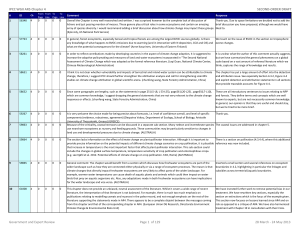
IPCC WGII AR5 Chapter 4 SECOND
... The section lacks information on the effect of climate change on plant-pollinator interaction. Although it is important to There is a section on pollination (4.3.4.4), where this additional provide precise information on the potential impacts of different climate change scenarios on crop pollination ...
... The section lacks information on the effect of climate change on plant-pollinator interaction. Although it is important to There is a section on pollination (4.3.4.4), where this additional provide precise information on the potential impacts of different climate change scenarios on crop pollination ...

Read the RSP-0276 Final Report
... mechanisms (Lowe and Walker 1997; Maslin et al., 2007). External forcing mechanisms (e.g., tectonic activities, see Figure 2.1, orbital forcing) are those which are outside the climate system; variations in solar energy are an example of external forcing (Lowe and Walker 1997). On the other hand, in ...
... mechanisms (Lowe and Walker 1997; Maslin et al., 2007). External forcing mechanisms (e.g., tectonic activities, see Figure 2.1, orbital forcing) are those which are outside the climate system; variations in solar energy are an example of external forcing (Lowe and Walker 1997). On the other hand, in ...
Climate Change Reporting Framework
... governance may be found at www.cdsb.net/ governance. CDSB seeks to standardise climate changerelated information reporting through collaboration and by identifying and coalescing around the most widely shared and tested ...
... governance may be found at www.cdsb.net/ governance. CDSB seeks to standardise climate changerelated information reporting through collaboration and by identifying and coalescing around the most widely shared and tested ...

Climate challenge – the safety`s off
... storms and floods – these are consequences of climate change that can entail direct risks and health effects for people. Indirect health effects might include increased problems for individuals with pollen allergies, as well as the increased spread of infectious diseases, both via insects and animal ...
... storms and floods – these are consequences of climate change that can entail direct risks and health effects for people. Indirect health effects might include increased problems for individuals with pollen allergies, as well as the increased spread of infectious diseases, both via insects and animal ...

Carbon-climate coupling in the Northern High Latitudes
... IPCC 2007). Most of these studies show a positive feedback to the climate system. That is, under a warmer scenario, ecosystems will further reduce their capacity to absorb anthropogenic emissions, leading to more CO2 being retained in the atmosphere and an acceleration of global warming. However, qu ...
... IPCC 2007). Most of these studies show a positive feedback to the climate system. That is, under a warmer scenario, ecosystems will further reduce their capacity to absorb anthropogenic emissions, leading to more CO2 being retained in the atmosphere and an acceleration of global warming. However, qu ...
Climate Change Act 2017 - Victorian Legislation and Parliamentary
... There is overwhelming scientific consensus that human activity is causing climate change and that global emissions will need to decline to net zero levels by the second half of the century if this global goal is to be met. The Parliament of Victoria recognises that some changes in the earth's climat ...
... There is overwhelming scientific consensus that human activity is causing climate change and that global emissions will need to decline to net zero levels by the second half of the century if this global goal is to be met. The Parliament of Victoria recognises that some changes in the earth's climat ...
South Africa`s Second National Communication under the
... made in this regard, significant development challenges remain. There is high social inequality in the population of about 50 million people, revealed by a Gini coefficient of between 0.66 and 0.69; and several poverty and human development indices emphasise this. These disparities, together with a ...
... made in this regard, significant development challenges remain. There is high social inequality in the population of about 50 million people, revealed by a Gini coefficient of between 0.66 and 0.69; and several poverty and human development indices emphasise this. These disparities, together with a ...

Accommodating Climate Change Science
... their claims about the value of the scientific discoveries they pass along. They cannot rely on the audience to recognize the significance of information” (ibid., 333–334). The second general observation Fahnestock makes about accommodated rhetoric has to do with the taxonomy of “statement types” in t ...
... their claims about the value of the scientific discoveries they pass along. They cannot rely on the audience to recognize the significance of information” (ibid., 333–334). The second general observation Fahnestock makes about accommodated rhetoric has to do with the taxonomy of “statement types” in t ...
Societal Adaptation to Abrupt Climate Change and Monsoon
... that such oscillations have occurred in the past and may occur in future, potentially with large impacts on society, economy and ecosystems. There is evidence to show that gradual and smooth climate changes in the Earth’s history were interspersed with abrupt climate changes such as rapid cooling, w ...
... that such oscillations have occurred in the past and may occur in future, potentially with large impacts on society, economy and ecosystems. There is evidence to show that gradual and smooth climate changes in the Earth’s history were interspersed with abrupt climate changes such as rapid cooling, w ...

Climate Change and the Resilience of New Orleans
... Human populations worldwide continue to populate coastal areas that are vulnerable to the near and long-term effects of climate change. New Orleans, Louisiana, USA, is like many historic deltaic cities around the world, a place sited on vulnerable ground that exploited the interface of land and wate ...
... Human populations worldwide continue to populate coastal areas that are vulnerable to the near and long-term effects of climate change. New Orleans, Louisiana, USA, is like many historic deltaic cities around the world, a place sited on vulnerable ground that exploited the interface of land and wate ...

Center for Economic and Policy Studies Rethinking Environmental
... nature of social relations, which in turn affect the path of emissions. We argue that the division of authority in a federal state has a very large effect on what national policies can and should be implemented. The transmission of incentives within a federal system will determine whether all levels ...
... nature of social relations, which in turn affect the path of emissions. We argue that the division of authority in a federal state has a very large effect on what national policies can and should be implemented. The transmission of incentives within a federal system will determine whether all levels ...

Middle Receptor - Eldorado
... the less likelihood of thermal stress (Source: Baker and Standeven, 1995, cited in Roaf et al. 2009) 39 Figure 7: Analysis and Conclusion workflow ____________________________________________________________ 49 Figure ...
... the less likelihood of thermal stress (Source: Baker and Standeven, 1995, cited in Roaf et al. 2009) 39 Figure 7: Analysis and Conclusion workflow ____________________________________________________________ 49 Figure ...

climate change - Saskatchewan.ca
... In the last decade, global temperatures have been higher 75 percent of the time when compared to the last 11,300 years. The global concentration of carbon dioxide in the atmosphere has reached 400 parts per million. This is the highest rate in recorded history. Carbon and water cycle scientists like ...
... In the last decade, global temperatures have been higher 75 percent of the time when compared to the last 11,300 years. The global concentration of carbon dioxide in the atmosphere has reached 400 parts per million. This is the highest rate in recorded history. Carbon and water cycle scientists like ...

International Conference on Climate and Environment Change
... about 12% of the potential are harnessed. Socioeconomic development of the countries sharing the basin therefore largely depends on optimal utilisation and prudent management of the precious water resources of the Indus River basin. High rates of population increase in the region and associated soci ...
... about 12% of the potential are harnessed. Socioeconomic development of the countries sharing the basin therefore largely depends on optimal utilisation and prudent management of the precious water resources of the Indus River basin. High rates of population increase in the region and associated soci ...
Climate change, crop yields, and internal migration in the United
... in rural agricultural areas of the Corn Belt. We focus on the agricultural linkage because, unlike sudden events such as hurricanes and flooding, changes in agricultural productivity are expected to have an enduring effect on the geographic distribution of the U.S. population. We utilize an instrume ...
... in rural agricultural areas of the Corn Belt. We focus on the agricultural linkage because, unlike sudden events such as hurricanes and flooding, changes in agricultural productivity are expected to have an enduring effect on the geographic distribution of the U.S. population. We utilize an instrume ...

GWP SAS - Global Water Partnership
... Compilation of WACREP Phase I report Water and Climate Resilient Programme (WACREP) is an initiative of GWP SAS formulated to improve the climate resilience of South Asian countries. With the completion of WACREP Phase I in March 2015, the achievements were documented in one report. - Single docume ...
... Compilation of WACREP Phase I report Water and Climate Resilient Programme (WACREP) is an initiative of GWP SAS formulated to improve the climate resilience of South Asian countries. With the completion of WACREP Phase I in March 2015, the achievements were documented in one report. - Single docume ...

Institutions for Climate Adaptation: An are Relevant for Climate Change
... 2.2.2 EU Green & White Paper on adaptation What kind of document is it: subject, author, audience? On 29 June 2007 European member states adopted the Green Paper on Adaptation (Adapting to climate change in Europe - options for EU action). The Green Paper identifies the most important climate risks ...
... 2.2.2 EU Green & White Paper on adaptation What kind of document is it: subject, author, audience? On 29 June 2007 European member states adopted the Green Paper on Adaptation (Adapting to climate change in Europe - options for EU action). The Green Paper identifies the most important climate risks ...
Effects of global warming on humans

Climate change has brought about possibly permanent alterations to our planet’s geological, biological and ecological systems. The Intergovernmental Panel on Climate Change (IPCC) contended in 2003 that “there is new and stronger evidence that most of the warming observed over the last 50 years is attributable to human activities”. These changes have led to the emergence of large-scale environmental hazards to human health, such as extreme weather, ozone depletion, increased danger of wildland fires, loss of biodiversity, stresses to food-producing systems and the global spread of infectious diseases. The World Health Organization (WHO) estimates that 160,000 deaths, since 1950, are directly attributable to climate change. Many believe this to be a conservative estimate.To date, a neglected aspect of the climate change debate, much less research has been conducted on the impacts of climate change on health, food supply, economic growth, migration, security, societal change, and public goods, such as drinking water, than on the geophysical changes related to global warming. Human impacts can be both negative and positive. Climatic changes in Siberia, for instance, are expected to improve food production and local economic activity, at least in the short to medium term. Numerous studies suggest, however, that the current and future impacts of climate change on human society are and will continue to be overwhelmingly negative.The majority of the adverse effects of climate change are experienced by poor and low-income communities around the world, who have much higher levels of vulnerability to environmental determinants of health, wealth and other factors, and much lower levels of capacity available for coping with environmental change. A report on the global human impact of climate change published by the Global Humanitarian Forum in 2009, estimated more than 300,000 deaths and about $125 billion in economic losses each year, and indicating that most climate change induced mortality is due to worsening floods and droughts in developing countries. This also raises questions of climate justice, since the 50 least developed countries of the world account for not more than 1% of worldwide emissions of greenhouse gases.