
Warming up to Global Warming - Laboratory for Atmospheric and
... animals can adapt. Reality: The projected rate of climate change is more rapid than any that has occurred in the last 10,000 years and may overwhelm the ability of plants and animals to adapt. Global average temperatures are projected to rise by 2.5–10.4°F over the next century. Even a small increas ...
... animals can adapt. Reality: The projected rate of climate change is more rapid than any that has occurred in the last 10,000 years and may overwhelm the ability of plants and animals to adapt. Global average temperatures are projected to rise by 2.5–10.4°F over the next century. Even a small increas ...

Some thoughts on a strategy for adaptation to
... be possible only at very high, perhaps prohibitive costs. There may thus be situations where adaptation measures would have only limited effect (e.g., Stern notes this in the case of protecting natural ecological systems). In thinking today about the agenda for adaptation, particularly by the public ...
... be possible only at very high, perhaps prohibitive costs. There may thus be situations where adaptation measures would have only limited effect (e.g., Stern notes this in the case of protecting natural ecological systems). In thinking today about the agenda for adaptation, particularly by the public ...

UN CLimate Change Conference, Bali Indonesia - VUFO
... 16,000 tCO2. This was pushed by African countries • But still many obstacles to ARCDM projects: – High risk for buyers ...
... 16,000 tCO2. This was pushed by African countries • But still many obstacles to ARCDM projects: – High risk for buyers ...

PDF
... different disaster dimensions, namely hazard, exposure and vulnerability. Population and wealth expansion are used to normalize damages in previous years. The normalization sheds some light on how destructive a past disaster is if it occurs today. Such a treatment allows us to compare damages across ...
... different disaster dimensions, namely hazard, exposure and vulnerability. Population and wealth expansion are used to normalize damages in previous years. The normalization sheds some light on how destructive a past disaster is if it occurs today. Such a treatment allows us to compare damages across ...

Hotte, Martin - Transportation Association of Canada
... temperature has increased by 0.6° C, which represents one of the fastest temperature increases that our planet has ever experienced. We now know that the major part of this temperature increase is primarily due to human activities and not solely planetary cycles. According to the last report of the ...
... temperature has increased by 0.6° C, which represents one of the fastest temperature increases that our planet has ever experienced. We now know that the major part of this temperature increase is primarily due to human activities and not solely planetary cycles. According to the last report of the ...

Physical Climatology
... impact due to climate change, or global warming, by studying the feedbacks of water vapor, clouds, surface albedo, soil moisture, vegetation as well as ocean-atmosphere interactions. Studies have generally given negative feedbacks when focusing on the potential impacts on water resources by global w ...
... impact due to climate change, or global warming, by studying the feedbacks of water vapor, clouds, surface albedo, soil moisture, vegetation as well as ocean-atmosphere interactions. Studies have generally given negative feedbacks when focusing on the potential impacts on water resources by global w ...

Land Desertification and Degradation Research Highlights
... Colorado Water Institute Colorado State University hosts the state-supported Colorado Water Institute, which addresses important issues related to Colorado’s water supply and growth, water quality issues, water policies, water rights and impacts of new water facilities on resources and the environme ...
... Colorado Water Institute Colorado State University hosts the state-supported Colorado Water Institute, which addresses important issues related to Colorado’s water supply and growth, water quality issues, water policies, water rights and impacts of new water facilities on resources and the environme ...

Experts for coo ange impacts on Indus
... Experts for coop to address climate change impacts on Indus MONITORING REPORT ISB: Experts at an international conference have emphasized for greater collaboration between various actors and initiatives to understand and mitigate the impacts of climate change in the Indus River Basin. They also said ...
... Experts for coop to address climate change impacts on Indus MONITORING REPORT ISB: Experts at an international conference have emphasized for greater collaboration between various actors and initiatives to understand and mitigate the impacts of climate change in the Indus River Basin. They also said ...


Barriers to Effective Climate Change Adaptation
... governments. Currently, there is no forum to consider the collective cost of climate change on society across all sectors to ensure least cost adaptation responses. WSAA proposes water utilities should be included in any such forum or coordination mechanism. WSAA supports this recommendation. Across ...
... governments. Currently, there is no forum to consider the collective cost of climate change on society across all sectors to ensure least cost adaptation responses. WSAA proposes water utilities should be included in any such forum or coordination mechanism. WSAA supports this recommendation. Across ...

Global Circulation Models – the basis for climate change science
... Most GCMs show a slowing of the Atlantic Thermohaline Circulation as the world heats up. However, some show the circulation stopping entirely as heating reaches a threshold value. (Manabe and Stouffer, 1988). Sea ice melting may be accelerated by feedback mechanisms. Sea level rise may destabilise l ...
... Most GCMs show a slowing of the Atlantic Thermohaline Circulation as the world heats up. However, some show the circulation stopping entirely as heating reaches a threshold value. (Manabe and Stouffer, 1988). Sea ice melting may be accelerated by feedback mechanisms. Sea level rise may destabilise l ...

Have disaster losses increased due to anthropogenic climate change?
... since the 1970s for hurricane losses (Schmidt et al. 2009), thunderstorm losses (Changnon 2001), and since the 1980s for flash flood losses (Fengqing et al. 2005), are likely related to the large natural variability shown by the weather hazards. For hurricane losses in the USA it is well establishe ...
... since the 1970s for hurricane losses (Schmidt et al. 2009), thunderstorm losses (Changnon 2001), and since the 1980s for flash flood losses (Fengqing et al. 2005), are likely related to the large natural variability shown by the weather hazards. For hurricane losses in the USA it is well establishe ...

Summary of Proceedings Conference on CLIMATE CHANGE AND ITS IMPLICATIONS
... amounts will change in the future. Differences in use according to region have to do with population density and the mix of fuels that each economy uses. The United States is the biggest user, followed by the European Union, but this is because the U.S. simply has more available space; it is thus p ...
... amounts will change in the future. Differences in use according to region have to do with population density and the mix of fuels that each economy uses. The United States is the biggest user, followed by the European Union, but this is because the U.S. simply has more available space; it is thus p ...
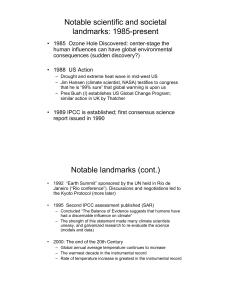
Notable scientific and societal landmarks: 1985
... Interior Greenland and Antarctica are accumulating more snow in the high interior where it is always well below freezing. This is expected as the earth warms: higher temperature -> more water vapor -> more snow These ice sheets are losing mass on the edges, where ice is flowing faster into the ocean ...
... Interior Greenland and Antarctica are accumulating more snow in the high interior where it is always well below freezing. This is expected as the earth warms: higher temperature -> more water vapor -> more snow These ice sheets are losing mass on the edges, where ice is flowing faster into the ocean ...

Climate Change, Heat Waves, and Adaptation NH-12
... in U.S. urban centers more than a decade ago (e.g., Davis et al., 2003). We identified apparent temperature thresholds in 28 major cities across the country and tracked the daily mortality excess that occurred on days exceeding that threshold during the period 1964 through 1998. ...
... in U.S. urban centers more than a decade ago (e.g., Davis et al., 2003). We identified apparent temperature thresholds in 28 major cities across the country and tracked the daily mortality excess that occurred on days exceeding that threshold during the period 1964 through 1998. ...

Climate change will make food less nutritious: Study
... points at the need for food production to already double by 2050 in order to meet the demand of rising populations. And while some of the varieties used in the research performed better than others, breeding programmes focused on these traits 'will not be a panacea for many reasons including the aff ...
... points at the need for food production to already double by 2050 in order to meet the demand of rising populations. And while some of the varieties used in the research performed better than others, breeding programmes focused on these traits 'will not be a panacea for many reasons including the aff ...

myclimate – a user perspective on the carbon market
... under “common but differentiated responsibility” this means that developed countries must reduce their emissions even more than that ...
... under “common but differentiated responsibility” this means that developed countries must reduce their emissions even more than that ...

IOSR Journal Of Environmental Science, Toxicology And Food Technology (IOSR-JESTFT)
... issues at the global level, has been historic in realizing and accepting the very fact that man has built a suicidal living system out of this world, that man is responsible for this environmental imbalance. The earth is stricken by a fever-that of Global Warming, and the cause of the fever is human ...
... issues at the global level, has been historic in realizing and accepting the very fact that man has built a suicidal living system out of this world, that man is responsible for this environmental imbalance. The earth is stricken by a fever-that of Global Warming, and the cause of the fever is human ...

Tennessee and Climate Change
... Changing weather patterns in Africa and Asia are creating new instability – potentially leading to new wars over resources. Extreme weather, like typhoons in Asia or hurricanes here are placing increasing demands on our armed forces to respond. Fortunately, Tennessee is poised to help lead the count ...
... Changing weather patterns in Africa and Asia are creating new instability – potentially leading to new wars over resources. Extreme weather, like typhoons in Asia or hurricanes here are placing increasing demands on our armed forces to respond. Fortunately, Tennessee is poised to help lead the count ...

Effects of Climate Change on Lakes
... warming each year. This differential effect is not apparent in tropical lakes that lack winter ice cover, and such waters appear to be more closely tracking the regional trend in air temperatures. At high latitudes, increased warming may lead to a complete change in the stratification and mixing reg ...
... warming each year. This differential effect is not apparent in tropical lakes that lack winter ice cover, and such waters appear to be more closely tracking the regional trend in air temperatures. At high latitudes, increased warming may lead to a complete change in the stratification and mixing reg ...

Climate forcing
... dealt with methods or paleoclimate, taking no position on current anthropogenic climate change. Remarkably, none of the papers disagreed with the consensus position. [Naomi Oreskes, UCSD, Science 2004.] ...
... dealt with methods or paleoclimate, taking no position on current anthropogenic climate change. Remarkably, none of the papers disagreed with the consensus position. [Naomi Oreskes, UCSD, Science 2004.] ...

Ocean iron fertilisation
... because it dissolves in seawater and it’s an industrial by-product, so it’s not too difficult to obtain. Their results validated the first part of Martin’s hypothesis. Increasing the iron concentration in the fertilized areas created phytoplankton blooms visible by satellite. This phytoplankton grow ...
... because it dissolves in seawater and it’s an industrial by-product, so it’s not too difficult to obtain. Their results validated the first part of Martin’s hypothesis. Increasing the iron concentration in the fertilized areas created phytoplankton blooms visible by satellite. This phytoplankton grow ...

Seven billion and 31 gigatons
... First, articulating a close and direct relationship between population growth and greenhouse gas emissions may lead countries which are under pressure to reduce their emissions to what they think is a “simple” solution: reducing their rates of population growth. And if done without regard for indivi ...
... First, articulating a close and direct relationship between population growth and greenhouse gas emissions may lead countries which are under pressure to reduce their emissions to what they think is a “simple” solution: reducing their rates of population growth. And if done without regard for indivi ...

IMPACTS OF LAND USE/LAND COVER CHANGE ON CLIMATE AND FUTURE RESEARCH PRIORITIES
... funnels), and human errors (e.g., improper recording of the timing and/or amount of precipitation) also contribute to errors in precipitation gauge measurement. There is evidence that local LULCC can change the bias in precipitation gauge measurement, which can induce a spurious trend or mask an exi ...
... funnels), and human errors (e.g., improper recording of the timing and/or amount of precipitation) also contribute to errors in precipitation gauge measurement. There is evidence that local LULCC can change the bias in precipitation gauge measurement, which can induce a spurious trend or mask an exi ...

When It Rains, It Pours: Future Climate Extremes and Health
... health (e.g., stress on food and water supplies). 4. Areas at risk from concurrent environmental or socioeconomic stresses and with little capacity to adapt. Earth system changes have direct and indirect implications for human health. The sections that follow address major categories of anticipated ...
... health (e.g., stress on food and water supplies). 4. Areas at risk from concurrent environmental or socioeconomic stresses and with little capacity to adapt. Earth system changes have direct and indirect implications for human health. The sections that follow address major categories of anticipated ...
Effects of global warming on humans

Climate change has brought about possibly permanent alterations to our planet’s geological, biological and ecological systems. The Intergovernmental Panel on Climate Change (IPCC) contended in 2003 that “there is new and stronger evidence that most of the warming observed over the last 50 years is attributable to human activities”. These changes have led to the emergence of large-scale environmental hazards to human health, such as extreme weather, ozone depletion, increased danger of wildland fires, loss of biodiversity, stresses to food-producing systems and the global spread of infectious diseases. The World Health Organization (WHO) estimates that 160,000 deaths, since 1950, are directly attributable to climate change. Many believe this to be a conservative estimate.To date, a neglected aspect of the climate change debate, much less research has been conducted on the impacts of climate change on health, food supply, economic growth, migration, security, societal change, and public goods, such as drinking water, than on the geophysical changes related to global warming. Human impacts can be both negative and positive. Climatic changes in Siberia, for instance, are expected to improve food production and local economic activity, at least in the short to medium term. Numerous studies suggest, however, that the current and future impacts of climate change on human society are and will continue to be overwhelmingly negative.The majority of the adverse effects of climate change are experienced by poor and low-income communities around the world, who have much higher levels of vulnerability to environmental determinants of health, wealth and other factors, and much lower levels of capacity available for coping with environmental change. A report on the global human impact of climate change published by the Global Humanitarian Forum in 2009, estimated more than 300,000 deaths and about $125 billion in economic losses each year, and indicating that most climate change induced mortality is due to worsening floods and droughts in developing countries. This also raises questions of climate justice, since the 50 least developed countries of the world account for not more than 1% of worldwide emissions of greenhouse gases.