
A Vast Machine - Paul N. Edwards
... warming has already occurred, and that human activities are responsible for a substantial part of it. A 2007 assessment by the Intergovernmental Panel on Climate Change (IPCC), the world’s most authoritative climate knowledge institution, concluded that the planet warmed by about 0.75°C over the per ...
... warming has already occurred, and that human activities are responsible for a substantial part of it. A 2007 assessment by the Intergovernmental Panel on Climate Change (IPCC), the world’s most authoritative climate knowledge institution, concluded that the planet warmed by about 0.75°C over the per ...

A Guide to Kyoto: Climate Change and What it Means to Canadians
... What are the possible implications of climate change? A United Nations panel representing the majority of the world’s climate scientists concluded in 1995 that “there is a discernible human influence on global climate.” The clearest evidence of this is the changing chemical composition of the earth’ ...
... What are the possible implications of climate change? A United Nations panel representing the majority of the world’s climate scientists concluded in 1995 that “there is a discernible human influence on global climate.” The clearest evidence of this is the changing chemical composition of the earth’ ...

The Anthropocene: From Global Change to Planetary Stewardship
... demand for phosphorus may soon outstrip supply; Cordell et al. 2009; Sverdrup and Ragnarsdottir 2011) and climate change demonstrate the existence of limits to the rate or magnitude at which humanity can consume the planet’s geophysical resources. Furthermore, climate change and the appearance of th ...
... demand for phosphorus may soon outstrip supply; Cordell et al. 2009; Sverdrup and Ragnarsdottir 2011) and climate change demonstrate the existence of limits to the rate or magnitude at which humanity can consume the planet’s geophysical resources. Furthermore, climate change and the appearance of th ...

When Islands Drown: The Plight Of "Climate Change Refugees" And
... catastrophic proportions impact millions around the globe annually. In fact, the conclusions of many scientists show that climate change has already had a significant impact on humans and the environment.6 One hundred fifty thousand have lost their lives,7 many more have lost their homes,8 and over ...
... catastrophic proportions impact millions around the globe annually. In fact, the conclusions of many scientists show that climate change has already had a significant impact on humans and the environment.6 One hundred fifty thousand have lost their lives,7 many more have lost their homes,8 and over ...

Climate Change in the Midwest - Union of Concerned Scientists
... states can expect 1.5 to 3 weeks’ worth of such days under lower emissions and up to 6 weeks’ worth of days under higher emissions. More southern Midwest states can expect 4 to 6 weeks’ worth under lower emissions and over 12 weeks’ worth each year under higher emissions. ...
... states can expect 1.5 to 3 weeks’ worth of such days under lower emissions and up to 6 weeks’ worth of days under higher emissions. More southern Midwest states can expect 4 to 6 weeks’ worth under lower emissions and over 12 weeks’ worth each year under higher emissions. ...

Key lessons from practitioners` experiences
... Strategy and Action Plan Mornington Peninsula Shire Council’s community engagement programs South Australian Integrated Climate Change Adaptation Quantifying the Cost of Climate Change Impacts Tasmanian Climate Change Adaptation Pathways ...
... Strategy and Action Plan Mornington Peninsula Shire Council’s community engagement programs South Australian Integrated Climate Change Adaptation Quantifying the Cost of Climate Change Impacts Tasmanian Climate Change Adaptation Pathways ...

Econometrics and the Science of Climate Change
... its growth rate is increasing, and of N2O, 11 per cent over that period (in total, not p.a.), against 13 per cent in CO2 (IPCC, Solomon et al. 2007:141). “The major (95%) sink for methane is OH radicals in the troposphere. These are concentrated in the tropics as water vapour is their source and wat ...
... its growth rate is increasing, and of N2O, 11 per cent over that period (in total, not p.a.), against 13 per cent in CO2 (IPCC, Solomon et al. 2007:141). “The major (95%) sink for methane is OH radicals in the troposphere. These are concentrated in the tropics as water vapour is their source and wat ...

China`s Policies and Actions for Addressing Climate Change
... Foreword Global climate change and its adverse effects are common concern of mankind. Ever since the industrial revolution, human activities, especially the massive consumption of energy and resources by developed countries in their process of industrialization, have increased the atmospheric conce ...
... Foreword Global climate change and its adverse effects are common concern of mankind. Ever since the industrial revolution, human activities, especially the massive consumption of energy and resources by developed countries in their process of industrialization, have increased the atmospheric conce ...

The Changes - Climate Change and Me
... increased CO2 levels are the most significant aspect of today’s climate change? For something complex like the weather system, many scientists are needed to unravel the story behind climate change. While most scientists believe climate change occurs, not all agree on the extent and relevance of huma ...
... increased CO2 levels are the most significant aspect of today’s climate change? For something complex like the weather system, many scientists are needed to unravel the story behind climate change. While most scientists believe climate change occurs, not all agree on the extent and relevance of huma ...

2008 Psychology`s essential role in climate change
... of its benefits. As just one example that is not widely recognised, air pollution kills about 800,000 people each year (Kenworthy & Laube, 2002), and most air pollution is caused by technology in one form or another. Of course, technology has another side to it, and as Midden, Kaiser, and McCalley ( ...
... of its benefits. As just one example that is not widely recognised, air pollution kills about 800,000 people each year (Kenworthy & Laube, 2002), and most air pollution is caused by technology in one form or another. Of course, technology has another side to it, and as Midden, Kaiser, and McCalley ( ...
Don`t Kill Kyoto
... industrialised countries set at the international level, in accordance with the science, and with strong monitoring and compliance measures. Even with a strong Kyoto amendment agreed there would still be a need for a good outcome in the second negotiation track of the talks - the ‘Long-term Cooperat ...
... industrialised countries set at the international level, in accordance with the science, and with strong monitoring and compliance measures. Even with a strong Kyoto amendment agreed there would still be a need for a good outcome in the second negotiation track of the talks - the ‘Long-term Cooperat ...

Bangladesh Experience Mohammad Abdul Qayyum 1
... ∗ Bangladesh remains to be one of the world’s poorest countries, but also the most resilient! ∗ Left unaddressed, climate change will increase and intensify Bangladesh’s disaster risks: ∗ Frequency and intensity of hazards such as flood, drought, salinity, cyclone, tidal surge, sea level rise etc. ∗ ...
... ∗ Bangladesh remains to be one of the world’s poorest countries, but also the most resilient! ∗ Left unaddressed, climate change will increase and intensify Bangladesh’s disaster risks: ∗ Frequency and intensity of hazards such as flood, drought, salinity, cyclone, tidal surge, sea level rise etc. ∗ ...

Drivers of adaptation: Responses to weather
... there is growing recognition of the importance of local governments as sites of action for both climate mitigation and adaptation (Bulkeley, 2010). More than half of the world’s population now lives in urban areas, with population growth in cities outpacing that of the planet as a whole (Birkmann et ...
... there is growing recognition of the importance of local governments as sites of action for both climate mitigation and adaptation (Bulkeley, 2010). More than half of the world’s population now lives in urban areas, with population growth in cities outpacing that of the planet as a whole (Birkmann et ...
1 - Utrecht University Repository
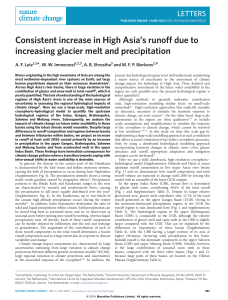
... estimates of future glacier changes are in good agreement with previous large-scale work22 . For all basins, the amount of glacier melt water contributing to the total flow does not change much at least until 2050 because the decrease in glacier area is compensated by an increase in melt rate (Fig. ...
... estimates of future glacier changes are in good agreement with previous large-scale work22 . For all basins, the amount of glacier melt water contributing to the total flow does not change much at least until 2050 because the decrease in glacier area is compensated by an increase in melt rate (Fig. ...

Author's personal copy On the use
... In Q-method, comprehensiveness and representiveness are sought through the careful selection of items (statements or images) representative of the issue in question (or ‘‘concourse’’ to use Q terminology), which is more critical than the selection of participants. To use an ecological analogy, the p ...
... In Q-method, comprehensiveness and representiveness are sought through the careful selection of items (statements or images) representative of the issue in question (or ‘‘concourse’’ to use Q terminology), which is more critical than the selection of participants. To use an ecological analogy, the p ...

Climate.Denial.2011
... because people want to “do the right thing” • The government can’t just pass a law and create a new global energy economy, any more than they could 200 years ago • If low-carbon-footprint goods and services cost less than “dirtier” ones, people will buy them ...
... because people want to “do the right thing” • The government can’t just pass a law and create a new global energy economy, any more than they could 200 years ago • If low-carbon-footprint goods and services cost less than “dirtier” ones, people will buy them ...

Beyond the Tipping Point: Understanding Perceptions of Abrupt
... The critical threshold at which a system will inescapably fall into one of these strange attractors is called the bifurcation point, or, as it is now often popularly referred to in climate change discourses, the ‘‘tipping point’’ (see Russill and Nyssa 2009). The nonlinearity of the Earth’s climate ...
... The critical threshold at which a system will inescapably fall into one of these strange attractors is called the bifurcation point, or, as it is now often popularly referred to in climate change discourses, the ‘‘tipping point’’ (see Russill and Nyssa 2009). The nonlinearity of the Earth’s climate ...

avoid dangerous climate change
... “We delude ourselves if our aspirations for a 2°C future resides substantially in the current framing of the EU ETS and the low-carbon technologies and practices that they may engender. Whilst technology undoubtedly has an important medium- and long-term role to play in reducing the carbon intensity ...
... “We delude ourselves if our aspirations for a 2°C future resides substantially in the current framing of the EU ETS and the low-carbon technologies and practices that they may engender. Whilst technology undoubtedly has an important medium- and long-term role to play in reducing the carbon intensity ...

presentation - Laboratory for Atmospheric and Space Physics
... panel: stratospheric responses, dark blue for upper stratosphere at ~2mb, light blue for middle stratosphere at ~20 mb. Middle Panel: tropospheric responses, red for tropopause at ~100 mb, brown for surface. Bottom Panel: temperature responses of four ocean layers. The curve with largest amplitude i ...
... panel: stratospheric responses, dark blue for upper stratosphere at ~2mb, light blue for middle stratosphere at ~20 mb. Middle Panel: tropospheric responses, red for tropopause at ~100 mb, brown for surface. Bottom Panel: temperature responses of four ocean layers. The curve with largest amplitude i ...

Climate Change - Division on Earth and Life Studies
... sources — including the number of sunspots and the abundance of certain forms (isotopes) of carbon or beryllium atoms, whose production rates in Earth’s atmosphere are influenced by variations in the Sun. There is evidence that the 11 year solar cycle, during which the Sun’s energy output varies by ...
... sources — including the number of sunspots and the abundance of certain forms (isotopes) of carbon or beryllium atoms, whose production rates in Earth’s atmosphere are influenced by variations in the Sun. There is evidence that the 11 year solar cycle, during which the Sun’s energy output varies by ...

Biodiversity - Lake Station Community Schools
... carbon dioxide and several other greenhouse gases have increased significantly over the last 200 years. Several kinds of data suggest this increase is due to the burning of fossil fuels, combined with the cutting and burning of forests worldwide. – @This added carbon dioxide is strengthening the nat ...
... carbon dioxide and several other greenhouse gases have increased significantly over the last 200 years. Several kinds of data suggest this increase is due to the burning of fossil fuels, combined with the cutting and burning of forests worldwide. – @This added carbon dioxide is strengthening the nat ...

Global Climate Change and Wetlands: Issues and Awareness by
... within a time-frame sufficient to allow ecosystems to adapt naturally to climate change, to ensure that food production is not threatened and to enable economic development to proceed in a sustainable manner" . The IPCC states that "potentially serious changes have been identified, including an incr ...
... within a time-frame sufficient to allow ecosystems to adapt naturally to climate change, to ensure that food production is not threatened and to enable economic development to proceed in a sustainable manner" . The IPCC states that "potentially serious changes have been identified, including an incr ...

Velocity of climate change algorithms for guiding conservation and
... The copyright line for this article was changed on 26 January, 2015 after original online publication. ...
... The copyright line for this article was changed on 26 January, 2015 after original online publication. ...

Impacts of Climate Change on Physical Characteristics of
... species, ecosystems or lakes and the mechanism of climate response is well understood; and there are no known or suspected antagonistic mechanisms or feedbacks that could mitigate or reverse the impact. Medium confidence – impact has been projected or modelled using several approaches and the mechan ...
... species, ecosystems or lakes and the mechanism of climate response is well understood; and there are no known or suspected antagonistic mechanisms or feedbacks that could mitigate or reverse the impact. Medium confidence – impact has been projected or modelled using several approaches and the mechan ...
Effects of global warming on humans

Climate change has brought about possibly permanent alterations to our planet’s geological, biological and ecological systems. The Intergovernmental Panel on Climate Change (IPCC) contended in 2003 that “there is new and stronger evidence that most of the warming observed over the last 50 years is attributable to human activities”. These changes have led to the emergence of large-scale environmental hazards to human health, such as extreme weather, ozone depletion, increased danger of wildland fires, loss of biodiversity, stresses to food-producing systems and the global spread of infectious diseases. The World Health Organization (WHO) estimates that 160,000 deaths, since 1950, are directly attributable to climate change. Many believe this to be a conservative estimate.To date, a neglected aspect of the climate change debate, much less research has been conducted on the impacts of climate change on health, food supply, economic growth, migration, security, societal change, and public goods, such as drinking water, than on the geophysical changes related to global warming. Human impacts can be both negative and positive. Climatic changes in Siberia, for instance, are expected to improve food production and local economic activity, at least in the short to medium term. Numerous studies suggest, however, that the current and future impacts of climate change on human society are and will continue to be overwhelmingly negative.The majority of the adverse effects of climate change are experienced by poor and low-income communities around the world, who have much higher levels of vulnerability to environmental determinants of health, wealth and other factors, and much lower levels of capacity available for coping with environmental change. A report on the global human impact of climate change published by the Global Humanitarian Forum in 2009, estimated more than 300,000 deaths and about $125 billion in economic losses each year, and indicating that most climate change induced mortality is due to worsening floods and droughts in developing countries. This also raises questions of climate justice, since the 50 least developed countries of the world account for not more than 1% of worldwide emissions of greenhouse gases.