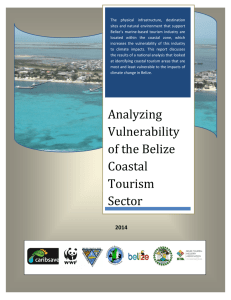
Analyzing Vulnerability of the Belize Coastal Tourism Sector
... 3. Development of vulnerability indicators The development of indicators to assess various dimensions of climate change is also a recent and emerging area of study. One of the most definitive discourses of such indicators comes from the Inter-governmental Panel on Climate Change Report (IPCC 2007), ...
... 3. Development of vulnerability indicators The development of indicators to assess various dimensions of climate change is also a recent and emerging area of study. One of the most definitive discourses of such indicators comes from the Inter-governmental Panel on Climate Change Report (IPCC 2007), ...

INDCs lower projected warming to 2.7˚C
... The CAT finds that different elements in China’s INDC, if considered separately, lead to different emission levels, which are illustrated on the CAT country page. We assume that China will only achieve its INDC if all elements (intensity + peaking + 20% non-fossil) are reached together, which result ...
... The CAT finds that different elements in China’s INDC, if considered separately, lead to different emission levels, which are illustrated on the CAT country page. We assume that China will only achieve its INDC if all elements (intensity + peaking + 20% non-fossil) are reached together, which result ...

South Africa`s Intended Nationally Determined Contribution
... “progressive” approach to enhance climate change mitigation and adaptation implementation and ambition. This implementation and ambition will be enabled by finance and technology and capacity building support. In this context, South Africa has transitioned its international mitigation commitment fro ...
... “progressive” approach to enhance climate change mitigation and adaptation implementation and ambition. This implementation and ambition will be enabled by finance and technology and capacity building support. In this context, South Africa has transitioned its international mitigation commitment fro ...

First Meeting of the Conference of African Heads of State
... • The aim of the current negotiating process is “The full and sustained implementation of the Convention”, not renegotiating it. Commitments of Developed countries under the Convention regarding the provision of financial resources and Technology have to be fulfilled. • Climate change poses an extra ...
... • The aim of the current negotiating process is “The full and sustained implementation of the Convention”, not renegotiating it. Commitments of Developed countries under the Convention regarding the provision of financial resources and Technology have to be fulfilled. • Climate change poses an extra ...

Climate change science and the climate change scare Contents
... There is no basis in science for the notion that rising CO2 increases the frequency or severity of extreme weather events (floods, droughts, storms, cyclones, extreme heat, extreme cold, and so on). Observation over the last 50 years shows no such increase. South Africa now (in November 2015) is exp ...
... There is no basis in science for the notion that rising CO2 increases the frequency or severity of extreme weather events (floods, droughts, storms, cyclones, extreme heat, extreme cold, and so on). Observation over the last 50 years shows no such increase. South Africa now (in November 2015) is exp ...

PDF
... warrant action and what kinds of actions need to be taken to address these issues. Several studies have been directed at the effects of climate change on the negative environmental externalities from agricultural production, including runoff (e.g., Chiew et al., 1995; Izaurralde et al., 1999; van Ka ...
... warrant action and what kinds of actions need to be taken to address these issues. Several studies have been directed at the effects of climate change on the negative environmental externalities from agricultural production, including runoff (e.g., Chiew et al., 1995; Izaurralde et al., 1999; van Ka ...

The Potential Impact of Climate Change on Agriculture in Puerto Rico
... I would like to thank the NASA-EPSCoR and USDATSTAR projects for their financial support. ...
... I would like to thank the NASA-EPSCoR and USDATSTAR projects for their financial support. ...

unjust waters
... and floods are already swelling the tide of rural-tourban migration across Africa, and the trend is expected to intensify as drought increases its grip over large swathes of the continent. By 2030, the majority of Africa’s population will live in urban areas. Unfortunately, however, global warming i ...
... and floods are already swelling the tide of rural-tourban migration across Africa, and the trend is expected to intensify as drought increases its grip over large swathes of the continent. By 2030, the majority of Africa’s population will live in urban areas. Unfortunately, however, global warming i ...

Future directions in adaptation research
... mid-2014, with a “clear understanding of the consequences of climate change for each sector” How can climate impact cost and adaptation benefit ...
... mid-2014, with a “clear understanding of the consequences of climate change for each sector” How can climate impact cost and adaptation benefit ...

RADIATIVE AND CLIMATE EFFECTS OF AEROSOLS OVER THE
... and sulphate produces a slight warming over the Arctic during spring. As the aerosol data is climatology, it may coarsely be representative the real situation. In this circumstance, higher resolution of aerosol simulations and more in-situ measurements are certainly needed. We believe that our simul ...
... and sulphate produces a slight warming over the Arctic during spring. As the aerosol data is climatology, it may coarsely be representative the real situation. In this circumstance, higher resolution of aerosol simulations and more in-situ measurements are certainly needed. We believe that our simul ...

E C A
... inhibiting human potential and may lead to suffering. Thus, the Cornwall Declaration and its signers give moral priority6 to man over the rest of creation in order for man to meet his full potential in making humanity more prosperous. The ICES and ISA seems to give a biblical foundation to the “wise ...
... inhibiting human potential and may lead to suffering. Thus, the Cornwall Declaration and its signers give moral priority6 to man over the rest of creation in order for man to meet his full potential in making humanity more prosperous. The ICES and ISA seems to give a biblical foundation to the “wise ...

Adaptation to climate change starts with human–environment
... all are limited in their capacity to adapt to climate extremes. Despite limited contributions of historical greenhouse gas emissions, developing nations are highly vulnerable to future impacts (AOSIS, 1999; Apuuli et al., 2000). Increasing adaptive capacity to climate change is a development issue t ...
... all are limited in their capacity to adapt to climate extremes. Despite limited contributions of historical greenhouse gas emissions, developing nations are highly vulnerable to future impacts (AOSIS, 1999; Apuuli et al., 2000). Increasing adaptive capacity to climate change is a development issue t ...

China’s growth, China’s cities, and the new global low-carbon industrial revolution: November 2010 (347 kB) (opens in new window)
... I have visited China many times in the last 22 years and I am a great admirer and I hope a loyal friend. China has lifted hundreds of millions out of poverty. This has been the most dramatic example of development in human history. But unmanaged climate change would likely halt and reverse the great ...
... I have visited China many times in the last 22 years and I am a great admirer and I hope a loyal friend. China has lifted hundreds of millions out of poverty. This has been the most dramatic example of development in human history. But unmanaged climate change would likely halt and reverse the great ...

Beyond species distribution modeling: A
... SDMs enables the identification of potential pathways, whose loss can affect the ability of species to shift their range into future climatically suitable areas, and the appropriate conservation management measures to increase landscape connectivity and facilitate movement. © 2015 Elsevier B.V. All r ...
... SDMs enables the identification of potential pathways, whose loss can affect the ability of species to shift their range into future climatically suitable areas, and the appropriate conservation management measures to increase landscape connectivity and facilitate movement. © 2015 Elsevier B.V. All r ...

The Science of Climate Change, Questions and Answers
... to small disturbances, although climate models and evidence from past climate change provide a plausible range of values. Climate changes over small regions and changes in rainfall patterns are very hard to estimate. Tipping points or rapid climate transitions associated with overall global warming ...
... to small disturbances, although climate models and evidence from past climate change provide a plausible range of values. Climate changes over small regions and changes in rainfall patterns are very hard to estimate. Tipping points or rapid climate transitions associated with overall global warming ...

... mortality [19–21]. The majority of research on quantifying the relationship between temperature and mortality has occurred in industrialized nations and in temperate climates; there are very few studies in developing countries in general, and Africa specifically [13,18]. Previous studies in northern ...

STRATEGIES FOR COPING WITH WEATHER CHANGES ADOPTED REGION HIGH SCHOOLS, SWAZILAND
... infrared radiation by gases in the atmosphere warm a planet’s lower atmosphere and surface. The major greenhouse gases are water vapour, carbon dioxide, methane, and ozone. Global warming is measured by the globally averaged temperature near the earth’s surface. It increased by 0.74ºC ± 0.18ºC over ...
... infrared radiation by gases in the atmosphere warm a planet’s lower atmosphere and surface. The major greenhouse gases are water vapour, carbon dioxide, methane, and ozone. Global warming is measured by the globally averaged temperature near the earth’s surface. It increased by 0.74ºC ± 0.18ºC over ...
Center for Policy Research
... Questions 3-6 cannot be answered on the basis of scientific evidence alone. They may involve, in addition to an appraisal of the scientific case for global climate change, judgments and opinions about the consensus views of the scientific community (questions 3, 4, and 6), about the magnitude of th ...
... Questions 3-6 cannot be answered on the basis of scientific evidence alone. They may involve, in addition to an appraisal of the scientific case for global climate change, judgments and opinions about the consensus views of the scientific community (questions 3, 4, and 6), about the magnitude of th ...

High Resolution - Responses to Climate Change
... 1.1 A Note on the Water Resources Region Scale USACE and other resource management agencies require reliable, science-based methods for incorporating climate change information into the assessments that support water resources decisions and actions. Such planning assessments must quantify projection ...
... 1.1 A Note on the Water Resources Region Scale USACE and other resource management agencies require reliable, science-based methods for incorporating climate change information into the assessments that support water resources decisions and actions. Such planning assessments must quantify projection ...

How do recent population trends matter to climate change?
... Although integrated assessment models (IAM) of the Intergovernmental Panel on Climate Change (IPCC) consider population, along with economic growth and technological change, as one of the root causes of greenhouse gas emissions, how population dynamics affect climate change is still under debate. Wh ...
... Although integrated assessment models (IAM) of the Intergovernmental Panel on Climate Change (IPCC) consider population, along with economic growth and technological change, as one of the root causes of greenhouse gas emissions, how population dynamics affect climate change is still under debate. Wh ...

Uncertainty in the impacts of projected climate change on the
... impact study (Prudhomme and Davis, 2009b). Considering all of the above, this study will use a welltested, semi-distributed hydrological model to examine the uncertainty in the impacts of different projected climate change scenarios on the quantity and seasonality of water resources for a large, com ...
... impact study (Prudhomme and Davis, 2009b). Considering all of the above, this study will use a welltested, semi-distributed hydrological model to examine the uncertainty in the impacts of different projected climate change scenarios on the quantity and seasonality of water resources for a large, com ...

View/Open - Sokoine University of Agriculture
... data were obtained from the Tanzanian Meteorological Agency (http://www.meteo.go.tz/) for the corresponding 49 year period. In order to preserve important local climatic heterogeneity, four stations representing the main arabica growing regions of Tanzania were used. These include Lyamungu, Arusha a ...
... data were obtained from the Tanzanian Meteorological Agency (http://www.meteo.go.tz/) for the corresponding 49 year period. In order to preserve important local climatic heterogeneity, four stations representing the main arabica growing regions of Tanzania were used. These include Lyamungu, Arusha a ...

13372001
... There is near undisputed scientific consensus that the rising atmospheric concentration of greenhouse gases owing to human activities will cause warming (and other climatic changes) at Earth’s surface. The Intergovernmental Panel on Climate Change (IPCC) revealed an increase in world average tempera ...
... There is near undisputed scientific consensus that the rising atmospheric concentration of greenhouse gases owing to human activities will cause warming (and other climatic changes) at Earth’s surface. The Intergovernmental Panel on Climate Change (IPCC) revealed an increase in world average tempera ...

香山科学会议 温室气体控制技术及关键问题
... Article 4.7 stipulates that “The extent to which developing country Parties will effectively implement their commitments under the Convention will depend on the effective implementation by developed country Parties of their commitments under the Convention related to financial resources and transfer ...
... Article 4.7 stipulates that “The extent to which developing country Parties will effectively implement their commitments under the Convention will depend on the effective implementation by developed country Parties of their commitments under the Convention related to financial resources and transfer ...

The impacts of climate change on the abundance and
... development, modelled population growth occurs optimally at temperatures around 24 ◦ C. Quantitatively, temperature profiles for RCP2.6-2020, RCP6.0-2050 and RCP8.5-2080 produce 74, 62 and 47 days respectively where temperatures are ±2 ◦ C from model optimal. As we cannot know a priori which of the ...
... development, modelled population growth occurs optimally at temperatures around 24 ◦ C. Quantitatively, temperature profiles for RCP2.6-2020, RCP6.0-2050 and RCP8.5-2080 produce 74, 62 and 47 days respectively where temperatures are ±2 ◦ C from model optimal. As we cannot know a priori which of the ...
Effects of global warming on humans

Climate change has brought about possibly permanent alterations to our planet’s geological, biological and ecological systems. The Intergovernmental Panel on Climate Change (IPCC) contended in 2003 that “there is new and stronger evidence that most of the warming observed over the last 50 years is attributable to human activities”. These changes have led to the emergence of large-scale environmental hazards to human health, such as extreme weather, ozone depletion, increased danger of wildland fires, loss of biodiversity, stresses to food-producing systems and the global spread of infectious diseases. The World Health Organization (WHO) estimates that 160,000 deaths, since 1950, are directly attributable to climate change. Many believe this to be a conservative estimate.To date, a neglected aspect of the climate change debate, much less research has been conducted on the impacts of climate change on health, food supply, economic growth, migration, security, societal change, and public goods, such as drinking water, than on the geophysical changes related to global warming. Human impacts can be both negative and positive. Climatic changes in Siberia, for instance, are expected to improve food production and local economic activity, at least in the short to medium term. Numerous studies suggest, however, that the current and future impacts of climate change on human society are and will continue to be overwhelmingly negative.The majority of the adverse effects of climate change are experienced by poor and low-income communities around the world, who have much higher levels of vulnerability to environmental determinants of health, wealth and other factors, and much lower levels of capacity available for coping with environmental change. A report on the global human impact of climate change published by the Global Humanitarian Forum in 2009, estimated more than 300,000 deaths and about $125 billion in economic losses each year, and indicating that most climate change induced mortality is due to worsening floods and droughts in developing countries. This also raises questions of climate justice, since the 50 least developed countries of the world account for not more than 1% of worldwide emissions of greenhouse gases.