
AFWA 2002 - Nevada Department of Wildlife
... According to the AFWA Guiding Principles White Paper (2002), Wildlife Action Plans should address the broad range of wildlife and associated habitats, as well as combine landscape/ecosystem/habitat-based approaches and smaller-scale approaches (e.g. focal, keystone, and/or indicator species; guilds; ...
... According to the AFWA Guiding Principles White Paper (2002), Wildlife Action Plans should address the broad range of wildlife and associated habitats, as well as combine landscape/ecosystem/habitat-based approaches and smaller-scale approaches (e.g. focal, keystone, and/or indicator species; guilds; ...

influence of surface/free-air decoupling on temperature trend patterns
... [Lundquist and Cayan, 2007; Lundquist et al., 2008]. This implies that surface temperatures (in decoupled locations) are less strongly controlled by the thermal structure of the free atmosphere when pressure is high. [14] We develop an index representative of the extent of surface versus free atmosp ...
... [Lundquist and Cayan, 2007; Lundquist et al., 2008]. This implies that surface temperatures (in decoupled locations) are less strongly controlled by the thermal structure of the free atmosphere when pressure is high. [14] We develop an index representative of the extent of surface versus free atmosp ...

Modeling plant species distributions under future climates: how fine
... Recent studies suggest that species distribution models (SDMs) based on fine-scale climate data may provide markedly different estimates of climate-change impacts than coarse-scale models. However, these studies disagree in their conclusions of how scale influences projected species distributions. I ...
... Recent studies suggest that species distribution models (SDMs) based on fine-scale climate data may provide markedly different estimates of climate-change impacts than coarse-scale models. However, these studies disagree in their conclusions of how scale influences projected species distributions. I ...

Impacts of future climate change on soil frost in the midwestern
... conducted to understand historic climate variability effects on seasonal soil frost in the midwestern United States [Sinha and Cherkauer, 2008; Sinha et al., 2010] through analysis of observations and retrospective model simulations. ...
... conducted to understand historic climate variability effects on seasonal soil frost in the midwestern United States [Sinha and Cherkauer, 2008; Sinha et al., 2010] through analysis of observations and retrospective model simulations. ...

Climate Smart Agriculture
... population. Being energy and input intensive, high yielding farming increases the greenhouse gas (GHG) emissions per hectare. However, deforestation and draining of wetlands is today the single largest source of GHG emissions related to agricultural production. The alternative of growing food by ...
... population. Being energy and input intensive, high yielding farming increases the greenhouse gas (GHG) emissions per hectare. However, deforestation and draining of wetlands is today the single largest source of GHG emissions related to agricultural production. The alternative of growing food by ...

Impacts of climate change on temperature and evaporation from a
... As a result of the change in climate, particularly the increase in surface air temperatures, evaporation is also expected to increase throughout Australia. According to CSIRO and BoM (2007), the largest increases in potential evapotranspiration are expected in the north and east, where the changes b ...
... As a result of the change in climate, particularly the increase in surface air temperatures, evaporation is also expected to increase throughout Australia. According to CSIRO and BoM (2007), the largest increases in potential evapotranspiration are expected in the north and east, where the changes b ...

Saimaa University of Applied Sciences Faculty of Technology, Imatra
... different factors affect on our climate. How do we know that greenhouse gases are responsible for the climate change and prove that? The third chapter introduces climate forcing, natural and man-made induced climate change: What is natural variability and what is anthropogenic human induced climate ...
... different factors affect on our climate. How do we know that greenhouse gases are responsible for the climate change and prove that? The third chapter introduces climate forcing, natural and man-made induced climate change: What is natural variability and what is anthropogenic human induced climate ...

Environmentally induced migration and displacement: a
... The impacts of climate change on the environment and human mobility are becoming increasingly worrying: the number of natural disasters has doubled over the past two decades. Every year 30 million people worldwide are forced to move because of serious degradation of environmental conditions, natural ...
... The impacts of climate change on the environment and human mobility are becoming increasingly worrying: the number of natural disasters has doubled over the past two decades. Every year 30 million people worldwide are forced to move because of serious degradation of environmental conditions, natural ...

Biodiversity Climate change impacts report card Technical paper 11
... degree of migratory tendency; relatively few species (c. 10%) can be considered entirely resident (Table 1). The UK is at the centre of the East Atlantic (Africa-Eurasia) flyway, linking Arctic breeding grounds stretching from Canada to central Siberia, with wintering grounds in western Europe and f ...
... degree of migratory tendency; relatively few species (c. 10%) can be considered entirely resident (Table 1). The UK is at the centre of the East Atlantic (Africa-Eurasia) flyway, linking Arctic breeding grounds stretching from Canada to central Siberia, with wintering grounds in western Europe and f ...

North Atlantic storminess and Atlantic Meridional Overturning
... from climate model simulations of the last Millennium. While an increase in storm frequency implicates positive NAO, increased intensity would be consistent with negative NAO during the LIA. Such an increase in cyclone intensity could have resulted from the steepening of the meridional temperature g ...
... from climate model simulations of the last Millennium. While an increase in storm frequency implicates positive NAO, increased intensity would be consistent with negative NAO during the LIA. Such an increase in cyclone intensity could have resulted from the steepening of the meridional temperature g ...

Climate-driven expansion of blanket bogs in Britain during the
... blanket-bog initiation in the UK. There is a long-standing hypothesis, first proposed by Moore (1973), that it was a consequence of land use by Neolithic human populations, and in particular land clearing practices at the time of the “elm decline” (often taken as a stratigraphic marker of Neolithic ...
... blanket-bog initiation in the UK. There is a long-standing hypothesis, first proposed by Moore (1973), that it was a consequence of land use by Neolithic human populations, and in particular land clearing practices at the time of the “elm decline” (often taken as a stratigraphic marker of Neolithic ...

Shiri Avnery
... warming world, combining CLM-DGVM simulations with high resolution paleoclimate proxies may provide insight into the historic relationship between terrestrial ecosystems and climate. ...
... warming world, combining CLM-DGVM simulations with high resolution paleoclimate proxies may provide insight into the historic relationship between terrestrial ecosystems and climate. ...

Annual Changes in Seasonal River Water Temperatures in the
... increasing water temperature on riverine fish species include range shifts towards upstream, higher elevations [4], influences on migration timing [5,6] and changes in community structure [7]. In addition, because temperature is a key controller of physiological processes, changes in water temperatu ...
... increasing water temperature on riverine fish species include range shifts towards upstream, higher elevations [4], influences on migration timing [5,6] and changes in community structure [7]. In addition, because temperature is a key controller of physiological processes, changes in water temperatu ...

Will Geoengineering With Solar Radiation Management Ever Be
... the planet by reducing the worst impacts of global warming, but that there would be regions that would suffer at the same time? How would it be possible to determine which adverse situations were caused by the geoengineering, and which were just bad weather luck? Even if it were possible, how could ...
... the planet by reducing the worst impacts of global warming, but that there would be regions that would suffer at the same time? How would it be possible to determine which adverse situations were caused by the geoengineering, and which were just bad weather luck? Even if it were possible, how could ...

United Nations Framework Convention on Climate Change
... Intergovernmental Panel on Climate Change, to marshal and assess scientific information on the subject. In 1990 the IPCC issued its First Assessment Report, which confirmed that the threat of climate change was real. The Second World Climate Conference, held in Geneva later that year, called for the ...
... Intergovernmental Panel on Climate Change, to marshal and assess scientific information on the subject. In 1990 the IPCC issued its First Assessment Report, which confirmed that the threat of climate change was real. The Second World Climate Conference, held in Geneva later that year, called for the ...

UNFCCC: UNITING ON CLIMATE
... Intergovernmental Panel on Climate Change, to marshal and assess scientific information on the subject. In 1990 the IPCC issued its First Assessment Report, which confirmed that the threat of climate change was real. The Second World Climate Conference, held in Geneva later that year, called for the ...
... Intergovernmental Panel on Climate Change, to marshal and assess scientific information on the subject. In 1990 the IPCC issued its First Assessment Report, which confirmed that the threat of climate change was real. The Second World Climate Conference, held in Geneva later that year, called for the ...
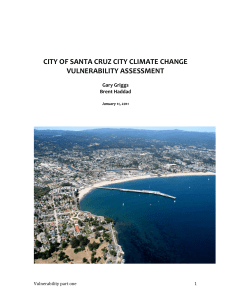
city of santa cruz city climate change vulnerability assessment
... Sea level rise will gradually inundate low‐lying areas, which include all of the shoreline and beach areas along the city coastline that are presently closest to sea level. Areas of inundation will extend landward as a result of sea level rise. The greatest uncertainty is the rate at which this ...
... Sea level rise will gradually inundate low‐lying areas, which include all of the shoreline and beach areas along the city coastline that are presently closest to sea level. Areas of inundation will extend landward as a result of sea level rise. The greatest uncertainty is the rate at which this ...

Incorporating estuaries as a source or sink of
... Complex coastal landforms exhibit variable behaviour in response to sea-level rise. A proposed modelling framework that integrates shoreline changes associated with longterm recession, short-term variability and sea-level rise advocates that coastal risk assessment be undertaken within the context o ...
... Complex coastal landforms exhibit variable behaviour in response to sea-level rise. A proposed modelling framework that integrates shoreline changes associated with longterm recession, short-term variability and sea-level rise advocates that coastal risk assessment be undertaken within the context o ...

Vol.5, No.2, 2005
... of Technology) and colleagues found no statistically significant increase in the world-wide frequency of tropical cyclones over the last 30 years. He did note, though, significantly more storms at category 4 and 5 levels, an indication that storms have become stronger. For the western North Pacific, a ...
... of Technology) and colleagues found no statistically significant increase in the world-wide frequency of tropical cyclones over the last 30 years. He did note, though, significantly more storms at category 4 and 5 levels, an indication that storms have become stronger. For the western North Pacific, a ...

PDF
... strengthens our motivation to explore possibilities to formulate bio-fuel mandates in a flexible way as suggested by Wright (2010). Another complicating factor in such considerations is that fact that yields are volatile and that often decisions need to be made under uncertainty, the implications of ...
... strengthens our motivation to explore possibilities to formulate bio-fuel mandates in a flexible way as suggested by Wright (2010). Another complicating factor in such considerations is that fact that yields are volatile and that often decisions need to be made under uncertainty, the implications of ...

NASA Research Strategy for Earth System Science
... detect the occurrence of significant variations in the major components of the climate system and independently determine changes in representative variables that currently cannot be inferred from other measured quantities (e.g., the structure of precipitating clouds and associated precipitation tha ...
... detect the occurrence of significant variations in the major components of the climate system and independently determine changes in representative variables that currently cannot be inferred from other measured quantities (e.g., the structure of precipitating clouds and associated precipitation tha ...

REVIEW - Integrative Biology - University of California, Berkeley
... billion people).1 The human species alone now uses more than 760 exajoules of energy per year (as of 2010), which approaches what was available to be shared by all terrestrial species on Earth prior to inventions that allowed us to augment the global energy budget. The global energy budget without h ...
... billion people).1 The human species alone now uses more than 760 exajoules of energy per year (as of 2010), which approaches what was available to be shared by all terrestrial species on Earth prior to inventions that allowed us to augment the global energy budget. The global energy budget without h ...

Petition - Center for Biological Diversity
... below the 1.5°C target so as to avoid truly catastrophic impacts to people and planet. 13 As CO2 levels continue to rise past 400 parts per million (ppm),14 the consequent effects of global warming are becoming ever more apparent. Extreme weather events, such as severe droughts, floods, and heat wav ...
... below the 1.5°C target so as to avoid truly catastrophic impacts to people and planet. 13 As CO2 levels continue to rise past 400 parts per million (ppm),14 the consequent effects of global warming are becoming ever more apparent. Extreme weather events, such as severe droughts, floods, and heat wav ...

WETLANDS, CARBON STORAGE, AND FUTURE CLIMATE
... plants may be moved 200 to 300 km north for each degree centigrade increase in temperature and about 60 to 90 miles for each degree Fahrenheit. The IPCC concluded more generally that the “composition and geographic distribution of many ecosystems…will shift as individual species respond to changes i ...
... plants may be moved 200 to 300 km north for each degree centigrade increase in temperature and about 60 to 90 miles for each degree Fahrenheit. The IPCC concluded more generally that the “composition and geographic distribution of many ecosystems…will shift as individual species respond to changes i ...

Carbon and the Anthropocene
... rate of change are so great that the epoch since the start of the industrial revolution is often called the ‘Anthropocene’ to distinguish it from the preceding Holocene (starting about 12 000 BP). In the Anthropocene, human activities are significantly modifying the great natural cycles of carbon, w ...
... rate of change are so great that the epoch since the start of the industrial revolution is often called the ‘Anthropocene’ to distinguish it from the preceding Holocene (starting about 12 000 BP). In the Anthropocene, human activities are significantly modifying the great natural cycles of carbon, w ...
Effects of global warming on humans

Climate change has brought about possibly permanent alterations to our planet’s geological, biological and ecological systems. The Intergovernmental Panel on Climate Change (IPCC) contended in 2003 that “there is new and stronger evidence that most of the warming observed over the last 50 years is attributable to human activities”. These changes have led to the emergence of large-scale environmental hazards to human health, such as extreme weather, ozone depletion, increased danger of wildland fires, loss of biodiversity, stresses to food-producing systems and the global spread of infectious diseases. The World Health Organization (WHO) estimates that 160,000 deaths, since 1950, are directly attributable to climate change. Many believe this to be a conservative estimate.To date, a neglected aspect of the climate change debate, much less research has been conducted on the impacts of climate change on health, food supply, economic growth, migration, security, societal change, and public goods, such as drinking water, than on the geophysical changes related to global warming. Human impacts can be both negative and positive. Climatic changes in Siberia, for instance, are expected to improve food production and local economic activity, at least in the short to medium term. Numerous studies suggest, however, that the current and future impacts of climate change on human society are and will continue to be overwhelmingly negative.The majority of the adverse effects of climate change are experienced by poor and low-income communities around the world, who have much higher levels of vulnerability to environmental determinants of health, wealth and other factors, and much lower levels of capacity available for coping with environmental change. A report on the global human impact of climate change published by the Global Humanitarian Forum in 2009, estimated more than 300,000 deaths and about $125 billion in economic losses each year, and indicating that most climate change induced mortality is due to worsening floods and droughts in developing countries. This also raises questions of climate justice, since the 50 least developed countries of the world account for not more than 1% of worldwide emissions of greenhouse gases.