
Sample
... Learning Outcome: 6. Discuss convection's relationship to weather 26) In tropical climates, the combination of ________ with ________ creates intense daily convective storms. A) low temperatures, humidity B) high temperatures, humidity C) low temperatures, dry air D) high temperatures, dry air Answe ...
... Learning Outcome: 6. Discuss convection's relationship to weather 26) In tropical climates, the combination of ________ with ________ creates intense daily convective storms. A) low temperatures, humidity B) high temperatures, humidity C) low temperatures, dry air D) high temperatures, dry air Answe ...

TABLE OF CONTENTS - Caribbean Community Climate Change
... Primary and secondary research was conducted, the data analyzed and findings reported. Recommendations were distilled from the findings and presented in this paper as the Adaptation Strategy and Action Plan. Belize’s development will be economically impacted by deleterious effects upon the water sec ...
... Primary and secondary research was conducted, the data analyzed and findings reported. Recommendations were distilled from the findings and presented in this paper as the Adaptation Strategy and Action Plan. Belize’s development will be economically impacted by deleterious effects upon the water sec ...

International Executive Agreements on Climate Change Hannah Chang*
... independent foreign affairs powers, together with authority derived from existing treaties and congressional delegations, to enter into binding international agreements that could address certain aspects of the climate change problem even as the United States waits for domestic climate legislation t ...
... independent foreign affairs powers, together with authority derived from existing treaties and congressional delegations, to enter into binding international agreements that could address certain aspects of the climate change problem even as the United States waits for domestic climate legislation t ...

AtKisson`s Compass Methodology for Climage Change
... reinforces the goals of sustainable development. Record at the top of your Compass Flip chart paper. For each of the four Compass directions, identify the 4-7 priority material needs that will provide the foundational focus of this integrated management plan. Material needs include those things that ...
... reinforces the goals of sustainable development. Record at the top of your Compass Flip chart paper. For each of the four Compass directions, identify the 4-7 priority material needs that will provide the foundational focus of this integrated management plan. Material needs include those things that ...

CARBON NEUTRALITY BY 2020:
... climate policies. Most, like the U.S. Mayors Climate Protection Agreement, are commitments to reduce greenhouse gas emissions by a certain percentage by a certain date (i.e. 7% below 1990 levels by 2012). Others, like The Evergreen State College, are striving for carbon neutrality. For most American ...
... climate policies. Most, like the U.S. Mayors Climate Protection Agreement, are commitments to reduce greenhouse gas emissions by a certain percentage by a certain date (i.e. 7% below 1990 levels by 2012). Others, like The Evergreen State College, are striving for carbon neutrality. For most American ...

AHDR-‐II FACT SHEET: POPULATION AND
... Climate change may increase resource development costs on land; 2) The recent dramatic increase in commodity prices is not likely persist, long term. Historically, high prices for any resource have encouraged ...
... Climate change may increase resource development costs on land; 2) The recent dramatic increase in commodity prices is not likely persist, long term. Historically, high prices for any resource have encouraged ...
America's Climate Choices: Panel on Limiting the Research Council
... atmosphere has been one of the world’s principal waste repositories because it has offered an easy and inexpensive means of managing unwanted by-products. It is currently absorbing a net gain of two parts per million of CO2 per year as the result of global emissions, and the world’s leading scientis ...
... atmosphere has been one of the world’s principal waste repositories because it has offered an easy and inexpensive means of managing unwanted by-products. It is currently absorbing a net gain of two parts per million of CO2 per year as the result of global emissions, and the world’s leading scientis ...

Freshwater Ecosystems and Fisheries
... Arctic will have far-reaching impacts, affecting aquatic species at various trophic levels, the physical and chemical environment that makes up their habitat, and the processes that act on and within freshwater ecosystems. Interactions of climatic variables, such as temperature and precipitation, wi ...
... Arctic will have far-reaching impacts, affecting aquatic species at various trophic levels, the physical and chemical environment that makes up their habitat, and the processes that act on and within freshwater ecosystems. Interactions of climatic variables, such as temperature and precipitation, wi ...

protected areas and climate change in canada
... Climate change has sufficiently begun to impact critical, once relatively stable climate regimes to now garner worldwide attention as the most serious environmental concern of the 21st century. Both the Intergovernmental Panel on Climate Change’s (IPCC) Fourth Assessment Report (AR4) and Canada’s na ...
... Climate change has sufficiently begun to impact critical, once relatively stable climate regimes to now garner worldwide attention as the most serious environmental concern of the 21st century. Both the Intergovernmental Panel on Climate Change’s (IPCC) Fourth Assessment Report (AR4) and Canada’s na ...
Mitigating climate change through reductions in greenhouse gas emissions: the science and economics of future paths for global annual emissions (1 MB) (opens in new window)
... limit the probability of exceeding warming of 2°C to 50 per cent, policy-makers should aim for annual global emissions to be between 40 and 48 Gt CO2e by 2020. This is equivalent to limiting global annual emissions to levels in 2020 that would be between 8 and 30 per cent higher than 1990 levels. Al ...
... limit the probability of exceeding warming of 2°C to 50 per cent, policy-makers should aim for annual global emissions to be between 40 and 48 Gt CO2e by 2020. This is equivalent to limiting global annual emissions to levels in 2020 that would be between 8 and 30 per cent higher than 1990 levels. Al ...
Mitigating climate change through reductions in greenhouse gas
... limit the probability of exceeding warming of 2°C to 50 per cent, policy-makers should aim for annual global emissions to be between 40 and 48 Gt CO2e by 2020. This is equivalent to limiting global annual emissions to levels in 2020 that would be between 8 and 30 per cent higher than 1990 levels. Al ...
... limit the probability of exceeding warming of 2°C to 50 per cent, policy-makers should aim for annual global emissions to be between 40 and 48 Gt CO2e by 2020. This is equivalent to limiting global annual emissions to levels in 2020 that would be between 8 and 30 per cent higher than 1990 levels. Al ...
An Integrated Assessment of Changes in the Thermohaline Circulation
... triggered this century, with some estimates even exceeding the 50% level for scenarios with high global temperature rise. Narrowing down this uncertainty will first of all require a better physical understanding of what determines ocean circulation stability; sensitivity studies with model ensembles ...
... triggered this century, with some estimates even exceeding the 50% level for scenarios with high global temperature rise. Narrowing down this uncertainty will first of all require a better physical understanding of what determines ocean circulation stability; sensitivity studies with model ensembles ...
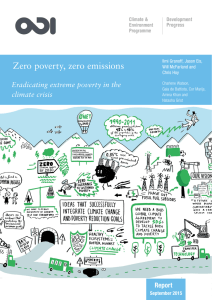
Zero poverty, zero emissions - Overseas Development Institute
... from 2030 to 2050 under BAU. This is about the same number of people who exited extreme poverty in the last two decades of record development progress (Povcal, 2015). These calculations derive from pathways tracing the impact of climate change on just four factors affecting poverty that have the mos ...
... from 2030 to 2050 under BAU. This is about the same number of people who exited extreme poverty in the last two decades of record development progress (Povcal, 2015). These calculations derive from pathways tracing the impact of climate change on just four factors affecting poverty that have the mos ...

Coastal Hazard Guide - Victorian Coastal Council
... permanent removal of material from a part of the coast. While erosion/recession is a natural process that has formed the present coastal edge, it is a hazard if it can adversely affect human life, property or aspects of the natural environment. ...
... permanent removal of material from a part of the coast. While erosion/recession is a natural process that has formed the present coastal edge, it is a hazard if it can adversely affect human life, property or aspects of the natural environment. ...

Evaluation of Carrying Capacity of Pacific Salmon in the North
... in the biomass of hatchery populations. Biological interaction between wild and hatchery populations should be an important consideration in the sustainable management of Pacific salmon production based at the ecosystem level. In the North Pacific Ocean, the annual catch of Pacific salmon increased ...
... in the biomass of hatchery populations. Biological interaction between wild and hatchery populations should be an important consideration in the sustainable management of Pacific salmon production based at the ecosystem level. In the North Pacific Ocean, the annual catch of Pacific salmon increased ...
UNDP Presentation - Global Environment Facility
... Any country that receives a sum total allocation for BD, CC, and LD that totals less than $6.5* M would be allowed to use its allocation within either of these three focal areas, if eligible. Around 50 countries are expected to benefit => several Caribbean countries (see previous table) These ...
... Any country that receives a sum total allocation for BD, CC, and LD that totals less than $6.5* M would be allowed to use its allocation within either of these three focal areas, if eligible. Around 50 countries are expected to benefit => several Caribbean countries (see previous table) These ...
Author`s personal copy
... public perceptions and even opposite opinions about the science community’s assessment on the existence and fundamental cause of GWCC (Leiserowitz et al. 2012; Pew 2012). In the United States, there are also controversies and confusions among the lawmakers, particularly in Congress, about climate sc ...
... public perceptions and even opposite opinions about the science community’s assessment on the existence and fundamental cause of GWCC (Leiserowitz et al. 2012; Pew 2012). In the United States, there are also controversies and confusions among the lawmakers, particularly in Congress, about climate sc ...
DOC 129KB - Climate Change Authority
... assumptions. When assessing countries’ action to reduce greenhouse gas emissions, 1990 is a reasonable point to start in most circumstances. Distant past emissions occurred when their impact was not well understood or foreseen. From 1990, however, there was widespread global recognition of the risks ...
... assumptions. When assessing countries’ action to reduce greenhouse gas emissions, 1990 is a reasonable point to start in most circumstances. Distant past emissions occurred when their impact was not well understood or foreseen. From 1990, however, there was widespread global recognition of the risks ...

Section I. Capacity-Building
... f. Ensuring that capacity-building is effective, [demand-driven] [country-driven] and sustainable over the long term.] ...
... f. Ensuring that capacity-building is effective, [demand-driven] [country-driven] and sustainable over the long term.] ...

The Daily Sun 11th April
... cultural preferences in running a business or practicing CSR, the demands of the natural environment and its preservation is given a lot of attention. The concern is spreading to biodiversity and access to natural resources and also widened to include supply chains. Climate change has been one of th ...
... cultural preferences in running a business or practicing CSR, the demands of the natural environment and its preservation is given a lot of attention. The concern is spreading to biodiversity and access to natural resources and also widened to include supply chains. Climate change has been one of th ...

The Three-North Shelterbelt Program and Dynamic Changes in
... Shelterbelt Program, TNSP) is the largest ecological reforestation program in the world. TNSP vegetation research has important ecological meaning and profound social and economic significance. Here, spatio-temporal variation in vegetation cover under the TNSP was examined using the NDVI average met ...
... Shelterbelt Program, TNSP) is the largest ecological reforestation program in the world. TNSP vegetation research has important ecological meaning and profound social and economic significance. Here, spatio-temporal variation in vegetation cover under the TNSP was examined using the NDVI average met ...

Assessing the Vulnerability of Victoria`s Central Highlands Forests to
... Table 8: Microclimatic modifiers used to create the stand modifying and stand maintaining scenarios from the generated climate scenarios ................................................................... 52 Table 9: Species that did not exhibit a significant change in regeneration niche size betwee ...
... Table 8: Microclimatic modifiers used to create the stand modifying and stand maintaining scenarios from the generated climate scenarios ................................................................... 52 Table 9: Species that did not exhibit a significant change in regeneration niche size betwee ...

Redrawing the energy-climate map - World Energy Outlook Special
... atmosphere exceeded 400 parts per million for the Įrst Ɵme in several hundred millennia. The weight of scienƟĮc analysis tells us that our climate is already changing and that we should expect extreme weather events (such as storms, Ňoods and heat waves) to become more freƋuent and intense, as well ...
... atmosphere exceeded 400 parts per million for the Įrst Ɵme in several hundred millennia. The weight of scienƟĮc analysis tells us that our climate is already changing and that we should expect extreme weather events (such as storms, Ňoods and heat waves) to become more freƋuent and intense, as well ...
Climate Change Impacts on Phenology
... migrant bird species to the east coast of Ireland indicated ...
... migrant bird species to the east coast of Ireland indicated ...

text_2ed_rev - Department of the Geophysical Sciences
... the natural Earth is as warm as it is (as well as other planets such as Venus and Mars). For the threat of human-induced climate change to go away, we’d have to toss out greenhouse theory, and come up with some other explanation for why the Earth has been warming over the past decades. But there is ...
... the natural Earth is as warm as it is (as well as other planets such as Venus and Mars). For the threat of human-induced climate change to go away, we’d have to toss out greenhouse theory, and come up with some other explanation for why the Earth has been warming over the past decades. But there is ...
Effects of global warming on humans

Climate change has brought about possibly permanent alterations to our planet’s geological, biological and ecological systems. The Intergovernmental Panel on Climate Change (IPCC) contended in 2003 that “there is new and stronger evidence that most of the warming observed over the last 50 years is attributable to human activities”. These changes have led to the emergence of large-scale environmental hazards to human health, such as extreme weather, ozone depletion, increased danger of wildland fires, loss of biodiversity, stresses to food-producing systems and the global spread of infectious diseases. The World Health Organization (WHO) estimates that 160,000 deaths, since 1950, are directly attributable to climate change. Many believe this to be a conservative estimate.To date, a neglected aspect of the climate change debate, much less research has been conducted on the impacts of climate change on health, food supply, economic growth, migration, security, societal change, and public goods, such as drinking water, than on the geophysical changes related to global warming. Human impacts can be both negative and positive. Climatic changes in Siberia, for instance, are expected to improve food production and local economic activity, at least in the short to medium term. Numerous studies suggest, however, that the current and future impacts of climate change on human society are and will continue to be overwhelmingly negative.The majority of the adverse effects of climate change are experienced by poor and low-income communities around the world, who have much higher levels of vulnerability to environmental determinants of health, wealth and other factors, and much lower levels of capacity available for coping with environmental change. A report on the global human impact of climate change published by the Global Humanitarian Forum in 2009, estimated more than 300,000 deaths and about $125 billion in economic losses each year, and indicating that most climate change induced mortality is due to worsening floods and droughts in developing countries. This also raises questions of climate justice, since the 50 least developed countries of the world account for not more than 1% of worldwide emissions of greenhouse gases.