
Adapting to Climate Change
... one of the world’s greatest environmental, social and economic threats. In Canada, climate changes over the past 35 to 40 years are in part responsible for the exponential rise in economic losses from extreme weather events, premature weathering of infrastructure, stresses on water supplies, worseni ...
... one of the world’s greatest environmental, social and economic threats. In Canada, climate changes over the past 35 to 40 years are in part responsible for the exponential rise in economic losses from extreme weather events, premature weathering of infrastructure, stresses on water supplies, worseni ...

Chapter 3: U.S. Legal Developments: Legislative, Executive, and
... B. Climate Change in the United States Global warming is significant for the United States. In the last fifty years, U.S. average air temperature increased more than 2°F, and precipitation increased 5%, with more rain falling in heavier downpours. Other changes include more frequent and intense extr ...
... B. Climate Change in the United States Global warming is significant for the United States. In the last fifty years, U.S. average air temperature increased more than 2°F, and precipitation increased 5%, with more rain falling in heavier downpours. Other changes include more frequent and intense extr ...

The impact of socio-economics and climate
... last ten years (see Fig. 1),1 largely due to socio-economic and climate-related developments, the former being primarily population growth, greater per capita wealth, and increasing settlement of exposed areas. Since the USA is likely to experience similar population and wealth development in the fu ...
... last ten years (see Fig. 1),1 largely due to socio-economic and climate-related developments, the former being primarily population growth, greater per capita wealth, and increasing settlement of exposed areas. Since the USA is likely to experience similar population and wealth development in the fu ...

Soil drying in Europe and its impact on atmospheric
... frequency is at the low end of the CTL range. This signature is also present in the ERA40 blocking frequency for the longitudinal range between 40°W and 120°E. Further West all ESSENCE runs underestimate the blocking frequency in summer. The origin of this bias is not known. To identify episodes wit ...
... frequency is at the low end of the CTL range. This signature is also present in the ERA40 blocking frequency for the longitudinal range between 40°W and 120°E. Further West all ESSENCE runs underestimate the blocking frequency in summer. The origin of this bias is not known. To identify episodes wit ...
A comprehensive review of climate adaptation in the United States
... Climate changes affect human health, natural ecosystems, and built environments, and stresses existing social, institutional, and legal arrangements. While a changing climate may create some new opportunities, the pace and magnitude of these changes will make historical planning and management pract ...
... Climate changes affect human health, natural ecosystems, and built environments, and stresses existing social, institutional, and legal arrangements. While a changing climate may create some new opportunities, the pace and magnitude of these changes will make historical planning and management pract ...

Flood Inundation Mapping along the Lower Reach of Kelani River
... lower Kelani River. Coarse grid atmospheric parameters provided by Global Climate Model (GCM) models for A2 (high emission scenario) and B2 (low emission scenario) scenarios of Intergovernmental Panel on Climate Change (IPCC, 2007) were downscaled to local scale by applying Statistical Downscaling M ...
... lower Kelani River. Coarse grid atmospheric parameters provided by Global Climate Model (GCM) models for A2 (high emission scenario) and B2 (low emission scenario) scenarios of Intergovernmental Panel on Climate Change (IPCC, 2007) were downscaled to local scale by applying Statistical Downscaling M ...

Environmental Sociology - Center for Teaching
... This course is a critical examination of the relationships between social inequalities and environmental degradation, both in the U.S. and internationally. Through case studies and comparative literatures, we will survey a variety of topics that reveal the complex interactions between social structu ...
... This course is a critical examination of the relationships between social inequalities and environmental degradation, both in the U.S. and internationally. Through case studies and comparative literatures, we will survey a variety of topics that reveal the complex interactions between social structu ...

Methane as a Greenhouse Gas: Why the EPA Should Regulate Emissions
... Since 1970, the Clean Air Act (CAA) has been the primary tool of the U.S. government for regulating harmful airborne pollutants.11 This regulation is carried out by the Environmental Protection Agency (EPA).12 At a general level, the EPA classifies a specific substance as a pollutant and is then abl ...
... Since 1970, the Clean Air Act (CAA) has been the primary tool of the U.S. government for regulating harmful airborne pollutants.11 This regulation is carried out by the Environmental Protection Agency (EPA).12 At a general level, the EPA classifies a specific substance as a pollutant and is then abl ...

federal actions for a clean growth economy
... heat records are broken and the effects that this has on the earth are troubling. We see the overwhelming scientific evidence of climate change, as well as its devastating impact. Canada is not immune. In Alberta and across the West, we see bigger wildfires that last longer than ever before. We see ...
... heat records are broken and the effects that this has on the earth are troubling. We see the overwhelming scientific evidence of climate change, as well as its devastating impact. Canada is not immune. In Alberta and across the West, we see bigger wildfires that last longer than ever before. We see ...

Fiji - unfccc
... Many educational resources available on climate change focus on its causes and its mitigation by reducing the emission of greenhouse gases. There are very few educational resources that address adaptation measures that are specific to Pacific islands. The focus of this resource is on the effects of ...
... Many educational resources available on climate change focus on its causes and its mitigation by reducing the emission of greenhouse gases. There are very few educational resources that address adaptation measures that are specific to Pacific islands. The focus of this resource is on the effects of ...

From Davos to Copenhagen and Beyond
... Reducing emissions is important for the long‐term, however the tourism and travel sector also needs to adapt to the impacts of climate change in the short‐ and medium‐term. Across destinations and locations the quality, quantity and accuracy of climate projection data varies. This could limit o ...
... Reducing emissions is important for the long‐term, however the tourism and travel sector also needs to adapt to the impacts of climate change in the short‐ and medium‐term. Across destinations and locations the quality, quantity and accuracy of climate projection data varies. This could limit o ...

English
... drivers, including land-use change, that are inevitably associated with some geoengineering approaches, as well as the other positive and negative side effects of specific techniques. Consequences for biodiversity are therefore mostly discussed in terms of climatic effectiveness, land-use change or ...
... drivers, including land-use change, that are inevitably associated with some geoengineering approaches, as well as the other positive and negative side effects of specific techniques. Consequences for biodiversity are therefore mostly discussed in terms of climatic effectiveness, land-use change or ...

Climate Change and Population Movement in Pacific Island Countries
... If droughts were to be longer or occur more frequently, the livelihoods of very large numbers of people would be placed under significant duress. As well as droughts, extreme rainfall events are likely to become increasingly intense and frequent, causing flooding that may make ...
... If droughts were to be longer or occur more frequently, the livelihoods of very large numbers of people would be placed under significant duress. As well as droughts, extreme rainfall events are likely to become increasingly intense and frequent, causing flooding that may make ...
7 Managing the Risks: International Level and Integration across Scales
... extremes. Experience in disaster risk management includes both bottom-up and top-down approaches, but most often has developed from disasters considered first as local issues, then at the national level, and only at the international level where needs exceed national capacity, especially in terms of ...
... extremes. Experience in disaster risk management includes both bottom-up and top-down approaches, but most often has developed from disasters considered first as local issues, then at the national level, and only at the international level where needs exceed national capacity, especially in terms of ...
Source IPCC 2012
... Source NASA: http://data.giss.nasa.gov/gistemp/graphs/Fig.A2.lrg.gif (février 2010) [email protected] ...
... Source NASA: http://data.giss.nasa.gov/gistemp/graphs/Fig.A2.lrg.gif (février 2010) [email protected] ...

Think Globally, Act Locally
... Ireland and Meath include: • Sea Level Rise (25% of population live in coastal areas) • Extreme Weather Events (storms, flooding & heat waves) • Increased River Flow in Winter and reduced River Flow in Summer ...
... Ireland and Meath include: • Sea Level Rise (25% of population live in coastal areas) • Extreme Weather Events (storms, flooding & heat waves) • Increased River Flow in Winter and reduced River Flow in Summer ...

Malawi`s Strategy on Climate Change Learning
... Climate change, caused by anthropogenic interference in the climate system, has become a serious global concern, affecting the world’s poorest countries mainly in sub-Saharan Africa where most people are at immediate risk. In the light of the above, the developmental gains that the Malawi Government ...
... Climate change, caused by anthropogenic interference in the climate system, has become a serious global concern, affecting the world’s poorest countries mainly in sub-Saharan Africa where most people are at immediate risk. In the light of the above, the developmental gains that the Malawi Government ...

ESPON Climate: Climate Change and Territorial Effects on Regions
... this area for domestic and international tourists. Therefore, climate change must necessarily be an issue of concern for the tourist sector and, more generally, for the well-being of the population. One of the most important challenges faced by Mediterranean societies during the last millennia is ho ...
... this area for domestic and international tourists. Therefore, climate change must necessarily be an issue of concern for the tourist sector and, more generally, for the well-being of the population. One of the most important challenges faced by Mediterranean societies during the last millennia is ho ...

skeptical science - The Science and Public Policy Institute
... warming for 15 years has been accepted by both sides of this debate. And since 1998, it's just cooling. Cook has no counter-arguments. He just says that the heat flows influence the temperature and I agree with that. Except that he doesn't show in which way the flows are going to go e.g. in the nex ...
... warming for 15 years has been accepted by both sides of this debate. And since 1998, it's just cooling. Cook has no counter-arguments. He just says that the heat flows influence the temperature and I agree with that. Except that he doesn't show in which way the flows are going to go e.g. in the nex ...
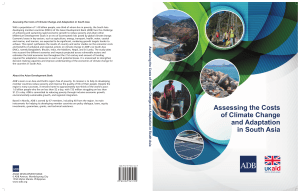
Assessing the Costs of Climate Change and Adaptation in South Asia
... to high population density, poverty, and lack of resources for adaptation. The region exhibits a broad range of extremes: in topography, from the tallest mountains to the largest deltas to atolls barely above level; in precipitation, from arid lands to vast plains subject to unpredictable flooding; ...
... to high population density, poverty, and lack of resources for adaptation. The region exhibits a broad range of extremes: in topography, from the tallest mountains to the largest deltas to atolls barely above level; in precipitation, from arid lands to vast plains subject to unpredictable flooding; ...

6th Hwa Chong Model ASEAN Summit
... fragments which denote the reasons for taking action. These should not propose any action. They should begin with a preambulatory phrase (which should be underlined), a list of which is provided below, have a line spacing between each clause, and end with a comma. Expressing its appreciation of the ...
... fragments which denote the reasons for taking action. These should not propose any action. They should begin with a preambulatory phrase (which should be underlined), a list of which is provided below, have a line spacing between each clause, and end with a comma. Expressing its appreciation of the ...

Trends in Extreme Precipitation Events for the Northeastern United
... Examining recent trends in extreme precipitation events of different magnitudes provides baseline data that can be used to inform a variety of decisions to enhance community resilience and reduce the impacts of future extreme precipitation events. For example, traditional practice in stormwater mana ...
... Examining recent trends in extreme precipitation events of different magnitudes provides baseline data that can be used to inform a variety of decisions to enhance community resilience and reduce the impacts of future extreme precipitation events. For example, traditional practice in stormwater mana ...

Drivers of Biodiversity Loss
... climate change and land use change (or combinations of these) drivers is also huge. For example, during the 21st century, predictions are that between c. 0.1% and 50% of all bird species will become extinct, and between 0.2-60% of all plant species (Pereira et al. 2010). Pereira et al. (2010) explai ...
... climate change and land use change (or combinations of these) drivers is also huge. For example, during the 21st century, predictions are that between c. 0.1% and 50% of all bird species will become extinct, and between 0.2-60% of all plant species (Pereira et al. 2010). Pereira et al. (2010) explai ...

Accurate estimates of yield gaps - Van Bussel et al 2015
... et al., 2013). For irrigated systems, the theoretically possible yield (yield potential, Yp ) is defined as the yield of an adapted crop cultivar when grown without water and nutrient limitations and biotic stress effectively controlled, i.e. yield is determined by prevailing radiation, temperature a ...
... et al., 2013). For irrigated systems, the theoretically possible yield (yield potential, Yp ) is defined as the yield of an adapted crop cultivar when grown without water and nutrient limitations and biotic stress effectively controlled, i.e. yield is determined by prevailing radiation, temperature a ...

Presentation from Professor Bill McGuire
... world’s agricultural land – Thames Barrier ineffective ...
... world’s agricultural land – Thames Barrier ineffective ...
Effects of global warming on humans

Climate change has brought about possibly permanent alterations to our planet’s geological, biological and ecological systems. The Intergovernmental Panel on Climate Change (IPCC) contended in 2003 that “there is new and stronger evidence that most of the warming observed over the last 50 years is attributable to human activities”. These changes have led to the emergence of large-scale environmental hazards to human health, such as extreme weather, ozone depletion, increased danger of wildland fires, loss of biodiversity, stresses to food-producing systems and the global spread of infectious diseases. The World Health Organization (WHO) estimates that 160,000 deaths, since 1950, are directly attributable to climate change. Many believe this to be a conservative estimate.To date, a neglected aspect of the climate change debate, much less research has been conducted on the impacts of climate change on health, food supply, economic growth, migration, security, societal change, and public goods, such as drinking water, than on the geophysical changes related to global warming. Human impacts can be both negative and positive. Climatic changes in Siberia, for instance, are expected to improve food production and local economic activity, at least in the short to medium term. Numerous studies suggest, however, that the current and future impacts of climate change on human society are and will continue to be overwhelmingly negative.The majority of the adverse effects of climate change are experienced by poor and low-income communities around the world, who have much higher levels of vulnerability to environmental determinants of health, wealth and other factors, and much lower levels of capacity available for coping with environmental change. A report on the global human impact of climate change published by the Global Humanitarian Forum in 2009, estimated more than 300,000 deaths and about $125 billion in economic losses each year, and indicating that most climate change induced mortality is due to worsening floods and droughts in developing countries. This also raises questions of climate justice, since the 50 least developed countries of the world account for not more than 1% of worldwide emissions of greenhouse gases.