The Impact of CO2 Emissions on Agricultural Productivity and
... Equilibrium (CGE) analysis. These studies focused on examining the economy-wide impact of climate change, focusing on productivity, food security, income distribution and the role of adaptation. However, to the best of our knowledge, research on estimating the economic impacts of CO2 emissions is li ...
... Equilibrium (CGE) analysis. These studies focused on examining the economy-wide impact of climate change, focusing on productivity, food security, income distribution and the role of adaptation. However, to the best of our knowledge, research on estimating the economic impacts of CO2 emissions is li ...

Assessing the Risk of a Collapse of the Atlantic Thermohaline
... billion watts (10 watts, a petawatt). As a result of this northward heat transport, at least in part, Europe is up to 8°C warmer than other longitudes at its latitude, with the largest effect in winter. It is this comparatively mild European climate, as well as the interrelated climates elsewhere, t ...
... billion watts (10 watts, a petawatt). As a result of this northward heat transport, at least in part, Europe is up to 8°C warmer than other longitudes at its latitude, with the largest effect in winter. It is this comparatively mild European climate, as well as the interrelated climates elsewhere, t ...
Climate Change - Arab Forum for Environment and Development
... (AFED). The first AFED report, published in 2008 under the title ‘Arab Environment: Future Challenges’, covered the most pressing environmental issues facing the region, and went beyond to provide a policy-oriented analysis. The report was presented to AFED’s annual conference which convened in Mana ...
... (AFED). The first AFED report, published in 2008 under the title ‘Arab Environment: Future Challenges’, covered the most pressing environmental issues facing the region, and went beyond to provide a policy-oriented analysis. The report was presented to AFED’s annual conference which convened in Mana ...

Impact of Climate Change on Thermal Power Plants
... In 2009, over 80% of the electricity in the world was generated using thermal power plants (IEA, 2011 ; Linnerund et al., 2011). Although technologies might change and we could see a switching to cleaner electricity, the proportion of thermal power plants in the global mix (exclusive of solar and ge ...
... In 2009, over 80% of the electricity in the world was generated using thermal power plants (IEA, 2011 ; Linnerund et al., 2011). Although technologies might change and we could see a switching to cleaner electricity, the proportion of thermal power plants in the global mix (exclusive of solar and ge ...

climate-smart agriculture in africa - International Policy Centre for
... climate change challenges and scales, and to meet the needs of different actors. But will it deliver? There are challenges, but the evidence presented in this e-discussion—based on experiences from across the globe—offers grounds for optimism. Participants provided insights drawn from South and Cent ...
... climate change challenges and scales, and to meet the needs of different actors. But will it deliver? There are challenges, but the evidence presented in this e-discussion—based on experiences from across the globe—offers grounds for optimism. Participants provided insights drawn from South and Cent ...

WWF Global 200 Reportfinal
... (the “Global 200” of WWF). In a real sense, these ecoregions represent the crown jewels of the planet’s biological diversity. These ecoregions are of special significance from a global warming perspective for the same reason that they were chosen for their biodiversity value — namely their broad rep ...
... (the “Global 200” of WWF). In a real sense, these ecoregions represent the crown jewels of the planet’s biological diversity. These ecoregions are of special significance from a global warming perspective for the same reason that they were chosen for their biodiversity value — namely their broad rep ...
Florida on the Coast of Climate Change: Responding to
... underwater refuges, Florida is a "biodiversity hot spot. '32 Salt-water intrusion and storm damage expected to result from sea level rise threaten the survival of ...
... underwater refuges, Florida is a "biodiversity hot spot. '32 Salt-water intrusion and storm damage expected to result from sea level rise threaten the survival of ...
IFinland`s National Strategy for Adaptation to Climate Change
... compiled the climate change scenarios based on the existing international and national data. According to the estimates on the future climate change in Finland, by 2080 the average temperature could rise by 4 - 6°C and the average precipitation would grow by 15 - 25 %. Extreme weather events, such a ...
... compiled the climate change scenarios based on the existing international and national data. According to the estimates on the future climate change in Finland, by 2080 the average temperature could rise by 4 - 6°C and the average precipitation would grow by 15 - 25 %. Extreme weather events, such a ...

ALLIE SALLUVINIQ - RESOLUTE I was born at lnukjuaq, Quebec in
... remember so I probably can talk that I remember when I was a child. When I was a child we always use to live in outpost camps at Grewell Bay and near Fort Ross. We would live in either of those two (2) places those are the things that I remember. In my teen years I use to always leave to go to schoo ...
... remember so I probably can talk that I remember when I was a child. When I was a child we always use to live in outpost camps at Grewell Bay and near Fort Ross. We would live in either of those two (2) places those are the things that I remember. In my teen years I use to always leave to go to schoo ...
The Paris Agreement and Beyond: International Climate Change
... Cooperation (Beijing); and Resources for the Future (Washington, D.C.) The Harvard Project has conducted numerous roundtables engaging researchers, policy makers, and stakeholders (advocates and leaders in business and non-governmental organizations), in Brussels, Washington, D.C., Canberra, Rome, L ...
... Cooperation (Beijing); and Resources for the Future (Washington, D.C.) The Harvard Project has conducted numerous roundtables engaging researchers, policy makers, and stakeholders (advocates and leaders in business and non-governmental organizations), in Brussels, Washington, D.C., Canberra, Rome, L ...

Positive feedback between global warming and atmospheric CO2
... temperature in this period. However, results differ depending on the particular temperature reconstruction and the CO2 data used. To explore this further we fitted linear regressions through different reconstructed drops in temperature and CO2 observed between the years 1200 and 1700. Using the high ...
... temperature in this period. However, results differ depending on the particular temperature reconstruction and the CO2 data used. To explore this further we fitted linear regressions through different reconstructed drops in temperature and CO2 observed between the years 1200 and 1700. Using the high ...

How inhibiting nitrification affects nitrogen cycle and reduces
... reactive N inputs in the past 50–100 years, causing deleterious effects on the environment through increased N leaching and nitrous oxide (N2O) and ammonia (NH3) emissions. Leaching and gaseous losses of N are greatly controlled by the net rate of microbial nitrification. Extensive experiments have ...
... reactive N inputs in the past 50–100 years, causing deleterious effects on the environment through increased N leaching and nitrous oxide (N2O) and ammonia (NH3) emissions. Leaching and gaseous losses of N are greatly controlled by the net rate of microbial nitrification. Extensive experiments have ...

$doc.title
... “greenhouse gas” that contributes to global warming). In its most recent report, the Intergovernmental Panel on Climate Change (“IPCC”) confirmed that it is “unequivocal” that the world’s climate is warming. See IPCC, Climate Change 2007: Synthesis Report, Summary for Policymakers, at 1 (Nov. 2007). ...
... “greenhouse gas” that contributes to global warming). In its most recent report, the Intergovernmental Panel on Climate Change (“IPCC”) confirmed that it is “unequivocal” that the world’s climate is warming. See IPCC, Climate Change 2007: Synthesis Report, Summary for Policymakers, at 1 (Nov. 2007). ...

American Climate Prospectus - Goldman School of Public Policy
... must weigh the potential economic and social impacts of climate change against the costs of policies to reduce GHG emissions (mitigation) or make our economy more resilient (adaptation). State and city officials need to identify local vulnerabilities in order to make sound infrastructure investments ...
... must weigh the potential economic and social impacts of climate change against the costs of policies to reduce GHG emissions (mitigation) or make our economy more resilient (adaptation). State and city officials need to identify local vulnerabilities in order to make sound infrastructure investments ...

Sensitivity of tree growth to the atmospheric vertical profile in the
... a variety of physiological, demographic, and ecosystem processes (Bonan 2002). Together, these processes determine where plant species grow, how well they grow, and how their arrangement within the communities changes over time (Bonan 2002). In this context, any changes in the state of weather and c ...
... a variety of physiological, demographic, and ecosystem processes (Bonan 2002). Together, these processes determine where plant species grow, how well they grow, and how their arrangement within the communities changes over time (Bonan 2002). In this context, any changes in the state of weather and c ...
SADC Policy paper on Climate Change
... their respective economic and technical capacity to tackle adaptation. It is for these reasons that SADC Member States have signed onto the UNFCCC and its Kyoto Protocol. ...
... their respective economic and technical capacity to tackle adaptation. It is for these reasons that SADC Member States have signed onto the UNFCCC and its Kyoto Protocol. ...

multiple demands on water and needs for adaptation to climate
... Temperature exhibits a slight rising trend since 1975. This increasing trend for temperature is expected to continue during the 21st century. Precipitation is expected to decrease, although some regional models claim the opposite. Considering the relationship between precipitation and runoff, correl ...
... Temperature exhibits a slight rising trend since 1975. This increasing trend for temperature is expected to continue during the 21st century. Precipitation is expected to decrease, although some regional models claim the opposite. Considering the relationship between precipitation and runoff, correl ...
Stratospheric Aerosol Geoengineering
... Assessment Report, which stated that ‘‘It is extremely likely that human influence has been the dominant cause of the observed warming since the mid-20th century.’’ ‘‘Extremely likely’’ is defined as with a greater than 95% probability of occurrence, using the expert judgment of the IPCC scientists. ...
... Assessment Report, which stated that ‘‘It is extremely likely that human influence has been the dominant cause of the observed warming since the mid-20th century.’’ ‘‘Extremely likely’’ is defined as with a greater than 95% probability of occurrence, using the expert judgment of the IPCC scientists. ...
Climate Scenario Development
... Scenarios are neither predictions nor forecasts of future conditions. Rather they describe alternative plausible futures that conform to sets of circumstances or constraints within which they occur (Hammond, 1996). The true purpose of scenarios is to illuminate uncertainty, as they help in determini ...
... Scenarios are neither predictions nor forecasts of future conditions. Rather they describe alternative plausible futures that conform to sets of circumstances or constraints within which they occur (Hammond, 1996). The true purpose of scenarios is to illuminate uncertainty, as they help in determini ...

DRAFT (2/15/2012) – PLEASE DO NOT CITE, QUOTE OR REPRODUCE A M -D
... address a regulatory problem, such as climate change, may be appropriate along one dimension, but not others. A. Normative Considerations for Allocation of Authority Determining the appropriate ways in which to allocate the authority to design and implement government programs, including programs to ...
... address a regulatory problem, such as climate change, may be appropriate along one dimension, but not others. A. Normative Considerations for Allocation of Authority Determining the appropriate ways in which to allocate the authority to design and implement government programs, including programs to ...
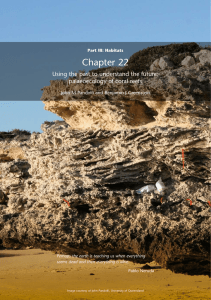
Using the past to understand the future
... a large number of ‘abrupt climate change’ events during the more recent geologic past when most living marine communities originated and thrived. Abrupt climate change occurs when ‘the climate system is forced to cross some threshold, triggering a transition to a new state at a rate determined by th ...
... a large number of ‘abrupt climate change’ events during the more recent geologic past when most living marine communities originated and thrived. Abrupt climate change occurs when ‘the climate system is forced to cross some threshold, triggering a transition to a new state at a rate determined by th ...
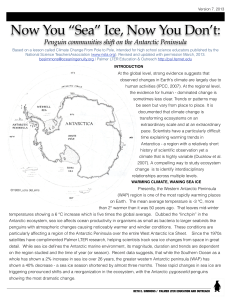
Now you Sea Ice, Now you Don`t
... observed changes in Earth’s climate are largely due to human activities (IPCC, 2007). At the regional level, the evidence for human - dominated change is sometimes less clear. Trends or patterns may be seen but vary from place to place. It is documented that climate change is transforming ecosystems ...
... observed changes in Earth’s climate are largely due to human activities (IPCC, 2007). At the regional level, the evidence for human - dominated change is sometimes less clear. Trends or patterns may be seen but vary from place to place. It is documented that climate change is transforming ecosystems ...

Climate Change Vulnerability Assessment Tool for Coastal Habitats
... including Eric Brunden, Nina Garfield, Pati Glick, and Pati Delgado. The development team is also appreciative for members of the scientific community who took time to review and provide suggestions on this guidance document including Norm Christensen, Scott Neubauer, R.E. Turner, and Mike Unger. Th ...
... including Eric Brunden, Nina Garfield, Pati Glick, and Pati Delgado. The development team is also appreciative for members of the scientific community who took time to review and provide suggestions on this guidance document including Norm Christensen, Scott Neubauer, R.E. Turner, and Mike Unger. Th ...

Natural selection and climate change: temperature
... Mitton et al. 1989). Such environmental correlation of molecular marker diversity is interpreted as evidence of adaptive genetic differentiation (Linhart & Grant 1996; Nevo 2001). The opposing view, based on evidence gained from some of the same species, is that these correlations of alleles with pa ...
... Mitton et al. 1989). Such environmental correlation of molecular marker diversity is interpreted as evidence of adaptive genetic differentiation (Linhart & Grant 1996; Nevo 2001). The opposing view, based on evidence gained from some of the same species, is that these correlations of alleles with pa ...

Disaster and Climate Change Risks Screening
... Tsunami possible/likely on some coasts. Lowland agri-business and subsistence farming in these regions at significant risk. ...
... Tsunami possible/likely on some coasts. Lowland agri-business and subsistence farming in these regions at significant risk. ...
Effects of global warming on humans

Climate change has brought about possibly permanent alterations to our planet’s geological, biological and ecological systems. The Intergovernmental Panel on Climate Change (IPCC) contended in 2003 that “there is new and stronger evidence that most of the warming observed over the last 50 years is attributable to human activities”. These changes have led to the emergence of large-scale environmental hazards to human health, such as extreme weather, ozone depletion, increased danger of wildland fires, loss of biodiversity, stresses to food-producing systems and the global spread of infectious diseases. The World Health Organization (WHO) estimates that 160,000 deaths, since 1950, are directly attributable to climate change. Many believe this to be a conservative estimate.To date, a neglected aspect of the climate change debate, much less research has been conducted on the impacts of climate change on health, food supply, economic growth, migration, security, societal change, and public goods, such as drinking water, than on the geophysical changes related to global warming. Human impacts can be both negative and positive. Climatic changes in Siberia, for instance, are expected to improve food production and local economic activity, at least in the short to medium term. Numerous studies suggest, however, that the current and future impacts of climate change on human society are and will continue to be overwhelmingly negative.The majority of the adverse effects of climate change are experienced by poor and low-income communities around the world, who have much higher levels of vulnerability to environmental determinants of health, wealth and other factors, and much lower levels of capacity available for coping with environmental change. A report on the global human impact of climate change published by the Global Humanitarian Forum in 2009, estimated more than 300,000 deaths and about $125 billion in economic losses each year, and indicating that most climate change induced mortality is due to worsening floods and droughts in developing countries. This also raises questions of climate justice, since the 50 least developed countries of the world account for not more than 1% of worldwide emissions of greenhouse gases.