

impact of aerosols on the hydrological cycle
... Diehl (2006) show that if, in addition to mineral dust, hydrophilic black carbon aerosols are assumed to act as ice nuclei at temperatures between 0°C and –35°C, then increases in ice nuclei in the present-day climate as compared to pre-industrial times result in more frequent glaciation of supercoo ...
... Diehl (2006) show that if, in addition to mineral dust, hydrophilic black carbon aerosols are assumed to act as ice nuclei at temperatures between 0°C and –35°C, then increases in ice nuclei in the present-day climate as compared to pre-industrial times result in more frequent glaciation of supercoo ...

High-impact Sectors: the Challenge of Reporting on Climate Change
... air and ocean temperatures, widespread melting of snow and ice and rising global average sea level. (p. 2) most of the observed increase in global average temperatures since the mid-20th century is very likely due to the observed increase in anthropogenic GHG concentrations. It is likely that there ...
... air and ocean temperatures, widespread melting of snow and ice and rising global average sea level. (p. 2) most of the observed increase in global average temperatures since the mid-20th century is very likely due to the observed increase in anthropogenic GHG concentrations. It is likely that there ...

Two Decades of the Atlantic Meridional Overturning
... Even when three-space-dimensional ocean models finally emerged, the zonally integrated properties of the circulation were retained as the sine qua non of the ocean circulation in climate. The volume of numbers required and the complexity of the zonally integrated fields are much less than that of th ...
... Even when three-space-dimensional ocean models finally emerged, the zonally integrated properties of the circulation were retained as the sine qua non of the ocean circulation in climate. The volume of numbers required and the complexity of the zonally integrated fields are much less than that of th ...

Agriculture and Future Climate Dynamics in Africa: Impacts and Adaptation Options
... hydrological factors influencing agricultural production. In addition to measuring impacts on aggregate revenue, the study examined variations in the response of three distinct production systems characterising African agriculture: specialised crop; specialised livestock and mixed crop and livestock ...
... hydrological factors influencing agricultural production. In addition to measuring impacts on aggregate revenue, the study examined variations in the response of three distinct production systems characterising African agriculture: specialised crop; specialised livestock and mixed crop and livestock ...

Waning habitats due to climate change: effects of streamflow and
... et al., 2016), America (e.g., Kaushal et al., 2010) and Australia (e.g., Chessman, 2009). Flow regimes are also being influenced by changes in precipitation, although those trends vary by climatic region (IPCC, 2013; Morán-Tejeda et al., 2014). The predictions of the International Panel of Climate C ...
... et al., 2016), America (e.g., Kaushal et al., 2010) and Australia (e.g., Chessman, 2009). Flow regimes are also being influenced by changes in precipitation, although those trends vary by climatic region (IPCC, 2013; Morán-Tejeda et al., 2014). The predictions of the International Panel of Climate C ...

PDF
... average temperature and rainfall for a crop, the authors used the notion of a “global growing season” defined as the period during which precipitation and temperature were most highly correlated with yield. One possible reason many studies continue to ignore the importance of farmer behavior is t ...
... average temperature and rainfall for a crop, the authors used the notion of a “global growing season” defined as the period during which precipitation and temperature were most highly correlated with yield. One possible reason many studies continue to ignore the importance of farmer behavior is t ...
lcmexl978i.pdf
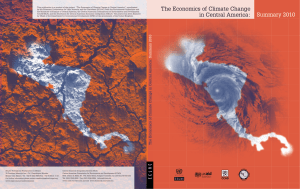
... This publication was produced under the auspices of an agreement between the United Kingdom Department for International Development (DFID) and the Subregional Headquarters of the Economic Commission for Central America and the Caribbean (ECLAC) in Mexico City, as part of the Project “The Economics ...
... This publication was produced under the auspices of an agreement between the United Kingdom Department for International Development (DFID) and the Subregional Headquarters of the Economic Commission for Central America and the Caribbean (ECLAC) in Mexico City, as part of the Project “The Economics ...

Climate finance in the Pacific: An overview of flows to the region`s
... The Small Island Developing States (SIDS) of the Pacific face serious threats from climate change, particularly due to sea-level rise. Addressing these threats will require a wide array of adaptation measures, at a cost that far exceeds many countries’ financial capacities. At the same time, governm ...
... The Small Island Developing States (SIDS) of the Pacific face serious threats from climate change, particularly due to sea-level rise. Addressing these threats will require a wide array of adaptation measures, at a cost that far exceeds many countries’ financial capacities. At the same time, governm ...

the Point of No Return report
... Energy Outlook that no more than one-third of the carbon contained in the proven reserves of fossil fuels can be released into the atmosphere by 2050 if the world is to achieve the 2°C goal.30 The 14 projects alone would eat up 30% of the carbon budget by 2050, and would ensure total emissions excee ...
... Energy Outlook that no more than one-third of the carbon contained in the proven reserves of fossil fuels can be released into the atmosphere by 2050 if the world is to achieve the 2°C goal.30 The 14 projects alone would eat up 30% of the carbon budget by 2050, and would ensure total emissions excee ...
Global Warming Index - Debate Central
... 13.7% South East Asia: 12.2% Japan: 3.7% South America/Central America: 3.8% Middle East: 2.6% Africa: 2.5% Australia: 1.1% These figures amply illustrate how Western Europe and the United States are by far largely responsible for the effects of global warming we are seeing today. Contrastingly the ...
... 13.7% South East Asia: 12.2% Japan: 3.7% South America/Central America: 3.8% Middle East: 2.6% Africa: 2.5% Australia: 1.1% These figures amply illustrate how Western Europe and the United States are by far largely responsible for the effects of global warming we are seeing today. Contrastingly the ...

LIFE and climate change adaptation
... climate adaptation measures, including ‘blue infrastructure’ to provide additional flood storage capacity and reduce overheating risks in urban areas. European Agricultural Fund for Rural Development (EAFRD) - Climate adaptation can be mainstreamed into agriculture through Rural Development Programm ...
... climate adaptation measures, including ‘blue infrastructure’ to provide additional flood storage capacity and reduce overheating risks in urban areas. European Agricultural Fund for Rural Development (EAFRD) - Climate adaptation can be mainstreamed into agriculture through Rural Development Programm ...

(GHG) mitigation within the Agriculture and Forestry
... protect our prosperity and quality of life. The OECD (2012) estimates that by 2050 the world population will reach nine billion, 70% of whom will live in urban areas. Demand for food, water and land will increase and also place further pressures on the environment. Challenges such as air pollution, ...
... protect our prosperity and quality of life. The OECD (2012) estimates that by 2050 the world population will reach nine billion, 70% of whom will live in urban areas. Demand for food, water and land will increase and also place further pressures on the environment. Challenges such as air pollution, ...

PDF
... also eliminate the positive effects of increased CO2, becoming the environmental limiting factor for C gain and tree growth. On the other hand, increased precipitation would result in increased forest growth of loblolly pine (Wertin, McGuire, and Teskey, 2012). Forest Dynamics and Disturbance Events ...
... also eliminate the positive effects of increased CO2, becoming the environmental limiting factor for C gain and tree growth. On the other hand, increased precipitation would result in increased forest growth of loblolly pine (Wertin, McGuire, and Teskey, 2012). Forest Dynamics and Disturbance Events ...

Understanding Sustainability Jon Barrett
... prevalent definitions in the context of ecological sustainability, this handbook does not provide its own. Instead it aims, through the learning experiences it contains, to inspire each of us to reflect on what is ecologically sustainable and unsustainable in our own lives and to act on our conclusi ...
... prevalent definitions in the context of ecological sustainability, this handbook does not provide its own. Instead it aims, through the learning experiences it contains, to inspire each of us to reflect on what is ecologically sustainable and unsustainable in our own lives and to act on our conclusi ...

9 IEAGHG Information Paper 2014-19: Report on London Convention meeting LC-36... Very slow progress on Export of CO
... In terms of CCS, its importance cannot be hidden, both for reducing emissions from fossil fuels and also for combining with bioenergy to take CO2 out of the atmosphere (BECCS or BioCCS). The importance of CCS jumps out of table SPM2 (Table 3.2 in full report) where their analysis shows that removing ...
... In terms of CCS, its importance cannot be hidden, both for reducing emissions from fossil fuels and also for combining with bioenergy to take CO2 out of the atmosphere (BECCS or BioCCS). The importance of CCS jumps out of table SPM2 (Table 3.2 in full report) where their analysis shows that removing ...

Simulating Future Wheat Yields` Response to Climate Change and
... forcing (RF) is used. It is a metric that “represents the net change in the energy balance (radiative flux) of the Earth system” which results in a warming of the planet (Myhre et al. 2013). Between 1750 and 2005 RF has increased by 0.2 W/m2 mainly due to the increase in CO2 concentrations (from 27 ...
... forcing (RF) is used. It is a metric that “represents the net change in the energy balance (radiative flux) of the Earth system” which results in a warming of the planet (Myhre et al. 2013). Between 1750 and 2005 RF has increased by 0.2 W/m2 mainly due to the increase in CO2 concentrations (from 27 ...

Microorganisms and climate change: terrestrial feedbacks and
... fixed carbon back to the atmosphere through autotrophic respiration. Along with the release of a substantial portion of newly fixed carbon through their roots, plant litters form a main source of energy for soil heterotrophs, including microorganisms and animals; this carbon pool is respired back to ...
... fixed carbon back to the atmosphere through autotrophic respiration. Along with the release of a substantial portion of newly fixed carbon through their roots, plant litters form a main source of energy for soil heterotrophs, including microorganisms and animals; this carbon pool is respired back to ...

Adélie penguins coping with environmental change
... representing 9% of the world population and the full range of breeding colony sizes. Five years into the 14-year study (1997–2010) two very large icebergs (spanning 1.5 latitude degrees in length) grounded in waters adjacent to breeding colonies, dramatically altering environmental conditions during ...
... representing 9% of the world population and the full range of breeding colony sizes. Five years into the 14-year study (1997–2010) two very large icebergs (spanning 1.5 latitude degrees in length) grounded in waters adjacent to breeding colonies, dramatically altering environmental conditions during ...

Predicting how adaptation to climate change could affect ecological
... (C) Current climatic suitability Distribution models for wheat and maize were created using maximum entropy (MAXENT; ...
... (C) Current climatic suitability Distribution models for wheat and maize were created using maximum entropy (MAXENT; ...

UNITED UNTIIONS ENVIRONMENT PROGRAMME ( UNEP)
... Liberia has a large traditional subsistence sector and a relatively small industrial sector. The subsistence sector accounts for the primary economic activities employing about 70% of the population and is characterized by low productivity, use of traditional technologies based on hand tools and low ...
... Liberia has a large traditional subsistence sector and a relatively small industrial sector. The subsistence sector accounts for the primary economic activities employing about 70% of the population and is characterized by low productivity, use of traditional technologies based on hand tools and low ...

couverture IRIS_out - Memorial University
... The vegetation of Nunavik and Nunatsiavut changes from treeline to arctic/alpine tundra moving northward and upwards in elevation. Current and predicted environmental changes promote shrub growth as well as treeline expansion, but not in a uniform way. Research has documented an increasing trend in ...
... The vegetation of Nunavik and Nunatsiavut changes from treeline to arctic/alpine tundra moving northward and upwards in elevation. Current and predicted environmental changes promote shrub growth as well as treeline expansion, but not in a uniform way. Research has documented an increasing trend in ...

Impacts of temperature on giant panda habitat in the north Minshan
... Understanding the impacts of meteorological factors on giant pandas is necessary for future conservation measures in response to global climate change. We integrated temperature data with three main habitat parameters (elevation, vegetation type, and bamboo species) to evaluate the influence of clim ...
... Understanding the impacts of meteorological factors on giant pandas is necessary for future conservation measures in response to global climate change. We integrated temperature data with three main habitat parameters (elevation, vegetation type, and bamboo species) to evaluate the influence of clim ...
p4418-4433 - Parliament of Western Australia
... increase. An increase in peak wind gusts of between 40 and 50 knots results in a 100 per cent increase in the level of damage that can be expected during a storm. If a peak gust is 25 per cent more severe, it results in a 650 per cent increase in the damage suffered by the community and buildings. A ...
... increase. An increase in peak wind gusts of between 40 and 50 knots results in a 100 per cent increase in the level of damage that can be expected during a storm. If a peak gust is 25 per cent more severe, it results in a 650 per cent increase in the damage suffered by the community and buildings. A ...

Seedling Growth Performance of Cassia fistula (Linn.) Using Climate
... was found in low temperature scenario followed by existing temperature; mid and high temperature scenarios respectively. Also, average leaf number (21) was developed in low temperature scenario followed by existing (11); high (4) and mid (3) temperature scenarios respectively. The indigenous forest ...
... was found in low temperature scenario followed by existing temperature; mid and high temperature scenarios respectively. Also, average leaf number (21) was developed in low temperature scenario followed by existing (11); high (4) and mid (3) temperature scenarios respectively. The indigenous forest ...
Effects of global warming on humans

Climate change has brought about possibly permanent alterations to our planet’s geological, biological and ecological systems. The Intergovernmental Panel on Climate Change (IPCC) contended in 2003 that “there is new and stronger evidence that most of the warming observed over the last 50 years is attributable to human activities”. These changes have led to the emergence of large-scale environmental hazards to human health, such as extreme weather, ozone depletion, increased danger of wildland fires, loss of biodiversity, stresses to food-producing systems and the global spread of infectious diseases. The World Health Organization (WHO) estimates that 160,000 deaths, since 1950, are directly attributable to climate change. Many believe this to be a conservative estimate.To date, a neglected aspect of the climate change debate, much less research has been conducted on the impacts of climate change on health, food supply, economic growth, migration, security, societal change, and public goods, such as drinking water, than on the geophysical changes related to global warming. Human impacts can be both negative and positive. Climatic changes in Siberia, for instance, are expected to improve food production and local economic activity, at least in the short to medium term. Numerous studies suggest, however, that the current and future impacts of climate change on human society are and will continue to be overwhelmingly negative.The majority of the adverse effects of climate change are experienced by poor and low-income communities around the world, who have much higher levels of vulnerability to environmental determinants of health, wealth and other factors, and much lower levels of capacity available for coping with environmental change. A report on the global human impact of climate change published by the Global Humanitarian Forum in 2009, estimated more than 300,000 deaths and about $125 billion in economic losses each year, and indicating that most climate change induced mortality is due to worsening floods and droughts in developing countries. This also raises questions of climate justice, since the 50 least developed countries of the world account for not more than 1% of worldwide emissions of greenhouse gases.