
Focus on Learning - earthjay science
... historical geology, on the other hand, is to *This is a partial list of interest sections and specialties of associated societies affiliated with the Geological understand the origin of Earth and its deSociety of America (www.geosociety.org) and the American Geophysical Union (www.agu.org), two prov ...
... historical geology, on the other hand, is to *This is a partial list of interest sections and specialties of associated societies affiliated with the Geological understand the origin of Earth and its deSociety of America (www.geosociety.org) and the American Geophysical Union (www.agu.org), two prov ...

Sai Kung Geopark Tour
... Hong Kong region had experienced four phases of volcanic activities stretching over a long period of time from mid-Jurassic to early Cretaceous period. During the late Jurassic and early Cretaceous and for a period of six million years, Sai Kung area was actually closing up the violent period of Hon ...
... Hong Kong region had experienced four phases of volcanic activities stretching over a long period of time from mid-Jurassic to early Cretaceous period. During the late Jurassic and early Cretaceous and for a period of six million years, Sai Kung area was actually closing up the violent period of Hon ...

Paleogene Foredeep Basin Deposits of North
... Paleogene deposits of north-central Cuba have been identified as a deformed foredeep basin, whose stratigraphy recorded very well the collision of the Bahamas–Proto-Caribbean realm (North American plate) with the Caribbean plate, a process that occurred since latest Cretaceous to early Late Eocene t ...
... Paleogene deposits of north-central Cuba have been identified as a deformed foredeep basin, whose stratigraphy recorded very well the collision of the Bahamas–Proto-Caribbean realm (North American plate) with the Caribbean plate, a process that occurred since latest Cretaceous to early Late Eocene t ...
Plate-Tectonics A review
... Similar rock types extend from one continent to the other The rocks are also of the same age COCLUSIONS - perhaps the two continents were once part of a single largest continent? Imtiyaz A. Parvez, C-MMACS ...
... Similar rock types extend from one continent to the other The rocks are also of the same age COCLUSIONS - perhaps the two continents were once part of a single largest continent? Imtiyaz A. Parvez, C-MMACS ...
Chiarenzelli, J., Regan, S., Peck, W., Selleck, B., Cousens, B., Baird, G. and Shrady, C. (2010)
... is sequentially underlain by fine-grained aluminous rocks of the Popple Hill Gneiss (Carl, 1988) and equivalent major paragneiss of Engel and Engel (1953), and then the lower marble. Much of our knowledge of the Adirondack Lowlands stratigraphy comes from exploration related to the sedimentary exhal ...
... is sequentially underlain by fine-grained aluminous rocks of the Popple Hill Gneiss (Carl, 1988) and equivalent major paragneiss of Engel and Engel (1953), and then the lower marble. Much of our knowledge of the Adirondack Lowlands stratigraphy comes from exploration related to the sedimentary exhal ...

42. The Geochemistry of Oceanic Crust at the Onset of Rifting in the
... with continental break-up (White and McKenzie, 1989; McKenzie and Bickle, 1988; Campbell and Griffiths, 1990), basalts that erupted in this environment should reflect a higher extent of mantle melting than those that erupted at a mid-ocean ridge axis in a mature ocean basin. For a mid-ocean ridge ba ...
... with continental break-up (White and McKenzie, 1989; McKenzie and Bickle, 1988; Campbell and Griffiths, 1990), basalts that erupted in this environment should reflect a higher extent of mantle melting than those that erupted at a mid-ocean ridge axis in a mature ocean basin. For a mid-ocean ridge ba ...

Fountains of the Great Deep
... water source to erode them—enter the Grand Canyon? After studying this, you will see a gigantic, focused water source and a surprisingly simple, but complete, explanation for the Grand Canyon’s rapid formation as well as where all the dirt went. As you might expect, the Grand Canyon’s origin is dire ...
... water source to erode them—enter the Grand Canyon? After studying this, you will see a gigantic, focused water source and a surprisingly simple, but complete, explanation for the Grand Canyon’s rapid formation as well as where all the dirt went. As you might expect, the Grand Canyon’s origin is dire ...

Continental Margins
... Prominent features of the deep ocean basins include rugged oceanic ridges, flat abyssal plains, occasional deep trenches, and curving chains of volcanic islands. The processes of plate tectonics, erosion, and sediment deposition have shaped the continental margins and ocean basins. In the next chapt ...
... Prominent features of the deep ocean basins include rugged oceanic ridges, flat abyssal plains, occasional deep trenches, and curving chains of volcanic islands. The processes of plate tectonics, erosion, and sediment deposition have shaped the continental margins and ocean basins. In the next chapt ...

Introduction to metamorphic petrology
... Rio Tinto, Canadian Light Source, Saskatchewan Research Council, NSERC ...
... Rio Tinto, Canadian Light Source, Saskatchewan Research Council, NSERC ...
Physical Geology Lecture - FacultyWeb Support Center
... the plastic would remain molten. Since lead has a greater density, it would move downward in the vessel. As the temperature drops below 2000F, the plastic would begin to solidify on top of the lead, completing the separation. B. Formation of Continental (Sialic) Plates: Continental Accretion As more ...
... the plastic would remain molten. Since lead has a greater density, it would move downward in the vessel. As the temperature drops below 2000F, the plastic would begin to solidify on top of the lead, completing the separation. B. Formation of Continental (Sialic) Plates: Continental Accretion As more ...
From Source to Sinks in Auriferous Magmatic
... contrast, may physically separate, with chloride and chloride-complexed species (for example, Cu, Pb, Zn, K, and some Au) concentrated in the brine and H2S and bisulfidecomplexed species (potentially Au, Cu and As) concentrated in the vapour. In the porphyry environment, the high-temperature fluid a ...
... contrast, may physically separate, with chloride and chloride-complexed species (for example, Cu, Pb, Zn, K, and some Au) concentrated in the brine and H2S and bisulfidecomplexed species (potentially Au, Cu and As) concentrated in the vapour. In the porphyry environment, the high-temperature fluid a ...

The Early Cretaceous Arperos oceanic basin
... however, the Cretaceous submarine volcanics of the lower and the upper sequences are geochemically undistinguishable, and they cannot be interpreted to correspond to different lithotectonic units as discussed below. On the other hand, Freydier et al. deduce an OIB affinity for the volcanics of the l ...
... however, the Cretaceous submarine volcanics of the lower and the upper sequences are geochemically undistinguishable, and they cannot be interpreted to correspond to different lithotectonic units as discussed below. On the other hand, Freydier et al. deduce an OIB affinity for the volcanics of the l ...
Books recommended
... This course is designed to acquire the knowledge about the formation of various landforms on the surface of the earth. This will help the students to understand the processes by which the various types of structures developed on the earth surface due to erosional and depositional processes. ...
... This course is designed to acquire the knowledge about the formation of various landforms on the surface of the earth. This will help the students to understand the processes by which the various types of structures developed on the earth surface due to erosional and depositional processes. ...

cornell rock parks - Cornell`s Earth and Atmospheric Sciences
... The Cornell Rock Parks, now four in number, beautify and enrich the University’s campus and stand as a memorial to the generosity and foresight of the Bender family. The first two are located on the Engineering Quadrangle: in the early 1970s, Rock Park East was installed in front of Kimball and Thur ...
... The Cornell Rock Parks, now four in number, beautify and enrich the University’s campus and stand as a memorial to the generosity and foresight of the Bender family. The first two are located on the Engineering Quadrangle: in the early 1970s, Rock Park East was installed in front of Kimball and Thur ...
Igneous Rocks - AC Reynolds High
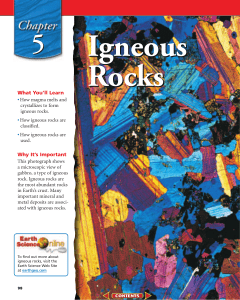
... overnight. Fine-grained igneous rocks that cool quickly on Earth’s surface are called extrusive igneous rocks. Coarse-grained igneous rocks that cool slowly beneath Earth’s surface are called intrusive igneous rocks. Granite is the most common intrusive igneous rock. Initially, scientists did not be ...
... overnight. Fine-grained igneous rocks that cool quickly on Earth’s surface are called extrusive igneous rocks. Coarse-grained igneous rocks that cool slowly beneath Earth’s surface are called intrusive igneous rocks. Granite is the most common intrusive igneous rock. Initially, scientists did not be ...

View Entire Bulletin - Ministry of Energy and Mines and Responsible
... Creek valley mark the course ...
... Creek valley mark the course ...

Carlin-Type and Low-Sulphidation Epithermal Gold Deposits
... years ago. The theory suggests they are associated with magmas (deeper in the crust). They are also associated with structures: inferred to be deep-seated and long-lived faults. ...
... years ago. The theory suggests they are associated with magmas (deeper in the crust). They are also associated with structures: inferred to be deep-seated and long-lived faults. ...

Diapositiva 1 - Claseshistoria.com
... sediments. Gradually, the sediments accumulated in layers over a long period of time hardens into rock. Generally, a sedimentary rock is fairly soft and may break apart or crumble easily. You can often see sand, pebbles, or stones in rocks, and it is usually the only type that contains fossils. ...
... sediments. Gradually, the sediments accumulated in layers over a long period of time hardens into rock. Generally, a sedimentary rock is fairly soft and may break apart or crumble easily. You can often see sand, pebbles, or stones in rocks, and it is usually the only type that contains fossils. ...

4- Igneous Rock (Intrusive)
... in these bodies, crystal settling has yielded very little felsic magma from an original mafic magma. If felsic magma could be derived on a large scale from mafic magma as Bowen thought, there should be far more mafic magma than felsic magma. For crystal settling to yield a particular volume of grani ...
... in these bodies, crystal settling has yielded very little felsic magma from an original mafic magma. If felsic magma could be derived on a large scale from mafic magma as Bowen thought, there should be far more mafic magma than felsic magma. For crystal settling to yield a particular volume of grani ...

Chapter 7 DIAGENESIS
... diagenesis as weird and terrible things that happen to sediments when they are buried. 1.2 The two most important diagenetic processes are compaction (the topic of a later section), and lithification, the term used for the complex of processes— including compaction—by which a loose sediment is conve ...
... diagenesis as weird and terrible things that happen to sediments when they are buried. 1.2 The two most important diagenetic processes are compaction (the topic of a later section), and lithification, the term used for the complex of processes— including compaction—by which a loose sediment is conve ...

NWGS NWCS
... later, strata of the Chuckanut Formation were deformed into continental margin composed of various terranes previously juxopen to tight N- to NW-trending folds, best described by taposed by along-margin translation (Brandon and others, 1988), Miller and Misch (1963). The folds may have been mechania ...
... later, strata of the Chuckanut Formation were deformed into continental margin composed of various terranes previously juxopen to tight N- to NW-trending folds, best described by taposed by along-margin translation (Brandon and others, 1988), Miller and Misch (1963). The folds may have been mechania ...
Jurassic igneous-related metallogeny of southwestern North America
... Although Jurassic igneous systems have not received as much attention as Cretaceous and Cenozoic igneous systems, a number of representative areas are well studied. These include plutons in southern Arizona (Haxel et al., 2008a,b) , the Mojave Desert (e.g. Fox and Miller, 1990; Young et al., 1992; M ...
... Although Jurassic igneous systems have not received as much attention as Cretaceous and Cenozoic igneous systems, a number of representative areas are well studied. These include plutons in southern Arizona (Haxel et al., 2008a,b) , the Mojave Desert (e.g. Fox and Miller, 1990; Young et al., 1992; M ...

geology
... Magma types: chemical composition, origin and distribution of The chemical compositions of rocks and magmas should be expressed in terms of oxides. basaltic, andesitic and granitic magmas; tectonic significance of It should be strongly pointed out, however, that the appearance of an oxide in an anal ...
... Magma types: chemical composition, origin and distribution of The chemical compositions of rocks and magmas should be expressed in terms of oxides. basaltic, andesitic and granitic magmas; tectonic significance of It should be strongly pointed out, however, that the appearance of an oxide in an anal ...

The Franklin Marble - State of New Jersey
... known as stromatolites were discovered in the marble (fig. 4), confirming that it formed in an ocean environment. During the collision of eastern North America and ancestral South America at about 1050 million years ago, rocks in the New Jersey Highlands were buried deep in the Earth’s crust where t ...
... known as stromatolites were discovered in the marble (fig. 4), confirming that it formed in an ocean environment. During the collision of eastern North America and ancestral South America at about 1050 million years ago, rocks in the New Jersey Highlands were buried deep in the Earth’s crust where t ...

KAROO SEDIMENTS OF THE ERONGO MOUNTAINS, THEIR
... cross-stratification (Fig. 12) suggest that the White Quartzite may largely be of aeolian origin with some fluvial reworking. 3. DEPOSITIONAL ENVIRONMENT AND CORRELATION Most of the Lions Head Formation was deposited in a proximal fluvial environment. The source area was situated to the north-west a ...
... cross-stratification (Fig. 12) suggest that the White Quartzite may largely be of aeolian origin with some fluvial reworking. 3. DEPOSITIONAL ENVIRONMENT AND CORRELATION Most of the Lions Head Formation was deposited in a proximal fluvial environment. The source area was situated to the north-west a ...
Geology of Great Britain

The geology of Great Britain is renowned for its diversity. As a result of its eventful geological history, Great Britain shows a rich variety of landscapes across the constituent countries of England, Wales and Scotland. Rocks of almost all geological ages are represented at outcrop, from the Archaean onwards.