BULLETIN OF THE GEOLOGICAL SOCIETY OF AMERICA
... Paleontology and biochemistry together may yield fairly definite information, eventually, about the paleochemistry of sea water and atmosphere. Several less conclusive lines of evidence now available suggest that the composition of both sea water and atmosphere may have varied somewhat during the pa ...
... Paleontology and biochemistry together may yield fairly definite information, eventually, about the paleochemistry of sea water and atmosphere. Several less conclusive lines of evidence now available suggest that the composition of both sea water and atmosphere may have varied somewhat during the pa ...
Answer Key
... Weathering is the process by which water, wind, ice, and heat break down rock. Erosion is the process by which sediment is removed from its source. Deposition is the process by which sediment moved by erosion is laid down. Uplift is the process by which rock within the Earth moves to Earth’s surface ...
... Weathering is the process by which water, wind, ice, and heat break down rock. Erosion is the process by which sediment is removed from its source. Deposition is the process by which sediment moved by erosion is laid down. Uplift is the process by which rock within the Earth moves to Earth’s surface ...

Stratigraphy and Structure Canberra 1:50 000 Geological Map Area
... Riverside Formation and the City Hill Shale. On the accompanying map the base of the Canberra Group has been lowered to include the Camp Hill Sandstone, which is thought to conformably underlie the Turner Mudstone, and the upper limit of the Canberra Group has been raised to include the St John's Ch ...
... Riverside Formation and the City Hill Shale. On the accompanying map the base of the Canberra Group has been lowered to include the Camp Hill Sandstone, which is thought to conformably underlie the Turner Mudstone, and the upper limit of the Canberra Group has been raised to include the St John's Ch ...
Rocks-Minerals - WordPress.com
... seek an eighth electron in their outer shell, can share an electron in what is known as a covalent bond, to form the gas Cl2. Electrons are shared in a covalent bond. Carbon has 6 protons and 6 electrons, 2 in the inner shell and 4 in the outer shell. Carbon would need to gain or lose 4 electrons to ...
... seek an eighth electron in their outer shell, can share an electron in what is known as a covalent bond, to form the gas Cl2. Electrons are shared in a covalent bond. Carbon has 6 protons and 6 electrons, 2 in the inner shell and 4 in the outer shell. Carbon would need to gain or lose 4 electrons to ...

The Precambrian Earth
... Early during the Proterozoic, small pieces of continental crust, called microcontinents, that formed during the Archean began to collide as a result of plate tectonics. The impact of the collisions jammed the microcontinents together, and they became larger continents. At each of these collision sit ...
... Early during the Proterozoic, small pieces of continental crust, called microcontinents, that formed during the Archean began to collide as a result of plate tectonics. The impact of the collisions jammed the microcontinents together, and they became larger continents. At each of these collision sit ...

University of Groningen Archaeological land evaluation
... From north to south, the Italian peninsula can be divided into the calcareous Alps, the alluvial Poplain, the Northern, Central and Southern Apennines and Sicily, running in north-west to south-east direction. Kamermans (1991) summarizes the geological history as follows: It is generally accepted th ...
... From north to south, the Italian peninsula can be divided into the calcareous Alps, the alluvial Poplain, the Northern, Central and Southern Apennines and Sicily, running in north-west to south-east direction. Kamermans (1991) summarizes the geological history as follows: It is generally accepted th ...

latest eocene to middle miocene plate tectonic model of the caribbean
... The orogeny which occurred in the Middle-Late Eocene is especially noteworthy. Associated with this orogeny were (1) reduction in the relative motion of the North and South American plates (Pindell, 1994: fig. 2.3), (2) reorientation of the Caribbean Plate stress field from mainly NE-SW to dominant ...
... The orogeny which occurred in the Middle-Late Eocene is especially noteworthy. Associated with this orogeny were (1) reduction in the relative motion of the North and South American plates (Pindell, 1994: fig. 2.3), (2) reorientation of the Caribbean Plate stress field from mainly NE-SW to dominant ...

Part 3: Normal faults and extensional tectonics
... depth, fabrics reflecting progressively colder and more brittle deformational envi ronments are superimposed upon one another. So, walking from the interior of the core complex out towards the lowgrade upper plate rocks ductile fabrics and my lonites will be overprinted by brittleductile transiti ...
... depth, fabrics reflecting progressively colder and more brittle deformational envi ronments are superimposed upon one another. So, walking from the interior of the core complex out towards the lowgrade upper plate rocks ductile fabrics and my lonites will be overprinted by brittleductile transiti ...
Mineral deposits and structurral pattern of the Big Burro Mountains
... The southwestern side of the Big Burro Mountain block is bounded by a narrow graben lying between the Taylor fault, which limits the Big Burro Mountain block, and the Malone fault which is the northeastern bounding fault of the Gold Hill block. A thick sequence of tilted Tertiary volcanic rocks, the ...
... The southwestern side of the Big Burro Mountain block is bounded by a narrow graben lying between the Taylor fault, which limits the Big Burro Mountain block, and the Malone fault which is the northeastern bounding fault of the Gold Hill block. A thick sequence of tilted Tertiary volcanic rocks, the ...

Horn corals
... seams. Coal is made of of carbon along with small amounts of other elements. Coal begins as layers of plant matter accumulating at the bottom of a body of water. For the process to continue, the plant matter must be protected from rotting, usually by mud or acidic water. This traps their carbon in i ...
... seams. Coal is made of of carbon along with small amounts of other elements. Coal begins as layers of plant matter accumulating at the bottom of a body of water. For the process to continue, the plant matter must be protected from rotting, usually by mud or acidic water. This traps their carbon in i ...

Geology SCarnarvon Regional - Offshore Petroleum Exploration
... unconformably overlain by thin Mesozoic and younger rocks, while the Merlinleigh and Byro sub-basins to the east are characterised by thick Pennsylvanian to Permian sequences over Devonian to Mississippian sequences. Due to collision between Australia and Eurasia in Mid-Miocene, the region has under ...
... unconformably overlain by thin Mesozoic and younger rocks, while the Merlinleigh and Byro sub-basins to the east are characterised by thick Pennsylvanian to Permian sequences over Devonian to Mississippian sequences. Due to collision between Australia and Eurasia in Mid-Miocene, the region has under ...
Paleozoic large igneous provinces of Northern Eurasia: Correlation
... Enormous lava eruptions formed large igneous provinces (LIPs) with millions of cubic kilometers emplaced in relatively short time intervals. Such magmatic events have been most likely initiated by the uplift of hot material from the core–mantle boundary and occurred several times during the Cenozoic ...
... Enormous lava eruptions formed large igneous provinces (LIPs) with millions of cubic kilometers emplaced in relatively short time intervals. Such magmatic events have been most likely initiated by the uplift of hot material from the core–mantle boundary and occurred several times during the Cenozoic ...
Update and economic significance of geological mapping in the
... lapilli tuff and crystal tuff, which define a roughly easttrending stratification in this unit. The breccia is characterized by a coarse, monolithic fragmental texture defined by very angular to subrounded, generally equant, unsorted fragments that range in size up to 25 cm (typically 1–5 cm). The frag ...
... lapilli tuff and crystal tuff, which define a roughly easttrending stratification in this unit. The breccia is characterized by a coarse, monolithic fragmental texture defined by very angular to subrounded, generally equant, unsorted fragments that range in size up to 25 cm (typically 1–5 cm). The frag ...

Structure of the larvikite-lardalite complex, Oslo
... Within the larvikite massif are occasionally found zones between 4 and 50 m wide with fine grained variants following the curvilenear structure elements. Loeally a gradation between aphyrie, fine grained varieties through porphyritic types to normal coarse grained larvikite is found. Crystal morphol ...
... Within the larvikite massif are occasionally found zones between 4 and 50 m wide with fine grained variants following the curvilenear structure elements. Loeally a gradation between aphyrie, fine grained varieties through porphyritic types to normal coarse grained larvikite is found. Crystal morphol ...
Neoproterozoic Conglomerate and Breccia in the Formation of
... Upper Formation of Leaton Gulch (OZlu) The upper part of the formation of Leaton Gulch (OZlu) unconformably overlies OZll on a channelized contact (Fig. 9), and consists of an upward-fining conglomerate to siltstone succession (see stratigraphic column, Fig. 4). The unit lacks outcrop scale folds, a ...
... Upper Formation of Leaton Gulch (OZlu) The upper part of the formation of Leaton Gulch (OZlu) unconformably overlies OZll on a channelized contact (Fig. 9), and consists of an upward-fining conglomerate to siltstone succession (see stratigraphic column, Fig. 4). The unit lacks outcrop scale folds, a ...

Understanding the thermal evolution of deep
... exploration, large and easily identifiable structures are favoured. Finally, hydrocarbons are less dense than interstitial waters, and so evidence for an unruptured seal, which would prevent buoyant hydrocarbons from leaking out, is needed. The best seals are finegrained rocks with low permeabilitie ...
... exploration, large and easily identifiable structures are favoured. Finally, hydrocarbons are less dense than interstitial waters, and so evidence for an unruptured seal, which would prevent buoyant hydrocarbons from leaking out, is needed. The best seals are finegrained rocks with low permeabilitie ...
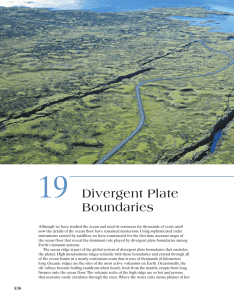
Divergent Plate Boundaries - North Coast Distance Education
... midocean ridge. Indeed, more rock is generated at this type of divergent plate boundary than by all other processes combined. Since the early periods of Earth’s history, igneous activity along divergent plate margins has generated enough basalt to cover the entire Earth with a layer about 120 km thi ...
... midocean ridge. Indeed, more rock is generated at this type of divergent plate boundary than by all other processes combined. Since the early periods of Earth’s history, igneous activity along divergent plate margins has generated enough basalt to cover the entire Earth with a layer about 120 km thi ...

Volcanoes and Igneous Activity Earth
... The transition of one rock into another by temperatures and/or pressures unlike those in which it formed Metamorphic rocks are produced from • Igneous rocks- Rocks formed from cooled Lava • Sedimentary rocks –Rocks formed from sediment piling on top of more sediment and forming rocks • Other metamor ...
... The transition of one rock into another by temperatures and/or pressures unlike those in which it formed Metamorphic rocks are produced from • Igneous rocks- Rocks formed from cooled Lava • Sedimentary rocks –Rocks formed from sediment piling on top of more sediment and forming rocks • Other metamor ...

The geology around the city of Guanajuato is specially interesting
... yet been carried out. A common phenomenon among Paleogene calcalkaline granites in other parts of the Cordillera is the presence of a peripheral ring of very small tonalitic bodies of slightly greater age and slightly greater depth of emplacement than the main granite (e.g., ar ...
... yet been carried out. A common phenomenon among Paleogene calcalkaline granites in other parts of the Cordillera is the presence of a peripheral ring of very small tonalitic bodies of slightly greater age and slightly greater depth of emplacement than the main granite (e.g., ar ...
Late Miocene to Pliocene stratigraphic evolution of northeast
... the gulf took place along a system of strike-slip faults and related pull-apart basins oriented parallel to the overall gulf trend between ,6 and 3.6 Ma (Lonsdale, 1989). Beginning ,3.5 Ma this fault zone evolved into the modern system of transform faults oriented ,208 more westerly than the gulf tr ...
... the gulf took place along a system of strike-slip faults and related pull-apart basins oriented parallel to the overall gulf trend between ,6 and 3.6 Ma (Lonsdale, 1989). Beginning ,3.5 Ma this fault zone evolved into the modern system of transform faults oriented ,208 more westerly than the gulf tr ...
The Floor of the Arctic Ocean in Photographs
... The level surface of the Canada Abyssal Plain covers the deepest part of the Canada Basin, an area of over 250,000 km.2. Depth varies little from 3,780 m. over the entire area. The bottom surface, with a slope of less than 1:1000, was evidently formed by turbidity currents which originated when sedi ...
... The level surface of the Canada Abyssal Plain covers the deepest part of the Canada Basin, an area of over 250,000 km.2. Depth varies little from 3,780 m. over the entire area. The bottom surface, with a slope of less than 1:1000, was evidently formed by turbidity currents which originated when sedi ...

Iron Ore Deposits of Afghanistan
... Afghanistan has been known since the first geological investigations by Hayden in 1911, and Brueckl in 1935 identified the ‘hematite bed’ that extends from Hajigak as far as the Panjshir valley. Subsequent investigations by Afghan-Soviet teams culminated in the identification of a very large deposit ...
... Afghanistan has been known since the first geological investigations by Hayden in 1911, and Brueckl in 1935 identified the ‘hematite bed’ that extends from Hajigak as far as the Panjshir valley. Subsequent investigations by Afghan-Soviet teams culminated in the identification of a very large deposit ...
DNR San Juan Islands Brandon
... Figure 2. Pre-Late Cretaceous terranes in the San Juan-Cascade nappes (modified from Brandon and others, 1988; see Table 1 for further details). Each column represents a separate terrane with its name appearing below. The continuous portion of a column shows rock units that are connected by demonstra ...
... Figure 2. Pre-Late Cretaceous terranes in the San Juan-Cascade nappes (modified from Brandon and others, 1988; see Table 1 for further details). Each column represents a separate terrane with its name appearing below. The continuous portion of a column shows rock units that are connected by demonstra ...
Earth`s Processes - Worth County Schools
... • Texture is described with terms based on grain size, grain shape, and grain pattern. Most rocks are made up of tiny particles of minerals or other rocks, which are called grains. A rock’s grains give it its texture. • There are three major groups of rocks: igneous rock, sedimentary rock, and metam ...
... • Texture is described with terms based on grain size, grain shape, and grain pattern. Most rocks are made up of tiny particles of minerals or other rocks, which are called grains. A rock’s grains give it its texture. • There are three major groups of rocks: igneous rock, sedimentary rock, and metam ...

Detrital Zircons from Missi Metasedimentary Rocks, Flin Flon Basin
... the Reindeer Zone did not occur until about 1810 Ma (Machado, 1990), and so the Flin Flon area was probably separated from Superior Province Archean rocks by an ocean basin at the time of Missi sedimentation. Bickford et al. (1990) suggest that collision between the Reindeer Zone, and the Rae-Hearne ...
... the Reindeer Zone did not occur until about 1810 Ma (Machado, 1990), and so the Flin Flon area was probably separated from Superior Province Archean rocks by an ocean basin at the time of Missi sedimentation. Bickford et al. (1990) suggest that collision between the Reindeer Zone, and the Rae-Hearne ...
Geology of Great Britain

The geology of Great Britain is renowned for its diversity. As a result of its eventful geological history, Great Britain shows a rich variety of landscapes across the constituent countries of England, Wales and Scotland. Rocks of almost all geological ages are represented at outcrop, from the Archaean onwards.