Memoir 36: Geology of Organ Mountains and southern San Andres
... describe sections of Paleozoic rocks that had not been described in detail or subdivided into up-to-date stratigraphic units, and finally 3) to investigate relationships between the Organ batholith and volcanic rocks in the southern Organ range, which recently were shown to be of the same age. Durin ...
... describe sections of Paleozoic rocks that had not been described in detail or subdivided into up-to-date stratigraphic units, and finally 3) to investigate relationships between the Organ batholith and volcanic rocks in the southern Organ range, which recently were shown to be of the same age. Durin ...

Metallogenesis of the world`s ocean against the background
... Abstract. This paper presents results of the studies on the metallogenesis of the deep-sea mineral resources and their sedimentary environment. Connections between the structure and evolution of the oceanic crust, with regard to the rules of occurrence and distribution of the ores, have been establi ...
... Abstract. This paper presents results of the studies on the metallogenesis of the deep-sea mineral resources and their sedimentary environment. Connections between the structure and evolution of the oceanic crust, with regard to the rules of occurrence and distribution of the ores, have been establi ...
Precambrian stratigraphy of Manzanita and north Manzano
... are present in the Hell Canyon—Bosque Peak area and consist of, in ascending order: (1) Moyos metasediments, composed of 580 m of phyllite and quartzite with the base not exposed; (2) the Hell Canyon greenstone, a mafic metavolcanic unit about 1,500 m thick; (3) Bosque metasediments, which consist o ...
... are present in the Hell Canyon—Bosque Peak area and consist of, in ascending order: (1) Moyos metasediments, composed of 580 m of phyllite and quartzite with the base not exposed; (2) the Hell Canyon greenstone, a mafic metavolcanic unit about 1,500 m thick; (3) Bosque metasediments, which consist o ...

Microsoft Word
... “Inorganic” means that it is not made of organic molecules. When scientists call a substance “organic,” they mean that the substance is made of complex molecules composed primarily of carbon and hydrogen. Examples of organic substances include oil, protein, wood, and leaves. “Organic” substances are ...
... “Inorganic” means that it is not made of organic molecules. When scientists call a substance “organic,” they mean that the substance is made of complex molecules composed primarily of carbon and hydrogen. Examples of organic substances include oil, protein, wood, and leaves. “Organic” substances are ...

Click here
... pervasive throughout the state. Exposed Proterozoic rocks are predominant in the northwest and central regions of the state, forming the bulk of the mountains that exist in the Transition Zone, but they are found elsewhere in smaller outcrops. In general, Proterozoic rocks in the northwest and far s ...
... pervasive throughout the state. Exposed Proterozoic rocks are predominant in the northwest and central regions of the state, forming the bulk of the mountains that exist in the Transition Zone, but they are found elsewhere in smaller outcrops. In general, Proterozoic rocks in the northwest and far s ...

Lab Activity #4: Refining Our Ability to Identify Minerals
... “Inorganic” means that it is not made of organic molecules. When scientists call a substance “organic,” they mean that the substance is made of complex molecules composed primarily of carbon and hydrogen. Examples of organic substances include oil, protein, wood, and leaves. “Organic” substances are ...
... “Inorganic” means that it is not made of organic molecules. When scientists call a substance “organic,” they mean that the substance is made of complex molecules composed primarily of carbon and hydrogen. Examples of organic substances include oil, protein, wood, and leaves. “Organic” substances are ...
2. Geophysics and the Structure of the Lesser Antilles Forearc
... Plate. The complex dates in part from the Eocene, and elements of the arc system have been dated as Late Cretaceous and Late Jurassic, although most of the volcanic rocks date from the Tertiary, particularly the latter part. It is probable that the arc system was moved a considerable distance eastwa ...
... Plate. The complex dates in part from the Eocene, and elements of the arc system have been dated as Late Cretaceous and Late Jurassic, although most of the volcanic rocks date from the Tertiary, particularly the latter part. It is probable that the arc system was moved a considerable distance eastwa ...
DOC, 365KB - Offshore Petroleum Exploration Acreage Release
... northeast–southwest structural lineament that forms a hinge-line between the Rowley Sub-basin and the Bedout and Oobagooma sub-basins, and concluded that these evolved during the same tectogenetic processes. This lineament terminates older northwest–southeast-trending Paleozoic structures (including ...
... northeast–southwest structural lineament that forms a hinge-line between the Rowley Sub-basin and the Bedout and Oobagooma sub-basins, and concluded that these evolved during the same tectogenetic processes. This lineament terminates older northwest–southeast-trending Paleozoic structures (including ...
Evidence for Early Cretaceous oceanic crust trapped in the
... partially discordant, probably as a result of some hydrothermal alteration on the oceanic £oor. This e¡ect is more pronounced in amphiboles from RD20 that do not display any plateau date, but discordant ages in the range 80^123 Ma. However, there is no record of younger dates which could suggest an ...
... partially discordant, probably as a result of some hydrothermal alteration on the oceanic £oor. This e¡ect is more pronounced in amphiboles from RD20 that do not display any plateau date, but discordant ages in the range 80^123 Ma. However, there is no record of younger dates which could suggest an ...
Physical Geology Laboratory Manual - e
... up to 2.5, a knife blade is near 6.5, window glass is 5.5 and a streak plate is near 6.5. Your problem is to determine the relative hardness of the given minerals by comparison to window glass. Procedure: Work with one specimen at a time. Record your results in Table 2. Step 1. Write mineral specime ...
... up to 2.5, a knife blade is near 6.5, window glass is 5.5 and a streak plate is near 6.5. Your problem is to determine the relative hardness of the given minerals by comparison to window glass. Procedure: Work with one specimen at a time. Record your results in Table 2. Step 1. Write mineral specime ...

GSA Bulletin: Late Cenozoic tectonics of the central and southern
... The individual ranges are mutually similar in ...
... The individual ranges are mutually similar in ...
54. Regional Geology of the Goban Spur Continental Margin
... CM 10) immediately landward of Site 549, Fig. 4). Sequence 1 is of relatively uniform thickness (500-1000 m), except over the seaward tips of the higher tilted blocks (e.g., beneath Sites 549 and 551, Figs. 4 and 5), where it may be notably thinner. A number of minor unconformities appear to be pres ...
... CM 10) immediately landward of Site 549, Fig. 4). Sequence 1 is of relatively uniform thickness (500-1000 m), except over the seaward tips of the higher tilted blocks (e.g., beneath Sites 549 and 551, Figs. 4 and 5), where it may be notably thinner. A number of minor unconformities appear to be pres ...
2200 million years of crustal evolution: the baltic shield
... The Early Archean ensialic basement of Late Archean greenstone belts in the easterncentral part of the shield is alleged to have formed the nucleus, with new crustal addition to the east during the Late Archean cycle. During the Svecokarelian cycle a diversified geosynclinal system developed on a pa ...
... The Early Archean ensialic basement of Late Archean greenstone belts in the easterncentral part of the shield is alleged to have formed the nucleus, with new crustal addition to the east during the Late Archean cycle. During the Svecokarelian cycle a diversified geosynclinal system developed on a pa ...
Geomorphology_Dics
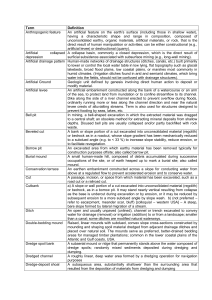
... A type of thermokarst depression with steep sides and a flat, grass-covered floor, found in thermokarst terrain, produced by thawing of extensive areas of very thick and exceedingly ice-rich permafrost. Alluvial cone A semi-conical type of alluvial fan with very steep slopes; it is higher, narrower, ...
... A type of thermokarst depression with steep sides and a flat, grass-covered floor, found in thermokarst terrain, produced by thawing of extensive areas of very thick and exceedingly ice-rich permafrost. Alluvial cone A semi-conical type of alluvial fan with very steep slopes; it is higher, narrower, ...
Immobile Element Fingerprinting of Ophiolites
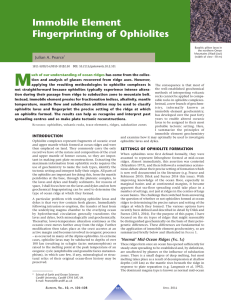
... beneath normal ridges. This leads to melting columns in which melting begins at greater depth than at plumedistal ridges. As a result, more melting takes place within the deeper garnet facies compared to the shallower spinel facies, and the overall degree of melting is higher. Unlike DMM, plume mant ...
... beneath normal ridges. This leads to melting columns in which melting begins at greater depth than at plumedistal ridges. As a result, more melting takes place within the deeper garnet facies compared to the shallower spinel facies, and the overall degree of melting is higher. Unlike DMM, plume mant ...
Petrography and illite crystallinity of the Lesser Himalayan
... Illite crystallinity Crystallinity of illite in pelitic rocks usually signifies the degree of ordering of crystal lattice of these minerals (Kübler, 1967). The crystallinity of illite increases with increasing metamorphic grade. Systematic changes in the shape of peaks of these minerals on X-ray dif ...
... Illite crystallinity Crystallinity of illite in pelitic rocks usually signifies the degree of ordering of crystal lattice of these minerals (Kübler, 1967). The crystallinity of illite increases with increasing metamorphic grade. Systematic changes in the shape of peaks of these minerals on X-ray dif ...
An integrated geophysical analysis of crustal structure in the Wichita
... The SOA comprises one of the most extensive exposures of igneous rocks within the mid-continent (McConnell and Gilbert, 1990). Ham et al. (1964) described in detail the exposed igneous and metamorphic rocks around the Wichita Mountains. The geology of the SOA can be divided into three stages spannin ...
... The SOA comprises one of the most extensive exposures of igneous rocks within the mid-continent (McConnell and Gilbert, 1990). Ham et al. (1964) described in detail the exposed igneous and metamorphic rocks around the Wichita Mountains. The geology of the SOA can be divided into three stages spannin ...
Figs 3.4 - Geoscience Australia
... have an impact on the global supply of REE. Primary hard-rock REE deposits are widely distributed throughout the continent, being particularly prominent in Proterozoic and Phanerozoic provinces (Fig. 3.1). The oldest REE deposits that have been dated in Australia are hosted by Archean pegmatites in ...
... have an impact on the global supply of REE. Primary hard-rock REE deposits are widely distributed throughout the continent, being particularly prominent in Proterozoic and Phanerozoic provinces (Fig. 3.1). The oldest REE deposits that have been dated in Australia are hosted by Archean pegmatites in ...
Accreted oceanic terranes in Ecuador: Southern edge of the
... Although the Andes of South America form a continuous mountain belt and result from processes related to oceanic subduction, the geological evolution varies latitudinally along the chain. The northern Andes differ from the Central Andes, by the lack of manifestations of oceanic subduction between la ...
... Although the Andes of South America form a continuous mountain belt and result from processes related to oceanic subduction, the geological evolution varies latitudinally along the chain. The northern Andes differ from the Central Andes, by the lack of manifestations of oceanic subduction between la ...
Chapter 5
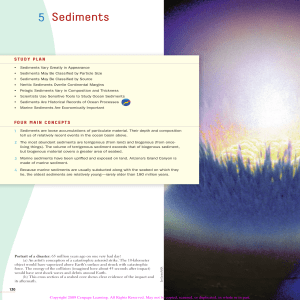
... of sediments collected during the Challenger expedition. A modern modification of their organization is shown in Table 5.2. This scheme separates sediments into four categories by source: terrigenous, biogenous, hydrogenous (or authigenic), and cosmogenous. Terrigenous Sediments Come from Land Terri ...
... of sediments collected during the Challenger expedition. A modern modification of their organization is shown in Table 5.2. This scheme separates sediments into four categories by source: terrigenous, biogenous, hydrogenous (or authigenic), and cosmogenous. Terrigenous Sediments Come from Land Terri ...

Geothermal gradients in continental magmatic arcs: Constraints from
... ambient temperature distribution (Condition II) lies anywhere between the upper limit defined by the MBG and the lower limit defined by a geothermal gradient that was present prior to arc magmatism. We conservatively assume this lower limit to be 18 °C/km, which is broadly characteristic of stable c ...
... ambient temperature distribution (Condition II) lies anywhere between the upper limit defined by the MBG and the lower limit defined by a geothermal gradient that was present prior to arc magmatism. We conservatively assume this lower limit to be 18 °C/km, which is broadly characteristic of stable c ...
Experimental_laboratory_files/2004_The source of Granites
... Archaean crust source for I-type granites receives strong support from field relations and laboratory experiments that will be discussed later on in this paper. The model also accounts for the decoupled behaviour of the Nd isotopic ratios of granite batholiths. If no other source components but rock ...
... Archaean crust source for I-type granites receives strong support from field relations and laboratory experiments that will be discussed later on in this paper. The model also accounts for the decoupled behaviour of the Nd isotopic ratios of granite batholiths. If no other source components but rock ...
Chapter 18: Volcanic Activity
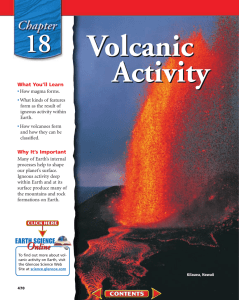
... Recall from Chapter 5 that the three major igneous rock types are basalt, andesite, and granite. These rocks form from three major types of magma: basaltic magma, andesitic magma, and rhyolitic magma. The term rhyolitic is used to describe the magma that solidifies to form granite because magmas are ...
... Recall from Chapter 5 that the three major igneous rock types are basalt, andesite, and granite. These rocks form from three major types of magma: basaltic magma, andesitic magma, and rhyolitic magma. The term rhyolitic is used to describe the magma that solidifies to form granite because magmas are ...
NWGS Methow
... accompanied by, and certainly was followed by, eastwardverging thrust faulting of the mid-Cretaceous Chwwanten fault system. These faults may be inferred to have been active from mid-AIbian (the time foreland-basin deposition was initiated) to about 90 Ma (the age of the youngest, Midnight Peak, str ...
... accompanied by, and certainly was followed by, eastwardverging thrust faulting of the mid-Cretaceous Chwwanten fault system. These faults may be inferred to have been active from mid-AIbian (the time foreland-basin deposition was initiated) to about 90 Ma (the age of the youngest, Midnight Peak, str ...
Geology of Great Britain

The geology of Great Britain is renowned for its diversity. As a result of its eventful geological history, Great Britain shows a rich variety of landscapes across the constituent countries of England, Wales and Scotland. Rocks of almost all geological ages are represented at outcrop, from the Archaean onwards.