
astronomy - sfox4science
... The universe is estimated to be over 10 billion years old. The universe is composed of galaxies, stars, planets, asteroids, comets, and meteors, each having different properties. Our solar system exists within the Milky Way galaxy. The known components of our solar system are the Sun, four terrestri ...
... The universe is estimated to be over 10 billion years old. The universe is composed of galaxies, stars, planets, asteroids, comets, and meteors, each having different properties. Our solar system exists within the Milky Way galaxy. The known components of our solar system are the Sun, four terrestri ...

previous mid-term () - Department of Physics and Astronomy
... a. Run-away greenhouse effect; carbon dioxide atmosphere. b. May also be called a trans-neptunian object; nitrogen methane atmosphere; not always the furthest planet from the Sun. c. First new planet discovered (by Herschel) since ancient times; hydrogen water and lots of chemicals. d. ¾ of all plan ...
... a. Run-away greenhouse effect; carbon dioxide atmosphere. b. May also be called a trans-neptunian object; nitrogen methane atmosphere; not always the furthest planet from the Sun. c. First new planet discovered (by Herschel) since ancient times; hydrogen water and lots of chemicals. d. ¾ of all plan ...

Exam #1 Review
... planets. For example: be able to discuss the differences in mass, density, size, etc.; be able to determine how many times larger the planet Jupiter is when compared to the Earth; number of moons; etc.. 14. If given a measurement scale (e.g. 1cm = 1000miles) and the distances and/or radii for ...
... planets. For example: be able to discuss the differences in mass, density, size, etc.; be able to determine how many times larger the planet Jupiter is when compared to the Earth; number of moons; etc.. 14. If given a measurement scale (e.g. 1cm = 1000miles) and the distances and/or radii for ...

Gravity and Motion Motion in astronomy Newton`s Laws of Motion
... An ellipse has polar equation where r, θ are distance and angle as seen from the focus, and a is the semimajor axis -the average distance from the Sun to the planet. The eccentricity e is the ratio of the centre-focus distance CF to the semimajor axis The sum r+r' (see figure) is constant and equal ...
... An ellipse has polar equation where r, θ are distance and angle as seen from the focus, and a is the semimajor axis -the average distance from the Sun to the planet. The eccentricity e is the ratio of the centre-focus distance CF to the semimajor axis The sum r+r' (see figure) is constant and equal ...

File
... around, forming an accretion disk. ►Sun formed in the middle from all the heat in the middle of the disk 3.Cooling of the disk caused small shapes to form 4. These cool forms combined to make the 4 SOLID inner planets ...
... around, forming an accretion disk. ►Sun formed in the middle from all the heat in the middle of the disk 3.Cooling of the disk caused small shapes to form 4. These cool forms combined to make the 4 SOLID inner planets ...

Ancient Astronomy
... • Having measured the position of a new star (now known as Tycho’s supernova), and observed no parallax, he concluded that it was farther away than the Moon. • This led him to question the Ptolemaic theory, according to which objects farther away than the Moon were celestial (therefore perfect) and ...
... • Having measured the position of a new star (now known as Tycho’s supernova), and observed no parallax, he concluded that it was farther away than the Moon. • This led him to question the Ptolemaic theory, according to which objects farther away than the Moon were celestial (therefore perfect) and ...

What If Earth Became Tidally Locked?
... in water vapor to go airborne. Life, if it manages to struggle along on such a planet, will either be underground or very, very hardy. So why are some planets and moons tidally locked while others are not? All planets bulge towards their stars, and all of them have their orbit slightly out of sync w ...
... in water vapor to go airborne. Life, if it manages to struggle along on such a planet, will either be underground or very, very hardy. So why are some planets and moons tidally locked while others are not? All planets bulge towards their stars, and all of them have their orbit slightly out of sync w ...

signatures of life on other worlds
... Kasting notes that this interpretation of the surface morphology on Mars is not universally accepted, but it is appealing. The possibility of a liquid-water phase in the planet’s history raises the question of whether life might have had an early start there with a thicker atmosphere that trapped he ...
... Kasting notes that this interpretation of the surface morphology on Mars is not universally accepted, but it is appealing. The possibility of a liquid-water phase in the planet’s history raises the question of whether life might have had an early start there with a thicker atmosphere that trapped he ...

tremaine_stanford
... • why are giant planets (M > 0.1 MJupiter = 30 MEarth) so common? • how common are smaller planets (< 30 MEarth )? • how do giant planets form at semi-major axes 200 times smaller than any solar-system giant? • why are there no planets more massive than » 15 MJ? • what are the relative roles of Phas ...
... • why are giant planets (M > 0.1 MJupiter = 30 MEarth) so common? • how common are smaller planets (< 30 MEarth )? • how do giant planets form at semi-major axes 200 times smaller than any solar-system giant? • why are there no planets more massive than » 15 MJ? • what are the relative roles of Phas ...

Outer or Jovian Planets - Academic Computer Center
... • Most asteroids orbit between Mars and Jupiter but there are some that cross the orbit of the Earth and other planets. • Most asteroids are not large enough to form into spheres. • Ceres, one of the largest asteroids, is about 1000 km in diameter (less than half the size of Pluto) and is spherical. ...
... • Most asteroids orbit between Mars and Jupiter but there are some that cross the orbit of the Earth and other planets. • Most asteroids are not large enough to form into spheres. • Ceres, one of the largest asteroids, is about 1000 km in diameter (less than half the size of Pluto) and is spherical. ...

What theory best explains the features of our
... • Many moons, including unusual Triton: orbits “backward”; and is larger than Pluto. ...
... • Many moons, including unusual Triton: orbits “backward”; and is larger than Pluto. ...

Document
... A brown dwarf is a substellar object below the sustained hydrogenburning limit of about 7.5% to 8.0% solar masses, and forms in a manner similar to stars by fragmentation of collapsing gas clouds. An extra-solar giant planet is a giant planet like Jupiter in orbit around a star other than the sun, a ...
... A brown dwarf is a substellar object below the sustained hydrogenburning limit of about 7.5% to 8.0% solar masses, and forms in a manner similar to stars by fragmentation of collapsing gas clouds. An extra-solar giant planet is a giant planet like Jupiter in orbit around a star other than the sun, a ...

SPACE By: Hailey Merrill and Katie Whatley Earth
... Three interesting facts Mars has 1/3 of the gravity that earth has witch means you could jump 3 times as high as you can on earth. Mars has tremendous wind storms in fact one of its storms covered the planet for several days. Mars has the biggest volcano in the entire solar system it is called Olymp ...
... Three interesting facts Mars has 1/3 of the gravity that earth has witch means you could jump 3 times as high as you can on earth. Mars has tremendous wind storms in fact one of its storms covered the planet for several days. Mars has the biggest volcano in the entire solar system it is called Olymp ...

Formation of Planets III
... they would never become part of a planet (which only gathered ___________ material). Today, however, most space between planets has no elements, it is empty. What happened to this gas? A possible solution has been found from observations of the early stages in life cycles of newly forming stars. Be ...
... they would never become part of a planet (which only gathered ___________ material). Today, however, most space between planets has no elements, it is empty. What happened to this gas? A possible solution has been found from observations of the early stages in life cycles of newly forming stars. Be ...
Rocket Science
... discouraged by PBIS, as it may result in little or no monetary gain after secondary education or a fine of $250,000. ...
... discouraged by PBIS, as it may result in little or no monetary gain after secondary education or a fine of $250,000. ...

Day_39
... Most of the extrasolar planets discovered to date are quite massive and have orbits that are very different from planets in our solar system ...
... Most of the extrasolar planets discovered to date are quite massive and have orbits that are very different from planets in our solar system ...

ASTR101 Unit 14 Assessment Answer Key 1. It is believed that the
... paradox. If other technological civilizations exist, they would tend to spread out and colonize the galaxy. It is estimated that this would take about a million years, a negligible fraction of the age of the galaxy. Since the galaxy does not seem to be colonized, Fermi argued that other technologica ...
... paradox. If other technological civilizations exist, they would tend to spread out and colonize the galaxy. It is estimated that this would take about a million years, a negligible fraction of the age of the galaxy. Since the galaxy does not seem to be colonized, Fermi argued that other technologica ...

The Scientific Revolution - Online
... manifestations of the same thing -- a somewhat unfamiliar conception for the average mind. Furthermore, the equation E is equal to m c-squared, in which energy is put equal to mass, multiplied by the square of the velocity of light, showed that very small amounts of mass may be converted into a very ...
... manifestations of the same thing -- a somewhat unfamiliar conception for the average mind. Furthermore, the equation E is equal to m c-squared, in which energy is put equal to mass, multiplied by the square of the velocity of light, showed that very small amounts of mass may be converted into a very ...

Key Stage 2: Teacher`s Pack
... many years and there are no waste products, until the end of the mission. 8. Which two planets have not been seen on the Planet Path yet? Uranus and Neptune 9. How far away from the Sun is the most distant planet in the Solar System? 4,500 million km (4.5 billion km) 10. There used to be a ninth pla ...
... many years and there are no waste products, until the end of the mission. 8. Which two planets have not been seen on the Planet Path yet? Uranus and Neptune 9. How far away from the Sun is the most distant planet in the Solar System? 4,500 million km (4.5 billion km) 10. There used to be a ninth pla ...
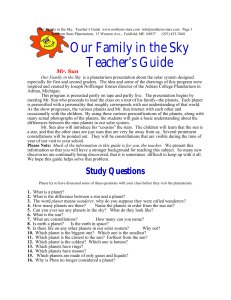
Our Family on the Sky - Northern Stars Planetarium
... Now that your model solar system is laid out properly, have your students pick up their respective planets. Tell them to try to keep the same distance from the sun and have them walk at approximately the same speed around the sun (in their respective orbits!). Which planet goes around the sun first? ...
... Now that your model solar system is laid out properly, have your students pick up their respective planets. Tell them to try to keep the same distance from the sun and have them walk at approximately the same speed around the sun (in their respective orbits!). Which planet goes around the sun first? ...

Space
... • Is the Earth flat? For centuries, people assumed the Earth was flat……it looks flat……… ...
... • Is the Earth flat? For centuries, people assumed the Earth was flat……it looks flat……… ...

... feeling a compelling need to evolve criteria that could help them classify an object as a planet. The IAU members gathered at the 2006 General Assembly toiled to reach a consensus in an effort to define a “planet”. First, it was argued that a celestial body can be defined as a planet if it is in orb ...

Stars - St. Mary School
... 4. Our Solar System The planets in order from the sun are: The first four are the “Terrestrial Planets” Mercury, Venus, Earth, Mars Then the last four are the “Jovian Planets” Jupiter, Saturn, Uranus, and Neptune ...
... 4. Our Solar System The planets in order from the sun are: The first four are the “Terrestrial Planets” Mercury, Venus, Earth, Mars Then the last four are the “Jovian Planets” Jupiter, Saturn, Uranus, and Neptune ...
history of life
... Many researchers now favor the hypothesis that the first hereditary material was not DNA, but RNA, which may also have functioned as the first enzymes. (This helps resolve the "chicken and egg" paradox of which came first, genes or enzymes.) According to this hypothesis, the molecular biology of tod ...
... Many researchers now favor the hypothesis that the first hereditary material was not DNA, but RNA, which may also have functioned as the first enzymes. (This helps resolve the "chicken and egg" paradox of which came first, genes or enzymes.) According to this hypothesis, the molecular biology of tod ...

The Solar System Information Pack
... sun (and the new planet that has been found!). The relative sizes of the planets and their distance from the sun. The sun is a star at the centre of our solar system. The sun, earth and moon are approximately spherical bodies. That some of the planets have moons and the number of moons for e ...
... sun (and the new planet that has been found!). The relative sizes of the planets and their distance from the sun. The sun is a star at the centre of our solar system. The sun, earth and moon are approximately spherical bodies. That some of the planets have moons and the number of moons for e ...
IAU definition of planet

The definition of planet set in Prague in 2006 by the International Astronomical Union (IAU) states that, in the Solar System, a planet is a celestial body which: is in orbit around the Sun, has sufficient mass to assume hydrostatic equilibrium (a nearly round shape), and has ""cleared the neighborhood"" around its orbit.A non-satellite body fulfilling only the first two of these criteria is classified as a ""dwarf planet"". According to the IAU, ""planets and dwarf planets are two distinct classes of objects"". A non-satellite body fulfilling only the first criterion is termed a ""small Solar System body"" (SSSB). Initial drafts planned to include dwarf planets as a subcategory of planets, but because this could potentially have led to the addition of several dozens of planets into the Solar System, this draft was eventually dropped. The definition was a controversial one and has drawn both support and criticism from different astronomers, but has remained in use.According to this definition, there are eight planets in the Solar System. The definition distinguishes planets from smaller bodies and is not useful outside the Solar System, where smaller bodies cannot be found yet. Extrasolar planets, or exoplanets, are covered separately under a complementary 2003 draft guideline for the definition of planets, which distinguishes them from dwarf stars, which are larger.